A Girl Mocked My 15-Year-Old’s Birthmark at the School Talent Show—Then One of the Most Popular Boys Stood Up for Him in a Way That Left Everyone Speechless.
For years, I watched my daughter make herself smaller to avoid the cruel comments about the birthmark on her face. Then she made a brave decision that I knew could change everything. What happened that night forced me to decide whether protecting her meant stepping in—or finally trusting her to stand up for herself.
The laughter started while my daughter was still under the spotlight.
One second, Eliza was singing.
The next, a girl's voice cut through the auditorium.
“Someone’s feeling confident today.”
I recognized that voice before I even turned around.
“Someone’s feeling confident today.”
A few students laughed.
Then more people joined in.
And Eliza stopped singing.
The music continued playing without her.
Her hand slowly rose toward the reddish birthmark that covered nearly half of her face.
A few students laughed.
I stood up from my chair.
Then Eliza looked directly at me.
And I remembered the promise she had made me promise two hours earlier.
“Don’t come save me.”
That morning, I almost broke one of Eliza’s oldest rules before breakfast.
Then Eliza looked directly at me.
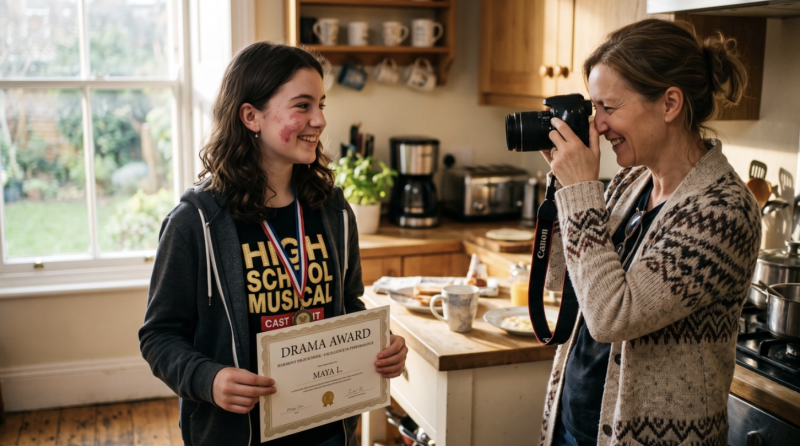
She was sitting at the kitchen table, laughing at something on her tablet, when I raised my phone.
“Mom.”
I froze.
“I didn’t take it.”
“You were going to take the picture.”
“You were happy, sweetheart.”
“I can be happy without needing photographic evidence.”
“You were going to take the picture.”
I lowered my phone.
“One day, you’ll wish I had more pictures.”
“One day, maybe you can retire that phrase.”
That made me go quiet.
My daughter was 15, smart, funny, and observant.
She had also been born with a large reddish birthmark covering most of her left cheek and extending toward her temple.
“One day, you’ll wish I had more pictures.”
When she was little, she didn’t care.
School taught her to care.
Kids stared, whispered, and asked if she had been burned.
By middle school, Eliza had started wearing her hair over one cheek and checking every photo before anyone posted it.
I hated watching her make herself smaller and smaller.
When she was little, she didn’t care.
So I compensated.
I watched everyone.
Questioned teachers.
Noticed whispers before she did.
At least, that was what I told myself.
Eliza pushed her bowl away.
“You’re watching me now.”
I noticed the whispers before she did.
“Sorry.”
She touched the hair covering her cheek.
“You don’t have to check if I’m okay every five minutes.”
“I’m your mother. Checking is part of the contract.”
“Can we renegotiate?”
I smiled despite myself.
“I’ll consider it.”
“You don’t have to check if I’m okay every five minutes.”
That afternoon, I stopped by the school to help with preparations for the talent show.
I was carrying programs down the hallway when I passed the art room and saw Eliza inside with Ms. Cole.
Ms. Cole was her art teacher and one of the few adults Eliza adored. She was caring without being intrusive.
A self-portrait was sitting on a drying rack.
I stopped walking.
Eliza had painted herself with her hair pulled back behind both ears.
A self-portrait was sitting on a drying rack.
Her birthmark was completely visible.
Ms. Cole stepped closer.
“She painted this face three times.”
I looked at her.
“Why?”
“The first two times, she covered half of it with her hair.”
Her birthmark was completely visible.
My throat tightened.
Eliza turned around.
“Are you talking about me?”
“Never,” I said.
Ms. Cole folded her arms.
“Your mother was criticizing your technique.”
“I was admiring it!”
“Are you talking about me?”
Eliza nodded.
“Of course.”
I pointed to the painting.
“It’s beautiful.”
“Thank you.”
Then she wiped her hands on a cloth and said, almost casually:
“I’m going to wear my hair like this tonight.”
I looked at her.
“I’m going to wear my hair like this tonight.”
“What’s happening tonight?”
She stared at me.
Ms. Cole suddenly became fascinated by a jar of brushes.
My stomach dropped.
“Eliza?”
“I signed up for the talent show.”
“What’s happening tonight?”
I blinked.
“You’re going to sing?”
She smiled nervously.
“Yes. I’m going to sing.”
Eliza loved singing, but only behind closed doors, never on a stage where people could look at her.
“Are you sure, sweetheart?”
“Yes. I’m going to sing.”
Her eyes moved toward the portrait.
“I’m tired of hiding, Mom.”
The humor disappeared from her face.
“I don’t want to spend another year thinking about which side of me people are allowed to see.”
That sentence hung heavily between us.
I wanted to tell her she didn’t need to prove anything.
“I’m tired of hiding, Mom.”
But I also knew that wasn’t what she was asking me.
So I asked:
“What do you need me to do?”
“Come tonight.”
“I was already planning to come.”
“And don’t pace back and forth in the hallway.”
“What do you need me to do?”
Two hours later, I discovered that sitting still would be the easy part.
I was helping backstage when Eliza walked toward the curtain.
Her dress was light blue, and her hair was pulled away from her face.
Her fingers opened and closed repeatedly at her sides.
“Are you okay?”
Her dress was light blue.
“I’m deciding whether disappearing through the ceiling is still an option.”
“Probably expensive.”
She let out a breath.
Then Maddie appeared in the hallway with two girls.
I had known Maddie since sixth grade.
Her cruelty was rarely loud enough for adults to notice: a whisper during a photo, a laugh when Eliza touched her hair.
Maddie appeared in the hallway with two girls.
Maddie’s eyes went straight to Eliza’s uncovered cheek.
“Wow.”
Eliza tensed.
Maddie looked at her friends.
“She’s really going to show it today.”
“Wow.”
One of the girls giggled.
My body moved before my brain could think.
Maddie kept walking.
“Give it ten minutes. She’ll cover it again.”
I took another step.
Eliza grabbed my wrist.
One of the girls giggled.
“Mom.”

“You heard her.”
“Yes.”
“Then let go.”
“No.”
I looked at her.
“I’m not going to stand here while she talks about you like that.”
“And I’m not going onstage after watching my mother argue with another teenager.”
“You heard her.”
My jaw tightened.
“I’m trying to protect you.”
“I know.”
“Then why are you stopping me?”
“Because today isn’t about her.”
Eliza released my wrist.
“I’m trying to protect you.”
“I know.”
“Then why are you stopping me?”
“Because today isn’t about her.”
Eliza released my wrist.
“I spent years letting people like Maddie decide what I wear, how I stand, whether I get into photos or not. I don’t want her deciding that too.”
“I’m not asking you to leave.”
“No. You’re asking me to let you handle it.”
I fell silent.
She softened her voice.
“I’m not asking you to leave.”
“Mom, I know why you do this.”
“Do what?”
“Scan every room like someone is about to hurt my feelings.”
I looked away.
She touched my arm.
“But sometimes I need you to trust me before you protect me.”
“What exactly are you asking me?”
“Mom, I know why you do this.”
“Sit out there.”
“And?”
“Be proud of me.”
“I can do that.”
“And if Maddie says something?”
I hesitated.
Eliza noticed.
“Be proud of me.”
“Mom.”
“I’ll try.”
“No. Promise.”
I looked at my daughter.
Then I nodded.
“I promise.”
She squeezed my hand.
“Okay.”
When I went into the auditorium, Elliot walked past us carrying student presentation cards. He was one of the student hosts and one of the most popular boys at school.
I looked at my daughter.
He stopped beside Eliza.
“You’re singing tonight, right?”
Eliza looked surprised.
“Yes.”
“I heard rehearsal yesterday.”
Her eyebrows rose.
“You heard?”
He nodded.
“You sang well.”
Then someone called his name, and he kept walking.
Eliza watched him.
“Well,” I said.
“You sang well.”
She gave me a warning look.
“No.”
“I didn’t say anything.”
“You were about to.”
“I was.”
“I didn’t say anything.”
Ms. Cole sat beside me before the show began.
“You’re pale, Courtney.”
“I was told to trust my daughter.”
“Hard.”
“I knew you’d understand.”
“You’re pale, Courtney.”
The curtains opened.
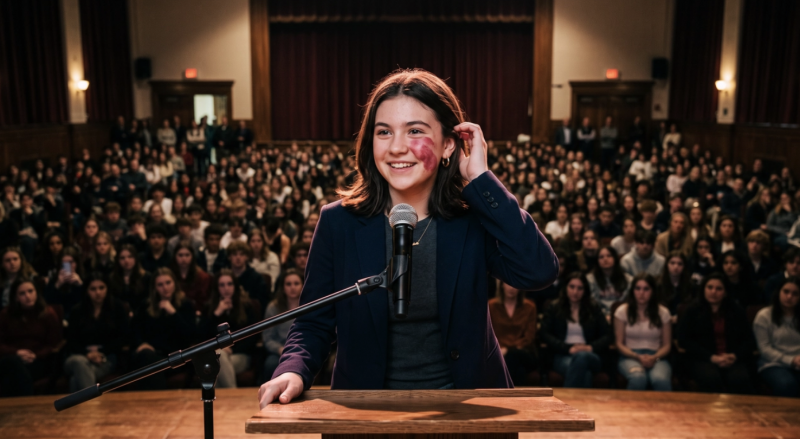
Eliza walked onto the stage and held the microphone with both hands.
Ms. Cole leaned toward me.
“Breathe, Courtney.”
“Her hands are shaking.”
“Watch her face. Let her live this moment.”
The music started.
Eliza’s first line came out thin.
I whispered:
“She’s speeding up.”
“Give her a second.”
The next line came out better.
Then another.
“Give her a second.”
On the chorus, her shoulders relaxed, and her voice echoed through the auditorium.
Ms. Cole smiled.
“And there she is.”
I could barely hear her.
Eliza was smiling.
Then Maddie’s voice cut through the room.
“Someone’s feeling confident today.”
“And there she is.”
A few students laughed.
Eliza stopped singing.
The backing track continued.
Her smile disappeared.
Her hand rose toward the birthmark.
I stood up.
Ms. Cole grabbed my arm.
Her smile disappeared.
“Courtney.”
“I promised I’d trust her. I didn’t promise to sit here while they humiliate her.”
“Look at her.”
“I am.”
“No. Look at who she’s looking at.”
My daughter wasn’t looking at Maddie.
“Look at who she’s looking at.”
She was looking at me.
I froze.
Backstage, she had made me promise.
“Sometimes I need you to trust me before you protect me.”
I gripped the chair in front of me and sat back down.
She was looking at me.
Then Elliot stood up.
He walked onto the stage, took the spare microphone, and turned toward the front row.
“Maddie?”
She shifted in her seat.
“What?”
“Say it again.”
Her smile disappeared.
“Say what?”
“Maddie?”
“The joke.”
Maddie laughed nervously.
“Seriously, Elliot?”
“You wanted everyone to hear it before.”
Her friends stopped smiling.
“I was joking, Elliot. My God.”
Elliot nodded once.
“About what?”
“Seriously?”
“What was funny, Maddie?”
The room went silent.
She crossed her arms.
“You don’t have to turn this into something.”
“I didn’t interrupt your show.”
Her face turned red.
“You don’t have to turn this into something.”
“It was a joke,” she repeated.
“Then explain it.”
Maddie looked at her friends.
None of them helped.
Finally, she muttered:
“Forget it.”
Elliot turned to Eliza. No speech, no rescue, just:
“I’m sorry, Eliza.”
“Then explain it.”
“I’m sorry, Eliza.”
“Then explain it.”
Maddie looked at her.
“It’s fine.”
“No,” he said. “But you weren’t finished.”
He stepped away.
He gave the stage back to her.
Eliza stood still for a moment.
Then lowered her hand.
A strand of hair had fallen across her cheek. She tucked it behind her ear.
“Actually, Maddie?”
Maddie looked up.
Eliza swallowed.
“You’re right about one thing.”
The room remained silent.
“I am feeling confident today.”
“I am feeling confident today.”
Then she looked toward the sound booth.
“Can we start over?”
A voice answered:
“Where did you stop?”
Eliza shook her head.
“From the beginning.”
The first notes started again.
“Can we start over?”
Her first note trembled.
The second didn’t.
On the chorus, she was stronger than before.
Halfway through the song, she saw me crying.
She rolled her eyes at me while singing.
I laughed and wiped my face.
She was stronger than before.
Then Eliza hit the final note.
For half a second, the room was silent.
Then the applause began quickly.
The students stood.
The parents followed.
Elliot applauded beside the stage.
Even one of the girls who had laughed beside Maddie stood slowly, avoiding eye contact with her.
Then I saw Mr. Walter walking toward the front row.
The room was silent.
The principal leaned beside Maddie and spoke quietly.
Her face changed.
Maddie looked around, as if someone might save her from that moment.
No one did.
A few seconds later, she and the two girls beside her followed Mr. Walter toward the doors—no lecture, no spectacle, just consequences.
I started walking toward the hallway.
The principal leaned beside Maddie.
Then stopped.
Ms. Cole looked at me.
“Aren’t you going backstage?”
“I am.”
I watched Eliza disappear behind the curtain.
“Just not before she finishes leaving that stage on her own.”
“Aren’t you going backstage?”
Backstage, I found her beside a stack of folded curtains.
Her hands were still shaking.
I opened my arms but stopped.
“Can I?”
She came straight into my arms.
“Yes.”
I hugged her tightly.
Her hands were still shaking.
“You took ten years off my life.”
“I was the one onstage.”
“I’m aware.”
She laughed, but her eyes were wet.
“You took ten years off my life.”
“What made you stay?”
“Elliot made them stop laughing.”
“He did.”
“But then he walked away.”
I nodded.
“He gave the stage back to you.”
“Exactly.”
Eliza swallowed.
“Elliot made them stop laughing.”
“I think I needed someone to make space without deciding for me what I should do with it.”
I brushed a loose strand of hair over her shoulder.
“I spent years thinking helping you meant getting there first.”
Her expression softened.
“And today?”
“I stayed in my seat.”
“I spent years thinking helping you meant getting there first.”
Later, Mr. Walter asked us to come to his office.
Ms. Cole stayed near the door while Eliza sat beside me.
“I’m sorry your performance was interrupted,” he said.
I leaned forward.
“This has been happening for years.”
Then I stopped.
Mr. Walter asked us to come to his office.
This time, Eliza needed to tell the rest.
Mr. Walter followed my gaze.
“Eliza, was today the first time you had a problem with Maddie?”
“No.”
“How long?”
“Since middle school.”
Eliza needed to tell the rest.
“What usually happens?”
Eliza looked at her hands.
“Comments. Group photos. She zooms in on my face and laughs about it with people. Sometimes she says things when teachers aren’t close enough to hear.”
I learned more in those 30 seconds than Eliza had told me in years.
Ms. Cole spoke softly near the door.
“What usually happens?”
“I noticed Eliza has been avoiding group photos this year.”
Mr. Walter nodded.
“Maddie and the girls who joined her tonight have already been removed from the event. Their parents have been contacted, and I’ll be meeting with them before they’re allowed to participate in extracurricular activities again.”
Then he looked at me.
Mr. Walter nodded.
“Courtney?”
I had a lot to say.
Instead, I looked at Eliza.
“I don’t need Maddie to be humiliated. But I need my daughter to be able to come here without having to plan how to hide her face.”
Mr. Walter nodded.
“Courtney?”
“And if it happens again?”
“I want Eliza to know exactly who to go to before this turns into another three-year problem.”
“She will.”
Eliza didn’t win the talent show.
A student who played piano won, and deserved it.
Still, when we left, I looked at Eliza.
“She will.”
“I wish you had won.”
“I know.”
I opened the car door.
“Let’s go.”
“Where?”
“Ice cream.”
She smiled.
“Now?”
“Ice cream.”
We sat at a table 20 minutes later, with two bowls of melting ice cream between us.
Eliza stirred the whipped cream with her spoon.
“Mom?”
“Yes?”
“Before I went onstage, I thought everyone was going to stare at my face.”
My chest tightened.
“Mom?”
“Some did.”
“I know.”
She looked up.
“But I stayed there.”
I reached across the table and squeezed her hand.
“I’m proud of you.”
“But I stayed there.”
“For singing?”
“For starting over.”
Her eyes softened.
The next afternoon, I was folding towels when Eliza walked into the kitchen.
“Did you take that picture yesterday morning?”
“No. You asked me not to.”
“For starting over.”
She nodded and tucked her hair behind her ear.
“Take one now.”
I froze.
“Seriously?”
She stood near the counter and smiled.
Without tilting her head, without a curtain of hair, without asking for a better angle.
“Take one now.”
I took the picture.
She grabbed an apple and started to leave.
“Eliza?”
She turned around.
I looked at the photo.
“Can I keep this one?”
She looked at the screen.
“Can I keep this one?”
“Of course.”
Then she walked away.
For years, I thought protecting my daughter meant putting myself between her and every cruel thing before it could reach her.
That night, I learned something harder.
Elliot stopped the laughter.
“Of course.”
Mr. Walter handled the consequences.
I made sure the adults finally listened.
But Eliza did the part none of us could do for her.
She took the microphone back.
She started from the beginning.
And the next day, for the first time in years, my daughter let me keep the photo without hiding a single part of herself.
She started from the beginning.