
After 27 years of marriage, my husband told me I had stopped taking care of myself and left me for another woman. Just three months later, he showed up at my door, furious, asking how I could have done what I did.
After 27 years of marriage, my husband told me I had “let myself go” and left me for another woman. I thought he had taken my confidence with him, until I found a forgotten box in our garage that proved exactly who had held our family together.
My husband said I had “let myself go” after 27 years of marriage and left me for another woman. Three months later, I found a forgotten box in our garage and used it.
The next morning, he showed up at my door screaming:
“How could you, Greta?”
But before all of that, there was the chicken pot pie.
That was Frank’s favorite meal. For 27 years, Thursday smelled like butter, rosemary, and that little bit of garlic Frank always claimed he didn’t like.
That night, I placed the dish in the center of the table and waited for him to do what he always did.
Loosen his tie.
Kiss the top of my head.
Say:
“Smells great, Greta.”
But instead, Frank walked in, looked at the table, and said:
“I’m not hungry.”
I turned from the counter.
“Since when?”
He didn’t smile. He stood there with one hand on the chair, as if sitting down would make him lose his courage.
“I don’t want dinner,” he said. “And I don’t want to do this anymore.”
“Do what? Thursdays?”
“No.” His voice turned cold. “Us.”
For a moment, all I heard was the sound of the oven crackling behind me.
“Frank.”
“I want a divorce, Greta.”
I squeezed the oven mitts so tightly my fingers started to hurt.
“We’ve been married for 27 years,” I said, as if he had forgotten the number.
“Then say that like it means something to you.”
He looked away.
That was when I understood.
I removed the oven mitts and placed them on the counter.
“Is there someone else?”
His silence answered first.
Then he said:
“Her name is Brittany.”
The name sounded far too young to belong between us after 27 years.
“Who is she?”
“She runs a mobile spa. Does manicures, pedicures, things like that.”
“So that’s where you were going on the nights you said you were working late.”
He looked at me, tired and defensive.
“At first it wasn’t like that.”
“I didn’t put another woman into our marriage, Frank. You did.”
He flinched for a moment, then became rigid.
“Brittany makes me feel alive. She listens to me. She takes care of herself. She makes people feel good again.”
“And I don’t?”
His eyes moved over my body. My loose cardigan. My hair tied back because I was cooking. My short nails. The burn mark on my wrist from the oven rack.
“Greta,” he said, “you let yourself go.”
The words fell so perfectly that they almost didn’t hurt at first.
“Where did I let myself go?” I asked. “To your mother’s appointments? To the grocery store? To Atlas’s games? To Aria’s recitals? To the life you always asked me to keep standing?”
“That’s not fair.”
“No,” I said, looking at the untouched dinner between us. “It really isn’t.”
He left that night with two suitcases and the leather jacket I had bought him for his 50th birthday.
By the end of the month, he was living in a temporary rental across town, and the divorce papers moved through lawyers like our marriage was just a pile of documents.
I wrapped the chicken pot pie in aluminum foil because I didn’t know what else to do. Then I sat at the kitchen table until the candles burned completely down and the house stopped pretending it was still a home.
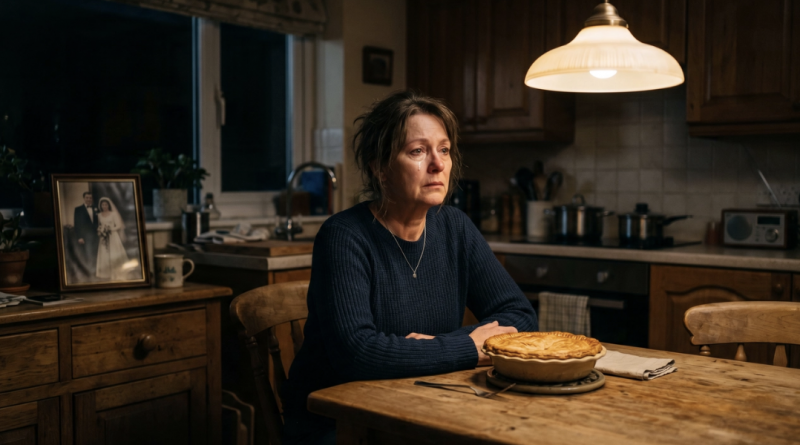
I cried over stupid things.
Frank’s mug in the dishwasher.
The empty space where his keys used to be.
On Friday, Aria came in while I was folding towels.
“I’m trying,” I said. “I’ll eat soon. I promise.”
I put Frank’s favorite towel into the donation bag.
Then came the posts.
Frank didn’t write: “I cheated on my wife after 27 years.”
He posted a picture of himself and Brittany at an outdoor market.
Later, I found out she made knitted stuffed animals and placed them in spa gift baskets with little cards that said:
“Every woman deserves to feel cared for.”
His caption said:
“Life is too short to stay where you are no longer seen. Sometimes choosing happiness means finally choosing yourself.”
Brittany commented:
“Proud of you for choosing joy.”
I read it three times and then placed my phone face down.
Aria came to talk to me again that night.
“Mom, Dad is making it seem like you were cold to him for years.”
“He needs that story, sweetheart.”
“Because without it, he’s just a man who walked away.”
She was quiet. Then she said:
“Atlas is furious.”
“Tell him not to call his father.”
“He wants to defend you.”
“I know,” I replied. “But I need to learn how to do that myself.”
Then Atlas sent a message.
“Dad is lying. We know who he really is. Not this person he’s pretending to be.”
I sat on my bed and read it until the letters blurred. Then I opened the mirror camera, looked at my tired face, and whispered:
“I didn’t disappear. I was just buried.”
Some mornings, I avoided mirrors. Once, I put on lipstick to go to the grocery store and almost cried beside the avocados because I realized I was still arguing with a man who wasn’t there anymore.
Three months after Frank left, I walked into the garage.
I wasn’t looking for healing. I went there because Frank had promised to pick up the rest of his things and then left me with everything he didn’t want to deal with.
Aria stood at the garage entrance holding two trash bags.
“Are you sure you want to do this today?” she asked.
“No,” I replied, dragging a plastic box across the floor. “But I want his golf shoes out of my laundry room even more.”
She smiled a little.
“Fair.”
Behind the winter blankets, I found a cardboard box sealed with tape.
Aria stepped closer.
“What is that?”
On top, in Frank’s thick black handwriting, were the words:
Aria read softly:
“Mom, is this yours?”
“I think so.”
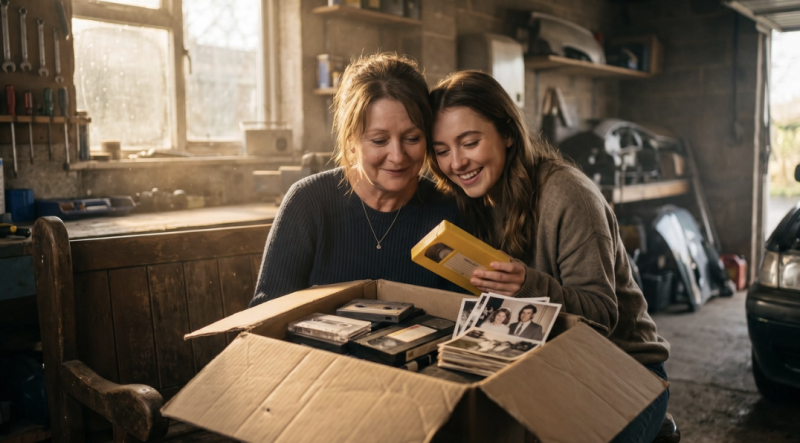
I cut the tape and opened the box.
On top were camcorder tapes. Dozens of them.
Christmas 2001.
Atlas’s baseball.
Aria’s recital.
Dad’s promotion dinner.
Aria picked up a tape.
“I thought Dad said they got lost when we moved.”
“So did I.”
Under the old camera was a folder I hadn’t seen in years.
My professional folder.
Before school lunches and medical forms, I worked in office administration, payroll, and scheduling.
Inside were my résumé, certificates, and a letter offering me a supervisor position when Aria was still a baby.
On top was a note from Frank.
“Just until the kids are older. Your turn will come. I promise.”
Aria froze.
“Mom.”
I sat down on an overturned paint bucket.
“He remembered what I gave up.”
“Did he know what you had sacrificed?”
“What I put aside. He just stopped caring after a while.”
Her eyes filled with tears, but she knew not to touch me before I could breathe.
I almost put everything back into the box. Then I saw the tape labeled:
Mom Dancing: Christmas Eve.
Aria touched my wrist.
“Let’s save everything.”
And that’s what we did.
At the local computer shop, an employee looked at the box.
“All of them?”
I looked at the recital tape.
“All of them.”
He pointed to the folder.
“Do you want these documents digitized too?”
I slid the folder toward him before I could change my mind.
“Everything,” I answered.
Four days later, I sat at the kitchen table with Aria, Atlas on a video call, and a flash drive connected to my laptop.
“Just one more video,” I said.
Aria clicked the first file.
“Mom, we both know this is a lie.”
The screen flickered.
There I was, younger and exhausted, carrying a sleeping Atlas from the car while Aria rested on my hip.
Atlas moved closer to the camera.
“You carried both of us?”
“You were four,” I replied. “You were still my baby.”
Aria laughed and quickly wiped away a tear.
The next video showed me in the kitchen, flour on my face.
“Look at this amazing woman,” young Frank’s voice said. “Feeding the whole school again.”
I, younger, smiled.
“Frank, put that away.”
Aria whispered:
“He looked like he loved you.”
“He did,” I answered. “At least back then.”
Another video began. It was in a hospital hallway. I was helping Frank’s mother walk after surgery.
His mother looked at the camera.
“Greta is the only reason I haven’t lost my mind.”
Atlas’s voice became quieter.
“Dad told me you didn’t like Grandma.”
I pressed play because answering would have hurt too much.
Then the promotion dinner appeared.
Frank was holding a champagne glass.
“Everyone, listen,” he said in the video. “This woman is the reason I have everything. Greta believed in me before I believed in myself. She gave up her own opportunities so I could have mine.”
My younger self shook her head, embarrassed.
Frank raised his glass.
“Greta, I promise you. Your turn will come.”
The kitchen went silent.
Aria held my hand.
“Mom.”
I removed the flash drive from the laptop.
“He remembered what I gave.”
Atlas clenched his jaw on the call.
“He just expected no one else to remember.”
The next morning, Frank posted a picture with Brittany at a spa event.
“Choose the person who brings out the best in you.”
I didn’t comment.
I opened the files and created a montage.
Aria watched from the doorway.
“Are you sure?”
“No cruel edits,” I replied. “No cheap attacks. Just the truth.”
I chose birthdays, graduations, hospital rooms, Christmas mornings, school nights, and that promotion toast.
Then I wrote:
“I digitized old family tapes for Atlas and Aria. Twenty-seven years is a long time, and memories deserve to be kept honestly.”
I posted it.
Ten minutes later, my phone lit up.
Aria commented:
“Love you, Mom.”
Atlas replied:
“I’m proud of you.”
Frank’s sister wrote:
“Greta, I remember that promotion dinner. You cooked for 40 people and still cleaned everything after everyone left.”
A neighbor commented:
“You were always the best mother and wife, Greta!”
Then a woman from Brittany’s spa page wrote:
“Some women don’t need a makeover. They need respect.”
I put my phone down, shaking.
That night, Atlas showed up with takeout.
He hugged me tightly.
“I should have spoken up more.”
I touched his face.
“You’re my son, not my shield.”
We ate and watched more videos.
Aria cried when she saw the video of me sewing her costume at midnight.
“You were eight,” I said. “You should have been sleeping while I made magic happen.”
Atlas looked away during the video where I cheered at his game while Frank’s empty folding chair sat beside me.
“You still showed up,” he said. “And you left a chair for him, Mom.”
A car door slammed outside.
Atlas stood.
“No,” I said. “My house. My door.”
Frank entered with Brittany.
He looked at the television.
“So this is what we’re doing now?”
“We’re watching old family videos.”
“You were invited the first time, Frank. You just lost more things than you remember.”
The next video started.
Video Frank raised his glass.
“This woman is the reason I have everything.”
Brittany looked at him.
“You told me she gave up on you.”
“She did,” Frank answered sharply.
On the screen, I helped his mother sit in a chair.
Brittany’s voice lowered.
“No. She gave up on herself for you.”
She left without saying anything else.
Frank looked at us as if he expected us to chase after her and deny the truth.
Aria paused the video.
“Dad, you said Mom stopped caring.”
Frank opened his mouth.
Atlas pointed toward the door.
“Go.”
The next morning, Frank pounded on my door.
I opened it with the security chain still attached.
“How could you, Greta?”
“I posted family videos.”
“No. You finally saw what we saw.”
“You chose the worst parts.”
“No, Frank. I chose the parts where I was still smiling while giving you everything.”
His face changed. It wasn’t guilt. It was fear.
“Brittany left me,” he said. “She went back to her mother’s house.”
“That was her choice.”
“Atlas and Aria won’t answer my calls.”
“They have the right to need time.”
“People are calling me a liar in those posts, Greta.”
I held the door firmly.
“Were they wrong?”
He looked at his phone like it could save him.
“You should have moved on quietly.”
There it was.
Not pain. Not regret.
Control.
I released the chain and opened the door wider so he could see my face as I said:
“That’s what bothers you, isn’t it? You don’t hate the videos because they were lies. You hate them because they told the truth without asking your permission.”
His mouth opened, but no words came out.
“You told everyone I had let myself go,” I continued. “But I didn’t let myself go, Frank. I put my life on hold. I waited for your career, your moods, your mother, your promises, and your version of our life.”
“No. You had 27 years to say my name with respect. You don’t get to whisper it now like that fixes anything.”
“I didn’t destroy your name,” I said. “I just stopped letting you use mine to keep yours clean.”
Then I closed the door.
In the hallway mirror, I saw the same lines on my face, the rough hands, and the tired eyes.
This time, I smiled.
I picked up my old professional folder and stepped out into the morning.
At ten o’clock, I had an interview at a small medical office that needed someone capable of managing schedules, payroll, and chaos.
Frank said I had let myself go.
He was wrong.
I was finally coming back to myself.