After 62 years of marriage, my husband passed away. During his funeral, a young woman came up to me, handed me an envelope, and said, “He asked me to give this to you on this particular day.”
Harold and I shared 62 years together, and I believed I knew every part of the man I married. Then a girl I had never seen before arrived at his funeral, handed me an envelope, and disappeared before I could ask her anything. That envelope contained the beginning of a story my husband had never found the courage to tell me himself.
I barely got through the service that day.
Harold and I had been married for 62 years. We met when I was 18 and were married within a year. Our lives had become so connected that standing in that church without him felt less like mourning and more like trying to survive with only half a breath.
My name is Rosa, and for more than six decades, Harold had been the most dependable part of my life. Our sons stood beside me, one on each side, and I leaned on them as we made it through the day.
People were beginning to leave when I noticed her. A girl, no older than 12 or 13, with a face I didn't recognize. She walked through the crowd, and when she spotted me, she came directly toward me.
“Are you Harold's wife?” she asked.
“I am.”
She held out a simple white envelope.
“Your husband... he asked me to give this to you on this day. At his funeral. He said I had to wait until this exact day.”
Before I could ask her who she was, how she knew Harold, or why a child was carrying a message for a man who had been ill for months, she turned around and rushed out of the church.
My son touched my shoulder.
“Mom? Are you okay?”
“Yes... I'm fine.”
I slipped the envelope into my purse and said nothing more.
That evening, after everyone had left and the house had settled into the strange silence that follows a funeral, I sat down at the kitchen table and opened it.
Inside was a letter written in Harold's familiar handwriting, along with a small brass key that fell onto the table when I emptied the envelope.
I unfolded the letter.
“My love,” it began. “I should have told you this years ago, but I couldn't. 65 years ago, I thought I had buried this secret forever, but it followed me throughout my life. You deserve the truth. This key opens Garage 122 at the address below. Go when you're ready. Everything is there.”
I read it twice.
I wasn't ready.
But I put on my coat, called a taxi, and went anyway.
The garage stood on the edge of the city, among a long row of identical metal doors in a lot that seemed frozen in the 1970s. I found number 122, unlocked the padlock with the key, and raised the door.
The first thing I noticed was the smell—old paper, cedar wood, and the stale air of a place that had been sealed for years.
In the center of the concrete floor sat a massive wooden chest, taller than I was, covered in dust and thick cobwebs that suggested it had been there a very long time.
I brushed off the front, found the latch, and lifted the lid.
Inside were children's drawings tied with faded ribbons, birthday cards addressed to “Dear Harold,” school awards, and dozens of carefully preserved letters.
Every single one was signed with the same name:
Virginia.
At the bottom was an old folder. I opened it carefully.
The documents, dated 65 years earlier, revealed that Harold had quietly taken responsibility for a young woman and her infant daughter after the baby's father abandoned them. He paid their rent, covered school expenses as the child grew older, and sent monthly support for years. Every letter the woman wrote to him had been kept as if it were priceless.
One terrible thought immediately filled my mind:
Harold had another family.
A hidden life he had kept from me for more than six decades.
I sank onto the floor of the garage and covered my mouth with both hands.
“Oh God,” I whispered. “Harold, what have you done?”

I heard tires crunch over the gravel outside.
A bicycle came to a stop. I turned and saw the girl from the funeral standing in the doorway, slightly breathless and red-cheeked from riding.
“I thought you might come here,” she said.
“You followed me?”
She nodded.
“I rode behind the taxi. When I felt the key inside the envelope, I couldn't stop wondering what it opened. When Harold asked me to give it to you, he told me it would be the most important thing I'd ever do. He said I had to wait until that exact day.”
“I don't understand. Who are you? How do you know my husband? What's your mother's name?” I asked.
The girl stepped closer and looked into the chest with curiosity.
“My mom's name is Virginia. I'm Gini, by the way.”
“Did she ever tell you who Harold was to her?”
Gini's face softened.
“She called him the man who made sure we were okay. She said he had been very close to my grandmother. But Mom never called Harold her father.”
If Harold wasn't Virginia's father, then why had he supported her for decades?
The question weighed heavily on me.
“Gini,” I said, “can you take me to your mother?”
The girl looked down for a moment.
“My dad left when I was little. My mom is in the hospital right now. I stay with a neighbor most of the time. That's how I learned Harold died. My neighbor showed me the obituary and told me when the funeral would be.”
“What happened to your mother?”
“She needs heart surgery,” Gini replied quietly. “But we can't afford it.”
“I want to meet her.”
We placed Gini's bicycle in the taxi trunk. During the ride she mentioned that Harold had given her the bicycle shortly before he died, and hearing that caught me off guard.
Then we headed to the hospital.
Her mother was lying in a narrow bed on the third floor. She looked pale and fragile, with tubes attached to her arm. Illness had stripped away everything except exhaustion.
“She has been here for two months,” Gini said softly. “Harold used to visit us sometimes. The last time I saw him, he gave me that envelope and told me to make sure you got it.”
“Did he tell you why?”
Gini shook her head.
“I asked where he was going. He just smiled and said his health wasn't very good anymore.”
Her words stayed with me as I stepped into the hallway and spoke with the doctor.
“The surgery is urgent,” he explained. “Without it, her chances are poor. The issue is the cost. Right now, we don't have the funding to proceed.”
Standing there, I thought about Harold sitting in his room before he died, writing that letter, arranging that key, and trusting a child to deliver everything at exactly the right time.
He had known.
He had known precisely what I would discover and exactly what he hoped I would do.

I squeezed Gini's hand.
“I'll be back in two days,” I told her and the doctor.
Two days later, I returned with the money needed for the operation.
Harold and I had always been careful with our finances, and the money came from the savings we had built together. Spending it didn't feel like a choice. It felt like completing something Harold had begun.
The surgery lasted six hours.
It was successful.
When Gini's mother was strong enough to receive visitors, I introduced myself properly.
“I'm Harold's wife, Rosa.”
She looked at me for several seconds before tears filled her eyes.
“Your husband saved us,” she said. “My daughter and I would not be alive without him.”
I held her hand quietly because one question still troubled me.
Harold had cared for these people throughout his life.
He had loved me faithfully for 62 years.
And yet he had never spoken of any of it.
Why?
Several days later, after she returned home, she invited me over.
She brought out an old photo album and began turning the pages.
I watched a life unfold through photographs—childhood memories, school portraits, birthdays, and holidays.
Then I turned another page and froze.
The air left my lungs.
The photograph showed a young Harold standing in front of what appeared to be a boarding house. Beside him stood a teenage girl holding a newborn baby.
I knew that girl.
I had grown up with her.
It was my older sister, Iris.
The sister who had disappeared when I was 15 and never returned.
The sister my parents spent the rest of their lives trying not to talk about because the pain was too great.
“That's my mother,” Virginia said quietly. “She passed away 12 years ago.”
The photograph slipped from my hands.
Tears filled my eyes.
“Are you okay?” Virginia asked, reaching toward me.
I closed the album.
“I need to go home,” I said.
Harold's study remained exactly as he had left it. Papers sat in neat stacks. His desk lamp stood where it always had. And there was the leather-bound diary he had written in every evening for as long as I could remember.
I sat in his chair and opened it to entries written 65 years earlier.
In Harold's careful handwriting, the truth slowly emerged.
One rainy evening, he had found my sister near an old trailer at the edge of town. She was 19 years old and holding a newborn baby. The man who had promised to marry her had already vanished.
At first, Harold had no idea who she was.
Later, he noticed the small locket she always wore. Inside was a photograph of my sister and me. That was when he realized the young woman he had been helping was the missing sister from my family.
For three years, Harold brought food, helped her find work, and quietly appeared whenever she needed assistance. He never expected anything in return. His diary described his concern for her with deep compassion.
But he also knew something else.
By then, he had already begun courting me.
Harold understood how much pain my parents carried because of my sister's disappearance. He knew that if they discovered where she was or how difficult her life had become, it would reopen wounds they had spent years trying to heal.
So Harold did what he always did.
He helped in silence.
He supported my sister and her child from a distance, making sure they survived while telling no one about the responsibility he carried.
And he continued doing so for the rest of his life.
I closed the diary and held it tightly against my chest.
Harold had not been hiding an affair or a betrayal.
He had been hiding an act of kindness so immense that it had required a lifetime of silence.
The next day, I returned to see Virginia and Gini.
We sat together at their kitchen table while I told them everything—the truth about my sister, the diary, Harold's years of support, and why he had kept it secret.
Virginia cried openly.
Gini sat quietly, staring at the table for a long time before finally looking up.
Her eyes were filled with disbelief and emotion.
“Virginia,” I said gently, “you are my sister's daughter.”
Then I turned to Gini.
“And that means you are my great-niece.”
For a moment, nobody spoke.
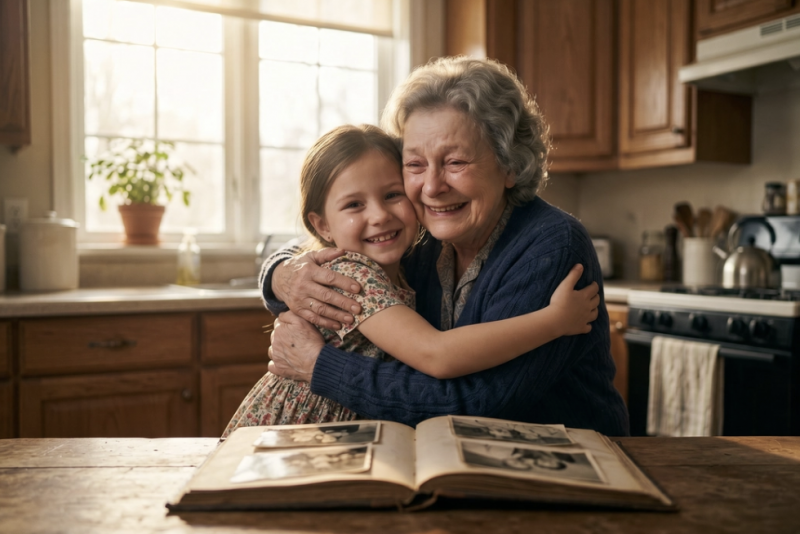
Then Gini climbed down from her chair, crossed the room, and wrapped her arms around me.
I hugged her tightly and thought about Harold—the burden he had carried alone and the grace with which he had carried it.
My husband had not only protected a secret.
He had protected a family.
Two families.
“He really was incredible,” Gini whispered against my shoulder.
“Yes,” I replied, resting my cheek on top of her head. “He truly was.”
Harold carried that secret alone for 65 years because he believed it would spare others pain.
And in the end, the secret he kept brought everyone back together.