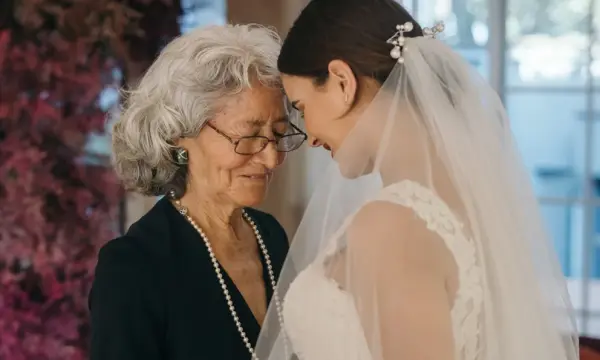
After our father passed away, my older brother, who has Down syndrome, wanted to be the one to walk me down the aisle. However, my mother-in-law was the only person who objected.
My brother asked me if he could do Dad’s job.
We had been sitting in the kitchen for an hour, and he kept starting sentences and stopping halfway through.
Nathan does that when something is important to him.
He looks at the table, rubs his thumb along the side of his mug, says “So...” three times, and then decides that maybe whatever it is can wait.
That night, it couldn’t wait.
“Can I do Dad’s job? At the wedding.”
I thought he was talking about handing out the programs.
“What job?” I asked.
He looked at me as if I were deliberately being slow.
“I mean, walk you down the aisle,” he said.
The aisle to the altar.
Dad had been dead for 11 months.
Nathan is 31. He has Down syndrome, and he and Dad were inseparable.
Saturdays in the garage.
The same coffee mug.
The same terrible jokes that nobody laughed at except the two of them.
Nathan used to spend most of his time with Dad.
Dad taught Nathan how to change the oil in a car, sharpen garden tools, and make grilled cheese without burning the pan.
Meanwhile, Nathan taught Dad not to take everything so seriously.
When Dad died, something inside both of us went quiet.
For 11 months, I hadn't allowed myself to think about who would stand with me at the back of that church, because every answer felt wrong.
Uncle Patrick?
Too obvious.
Mom?
She'd cry before we reached the first pew.
Walk in alone?
That was possible.
But in every version, I kept realizing who wasn't there.
Then Nathan asked.
I put my hand over my mouth.
He waited.
“Sarah?”
I nodded, because speaking was impossible in that moment.
“Yes.”
His whole face transformed.
“Yes?” he repeated.
“Yes, Nathan.”
He stood up so quickly that the chair scraped across the floor.
Then he hugged me so tightly that it actually hurt.
“I won't walk too fast.”
I laughed against his shoulder.
“Good.”
“I already practiced with Dad.”
I pulled back a little.
“What?”
“I practiced with Dad.”
“You practiced with Dad?”
Nathan shrugged, as if it were the most obvious thing in the world.
“A long time ago.”
Apparently, years ago, Dad used to joke with him that when I finally got married, Nathan would have to make sure he didn't trip over his own feet while walking me down the aisle.
I started crying again.
Nathan looked alarmed.
“Did I say something wrong?” he asked.
“No.”
“Then why are you crying?”
“Because apparently that's what brides do.”
He accepted the explanation.
Nathan started practicing that same week.
My uncle told me about it later.
Nathan was walking down the upstairs hallway with his arm extended, holding nothing, counting his steps.
One, two, three.
Pause.
Turn.
Again.
But practicing at home apparently wasn't enough for him.
Without telling any of us, he personally called the church to ask the priest what he was supposed to do when we reached the altar.
Father Michael called me afterward.
“Your brother is taking this very seriously.”
“I know.”
“He asked whether he should bow before or after handing you over.”
I laughed.
“What did you tell him?”
“That nobody is handing you over to anyone.”
Apparently, Nathan disagreed.
“Dad said that's what it's called.”
So Father Michael came up with a compromise.
He told me the final plan.
Nathan would walk me to Daniel, shake his hand, hug me, and then sit beside Mom.
Nathan wrote down the entire sequence.
And he practiced that too.
Whenever anyone raised a concern, he said the same two words.
“I practiced.”
Mom worried that he might become overwhelmed by the crowd.
“I practiced.”
My uncle Patrick wondered if the music might interfere with his pace.
“I practiced.”
Daniel asked if he wanted someone beside him in case he forgot where he was supposed to sit.
Nathan frowned.
“I practiced.”
Everyone agreed.
Mom cried.
Daniel said that this was the only version of that day that made sense.
And for a while, that was how things stayed.
Then, three weeks before the wedding, Daniel's mother brought it up during dinner.
Her name is Margaret.
I'd known her for five years.
We were never close, but we'd always been polite to each other.
She likes everything done properly.
Napkins passed around.
Christmas cards sent by December first.
Coordinated family photographs.
Once, she made Daniel change his shirt before Thanksgiving dinner because his navy sweater “didn't match the table runner.”
So when she invited us over to discuss the wedding details, I assumed she'd ask questions about the seating chart.
I didn't expect her to ask about Nathan.
Dinner was almost over when she put down her fork.
“I wanted to ask about the ceremony entrance.”
Daniel looked up.
“What about it?”
“Is Nathan still walking Sarah down the aisle?”
I looked at her.
“Yes.”
Margaret smiled.
Not warmly.
Carefully.
“He can come, obviously. Nobody is saying he can't come.”
“Mom...” Daniel began.
“I'm saying he doesn't have to participate. Darling, think practically. It's not just one photograph. It's the whole sequence of the entrance, the album, the enlargement, and what will eventually be hanging above our fireplace, too.”
I stared at her.
She continued.
“His face will be in all the photographs.”
Daniel went completely still.
“You're going to look at those for 40 years. I don't want those photographs.”
The room changed.
That's the only way I can explain it.
Nothing moved.
But everything changed.
I put my glass down on the table.
Very slowly.
I had six things ready to say, and I intended to say all of them, right there in her dining room, in front of her son.
This is my brother.
Say his name.
Say what you actually mean while I'm sitting right here.
Tell me exactly which part of his face ruins your photographs.
Tell me whether you think Down syndrome is contagious through a photo album.
Tell me if you understand that my father is dead.
Tell me why you think your fireplace gets a vote in my wedding.
Then Daniel took my hand under the table and squeezed it once.
“We'll figure this out,” he said.
Not to me.
To her.
I slowly turned my head.
For half a second, I thought he was saying we'd find a way to remove Nathan from the wedding.
Then I saw his face.
Daniel wasn't agreeing with her.
He was stopping me.
Not because she deserved protecting.
But because he knew me.
He knew that if I started, I wouldn't stop.
And when I stopped, Margaret would become the story of that night.
The argument would spread.
Phone calls would happen.
Families would take sides.
Nathan might end up hearing something.
It was my wedding.
I wasn't going to hand her the story of the night I screamed at her dinner table.
So I smiled.
Seriously, I smiled.
And said:
“The salmon was really good.”
Daniel nearly choked.
Margaret looked confused.
Dinner ended 15 minutes later.
I didn't say anything in the car until we were on the highway.
Then I said:
“Pull over.”
Daniel looked at me.
“Why?”
“Because I need to scream, and I don't want you to crash the car.”
He pulled into a gas station.
I unbuckled my seat belt.
“What the hell was that?”
“I know.”
“No. What did you mean by ‘we'll figure this out’?”
“I meant I needed five minutes before you set my mother's dining room on fire.”
“She said she didn't want my brother's face in the photographs from our wedding.”
“I heard her.”
“And you said we'd find a solution?”
Daniel turned toward me.
“Sarah, Nathan is walking you down that aisle.”
I stopped.
“There was never another option,” Daniel said firmly.
“Then why didn't you tell her that?” I demanded.
“Because if I said what I was thinking, we'd both be banned from Thanksgiving at my parents' house.”
Despite myself, I started laughing.
Then I cried.
Daniel reached his arms out to me.
I let him.
“I don't want Nathan to know,” I said.
“He won't know.”
“Promise?”
“I promise.”
That mattered more than anything else.
Nathan had spent almost a year grieving Dad.
He didn't need to know that someone thought his face was a problem.
I didn't sleep much.
Around three in the morning, I knew exactly what I was going to do.
And it had nothing to do with saying anything to Margaret.
The next morning, I called the photographer.
Her name was Lena.
“I need to change something for the wedding day,” I said. “And I need you not to mention this to anyone in his family. His mother, especially.”
She was quiet for a second.
“Okay. Tell me.”
“I want another photographer.”
“We already have a second photographer.”
“I want another angle.”
“For the ceremony?”
“For Nathan.”
Another pause.
“What exactly do you want him to photograph?”
“Everything.”
I explained.
Nathan waiting at the back of the church.
Nathan offering his arm.
Nathan counting the steps, if he was counting.
Nathan's hands.
His face.
Every step.
I wanted one photographer in front, documenting the two of us normally, and another positioned farther back or to the side, focusing almost exclusively on him.
Not just the walk.
The preparation before the ceremony.
The moment we reached Daniel.
The moment Nathan sat down.
Everything.
“And I want a separate album,” I said.
Lena was silent.
Then she said:
“So you want the walk to be the wedding.”
“Yes. That's exactly what I want.”
The extra coverage cost enough that I had to take money out of the flower budget.
I canceled two large arrangements for the reception and replaced them with smaller ones.
Nobody noticed.
Certainly not Margaret.
For the next three weeks, Nathan practiced.
He sent me updates.
“Twenty-two steps today.”
Then: “I forgot to slow down at the turn. I'll do it again.”
Once, he called Daniel.
“Which hand do I use?”
“For what?”
“Handshake.”
“Right.”
“But Sarah is on my right side.”
Daniel apparently spent five minutes explaining the logistics.
Nathan figured it out himself.
“I let go of Sarah first.”
“Perfect.”
“I practiced.”
On the morning of the wedding, I was calmer than I expected.
Until I saw Dad's cufflinks.
Mom had brought them for Nathan.
Then I cried so hard that my makeup artist had to leave the room.
Nathan got dressed with Daniel and the groomsmen.
At some point, Daniel sent me a picture.
It was Nathan in his suit.
Hair combed back.
Dad's cufflinks visible.
His face more serious than I'd ever seen it.
Underneath, Daniel wrote: “He's already asked what time it is 11 times.”
I replied:
“Tell him I didn't run away.”
A minute later, Daniel responded: “He said ‘good.’”
When the time came, I stood in a small side room at the back of the church.
Nathan came in.
He stopped when he saw me.
For a second, neither of us said anything.
Then Nathan said:
“You look like Mom in her wedding picture.”
That destroyed me more effectively than any compliment could have.
“You look like Dad,” I replied.
He touched one of the cufflinks.
“I know.”
The music started outside.
Nathan straightened.
Then he extended his arm.
“Ready?”
“No.”
He frowned.
“That isn't right.”
I laughed through my tears.
“I’m ready.”
He nodded.
“Good.”
The doors opened.
One hundred and forty people stood.
I saw Daniel at the altar.
I saw Mom in the first pew, already crying.
I saw Margaret two seats over.
Then I stopped seeing everyone except Nathan.
He began counting quietly.
“One.”
Step.
“Two.”
Step.
“Three.”
I squeezed his arm.
He looked at me.
“Too fast?”
“No.”
“I practiced.”
“I know.”
The photographers Lena had arranged moved silently, one near the front and another capturing the two of us from the side.
Nathan never hurried.
Never forgot.
Never let go of my arm.
Halfway down the aisle, his mouth began to tremble.
I thought he was going to cry.
Instead, he whispered:
“Dad would have liked your dress.”
That almost broke me.
At the altar, he stopped exactly where Father Michael had explained.
Then he released my arm and shook Daniel's hand.
Daniel pulled him into a hug.
Then Nathan turned toward me.
Except he didn't go sit down.
He reached inside his jacket.
My stomach dropped.
“What are you doing?”
He pulled out a folded piece of paper.
I looked at Daniel.
Daniel looked just as confused as I was.
Father Michael smiled.
Apparently, one person knew what was happening.
Nathan unfolded the paper.
His hands were shaking.
Then he turned toward the guests.
“I wrote something.”
A few people laughed softly.
Nathan looked at the paper.
His voice trembled through the first two words.
Then it became steady.
“Sarah is my little sister.”
He looked at me.
“Dad always walked with her when she was scared.”
I covered my mouth.
“Dad can't do that today, so I did.”
The church went completely silent.
Nathan looked back at the paper.
“Dad told me I'm her big brother and that I have to take care of her.”
Then came the last sentence.
“So that's what I'm doing.”
I don't remember managing to stay standing after that.
I remember Daniel's hand on my back.
I remember Mom crying openly.
I remember Father Michael taking off his glasses.
And I remember Nathan carefully folding the paper.
Then he asked:
“Do I sit now?”
Everyone laughed through their tears.
“Yes,” I managed to answer.
He went to sit beside Mom.
The ceremony continued.
And Margaret didn't say a word.
Not about Nathan.
Not about the photographs.
Nothing that day.
Eight weeks later, the album arrived.
The regular wedding album was beautiful.
The second one was even better.
It began with Nathan getting ready.
Dad's cufflinks.
Nathan checking the time.
Nathan standing alone at the church doors, arm extended.
Then the walk.
Page after page.
His focused face.
My hand on his arm.
His lips moving as he counted.
The moment he looked at me halfway down the aisle.
Daniel hugging him.
Then the speech.
A double-page spread showed Nathan at the altar, holding the paper with both hands, while all the guests behind him were blurred through their tears.
I cried again.
We had family over for dinner the following Sunday.
Daniel's parents came.
Mom came too.
Nathan was there, arguing about a soccer match with Daniel as if he hadn't just moved an entire church to tears eight weeks earlier.
I placed the album on the coffee table.
I didn't make an announcement.
I didn't hand the album to Margaret.
I didn't draw attention to it.
I went into the kitchen.
When I came back, she was sitting with the album open in her lap.
She had seen about half of it.
She was looking at the two-page photograph of Nathan at the church doors.
Arm extended.
Waiting for me.
You could see his lips slightly parted.
Counting.
Margaret didn't look up.
“He practiced this.”
I stood behind the sofa.
“Every day for three weeks.”
She turned another page.
Then another.
She reached the photograph at the altar.
Nathan holding the paper.
Me crying.
Daniel behind me.
She stayed there for a long time.
Then she closed the album and placed both hands on the cover.
“Can I have a copy of this?”
I knew exactly which one she wanted.
The speech.
“Yes.”
That was all.
She never apologized.
Not with words.
And I stopped needing her to.
A few weeks later, Daniel sent me a photograph of his parents' house.
The picture was hanging in Margaret's hallway.
Nathan at the altar.
Paper in his hands.
A frame she had definitely paid far too much for.
I couldn't believe it.
Now, when people visit the house, apparently she says:
“This is Nathan, Sarah's brother. Their father died before the wedding, so Nathan walked her down the aisle.”
And then, according to Daniel:
“He practiced for three weeks because he wanted to do everything right.”
She says it as if it's the best thing she knows about us.
Maybe, by now, it is.
I never told Nathan what she said at that dinner table.
He doesn't know there was ever a conversation about whether he should appear in the photographs.
He doesn't know I hired an extra photographer because someone thought his face would ruin them.
He doesn't need to know.
In my brother's mind, he asked if he could do Dad's job.
Everyone said yes.
He practiced.
And he did everything perfectly.
And in every way that truly mattered in the end, that's exactly what happened.