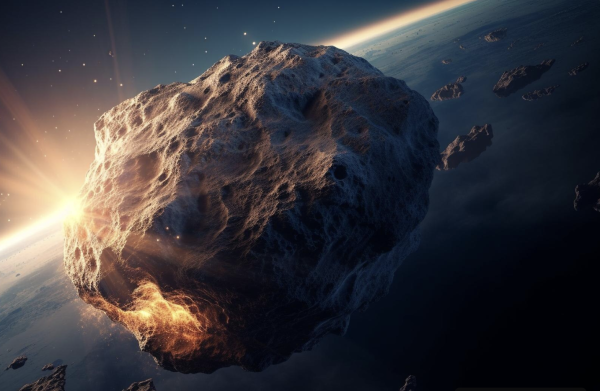
Comets and asteroids: The Cosmic wanderers
Comets and asteroids are often the stars of the night sky, yet they are also among the most mysterious and misunderstood objects in our solar system.
Both originate from distant regions in the solar system, and despite their similarities, they have distinct characteristics that set them apart.
Understanding these cosmic wanderers can help us learn more about the early days of our solar system, the potential threats they may pose, and the opportunities they present for space exploration.
What are Comets?

Comets are icy bodies that orbit the Sun in highly elliptical orbits. Often referred to as "dirty snowballs," comets are composed of a mixture of dust, rock, and volatile substances such as water, carbon dioxide, methane, and ammonia.
Their orbits take them far from the Sun, sometimes extending beyond Pluto, but they return closer to the Sun during their perihelion (closest approach), which can heat them up and cause them to "fuzz out" and form a visible tail.
A comet’s tail is one of its most spectacular features. It is formed as the Sun's heat vaporizes the ice and gases in the comet, causing them to stream away in a beautiful display of gas and dust. The tail always points away from the Sun, due to the pressure exerted by solar radiation and solar wind.
One of the most famous comets in history is Halley's Comet, which is visible from Earth about once every 76 years. Its last appearance was in 1986, and it won’t be visible again until 2061.
What are Asteroids?

Asteroids, on the other hand, are rocky bodies that primarily orbit the Sun between Mars and Jupiter in the asteroid belt.
While comets are icy and volatile, asteroids are made mostly of metal and rock, and they often appear as irregular, jagged objects.
These rocky bodies are remnants from the early solar system and are often thought of as "leftover building blocks" that never coalesced into planets.
Asteroids vary greatly in size. Some are as small as a boulder, while others, like Ceres (which is technically classified as a dwarf planet), are large enough to be visible to the naked eye.
Despite their rocky nature, some asteroids also contain volatile substances, and scientists believe that studying them can give us clues about the materials that formed the planets and moons.
While these objects are fascinating, they can also pose a threat to Earth. Near-Earth objects (NEOs), including both comets and asteroids, occasionally cross Earth’s orbit.

Though the likelihood of a large impact event is low, the consequences of such an event could be catastrophic.
In fact, scientists believe that the asteroid impact that caused the mass extinction of the dinosaurs 66 million years ago was a key event in shaping life on Earth.
However, comets and asteroids also represent significant opportunities. The study of these objects can give us a glimpse into the early solar system, potentially revealing how the planets formed and how Earth became habitable.
Additionally, some scientists propose the idea of mining asteroids for valuable resources, such as platinum, gold, and rare earth metals, which could be used to support space exploration or even Earth-based industries.
In 2020, NASA's OSIRIS-REx spacecraft successfully collected samples from the near-Earth asteroid Bennu. The samples, which are scheduled to return to Earth in 2023, will provide scientists with valuable information about the composition of asteroids and help them better understand the origins of life on Earth.

Space agencies around the world are continually investigating these celestial objects. NASA's Comet Interceptor mission, slated for launch in the 2020s, aims to study a pristine comet that has never passed near the Sun.
By examining an untouched comet, scientists hope to learn more about the early solar system, including the processes that led to the formation of planets and other objects.
Additionally, the European Space Agency’s Hera mission will study the binary asteroid system Didymos and its moonlet Didymoon (or Didymos B). This mission will help scientists better understand the dynamics of asteroid systems and contribute to planetary defense strategies.
Whether they are icy comets with spectacular tails or rocky asteroids silently drifting through space, both of these objects offer invaluable insights into the history of our solar system.

While they do pose risks, they also provide vast opportunities for scientific exploration and discovery. By continuing to explore and study comets and asteroids, we gain not only a deeper understanding of the universe but also the potential to shape humanity's future in space.
As technology advances and our capabilities for exploring the solar system expand, who knows what secrets these cosmic wanderers will reveal next?