For 20 Years, My Dad Made My Lunch Every Morning — The Day After His Funeral, I Discovered One Final Lunch, and I Turned Pale
My father prepared my lunch every morning for as long as I could remember. The only day he didn't was the day he died. So, when his old blue lunchbox appeared outside my door the morning after the funeral, I knew someone had left it there for a reason.
My father raised me alone after my mother left us for her wealthy boss when I was four. He never talked much about her. He would just clench his jaw whenever anyone asked and change the subject before I could watch his face for too long.
His alarm went off every morning at 4:30. By five, he was already dressed in his worn construction boots, pouring coffee into a dented thermos and heading out to build houses for other families. But before he left, he always prepared my lunch.
Good luck on your spelling test.
When I was five, he cut sandwiches into hearts and dinosaurs because I hated the crusts. In elementary school, he arranged apple slices like flowers and made pancakes shaped like smiling faces. When I reached high school, handwritten notes began appearing beneath the napkins.
Good luck on your spelling test, one of them said.
College came, then my first job at an office across town. Nothing changed. Before sunrise, Dad would stop outside my apartment and leave the same blue lunchbox on my doormat.
For years, he never missed a single morning.
Not during snowstorms. Not after twelve-hour shifts. Not even after cancer hollowed out his cheeks and made climbing stairs difficult.
He hid the diagnosis for months, saying the treatments were only "appointments." I discovered the truth when I found hospital bracelets beneath the passenger seat.
Some mornings, his hands shook so badly that he used toothpicks to hold the bread together.
"You should have told me," I said.
He apologized.
"I didn't want every sandwich to taste like bad news."
Even so, he kept making them. Some mornings, his hands shook so badly that he used toothpicks to hold the bread together.
I begged him to rest.
"Then tomorrow," he always promised.
Tomorrow kept moving farther away from both of us.
The only morning I didn't find a lunchbox outside my door was the morning he died.
Cal, his foreman and oldest friend, called before dawn. I knew before he even spoke. The silence on the other end felt different from every silence that had existed before.
"He’s gone," Cal whispered.
I sat down.
The funeral passed in a blur of black clothes, lilies, plates of food, and strangers describing my father as a dependable man.
They were right.
The next morning, I opened the door out of habit.
Still, none of them understood the hardest work he did. He had spent his life making sure I never started a day feeling forgotten, even when pain made the simplest tasks difficult near the end.
The next morning, I opened the door out of habit.
Grief had turned my body into a machine repeating old movements. I expected to find an empty doormat.
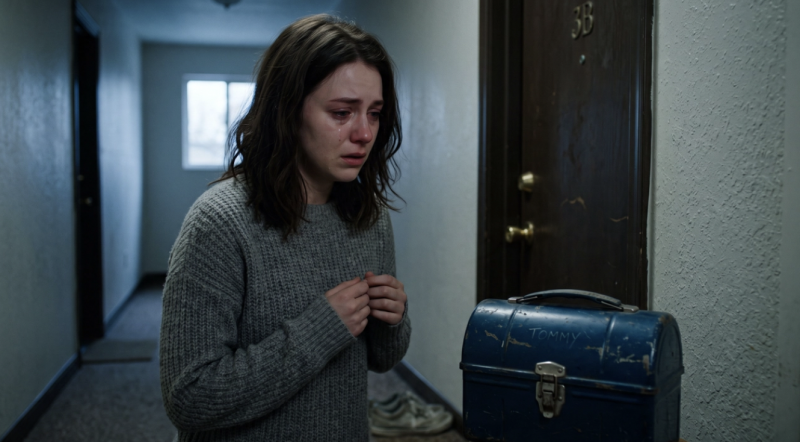
Instead, Dad's old blue lunchbox sat beneath the porch light.
I stood there until my bare feet went numb from the cold.
It was the same one he'd carried for years.
There was mud on one corner. The handle leaned to the left, exactly as it always had.
I stood there until my bare feet went numb from the cold.
Dad had been buried the day before.
That couldn't be there.
There was no sandwich.
I carried the lunchbox inside, locked the door, and set it on the kitchen table. My hands trembled as I worked the metal latch.
Then I opened it.
There was no sandwich.
No fruit.
No note folded beneath a napkin.
A photograph slipped from my hands and landed face-up beside me.
Instead, there was a brown package in the center, tied with simple twine. Beside it was a bus ticket for that afternoon.
I untied the twine.
When I saw what was inside, I screamed and collapsed onto the kitchen floor.
A photograph slipped from my hands and landed face-up beside me.
Behind them was an apartment building.
A teenage girl stood beside Dad in the photograph. She looked about sixteen. She had my eyes, the dimple in my left cheek, and the same tilt of her head that appeared in all my childhood photos.
Dad looked thin, but happy.
Behind them was an apartment building.
Beneath the photograph was a sealed envelope.
His handwriting covered the bottom of the photograph:
"Her name is Lily. Find her."
Beneath the photograph was a sealed envelope with my name on it and an address written on the back.
My first thought was betrayal.
Dad had another daughter. He had built a second family while telling me I was his whole world.
I called Cal so quickly that I got his name wrong twice.
The shame for thinking that came later.
First came anger.
I called Cal so quickly that I got his name wrong twice. He answered immediately.
"You left this at my door."
Cal exhaled. "Your father made me promise."
"Who is Lily?" I asked. "Tell me the truth."
"She's not his daughter."
I gripped the counter.
Cal continued, "She's your mother's daughter. Your half-sister."
The room seemed to tilt beneath my feet before becoming still again.
"How does he know her?"
I hadn't heard my mother's name in years. Dad only called Denise by name when some document required it.
"How does he know her?" I asked.
Cal paused. "Three years ago, Denise called him. Richard had left. She was sick. Lily was working nights and struggling in school."
"And Dad helped?"
"Once a week," Cal said. "Sometimes more. He fixed things, filled out forms, taught her to drive, and left lunches for her when he could."
"Why didn't he tell me?"
"She thought you'd believe he'd chosen the family Denise built after abandoning you."
My throat tightened. "Why didn't he tell me?"
"He thought you'd believe he'd chosen the family Denise built after abandoning you."
I looked at the bus ticket. "Why this?"
"His truck is still in my yard, and he knew you wouldn't drive while you were angry."
Despite everything, that sounded exactly like Dad.
Every answer I imagined only made me angrier.
I took the bus that afternoon.
The city passed in gray blocks as questions piled up in my head. Why had Dad protected such a huge secret? Why had he helped Denise after everything she'd done?
Every answer I imagined only made me angrier.
None explained the tenderness in that photograph.
She stood up so quickly that her backpack fell.
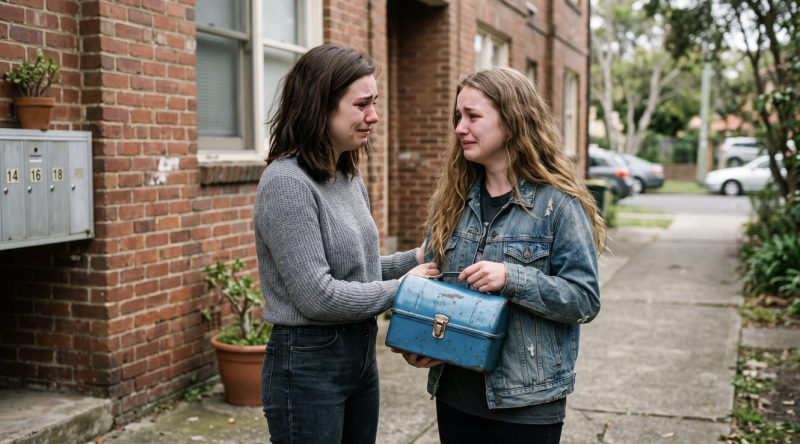
The address belonged to a modest apartment building above a laundromat. A girl sat alone on the front steps, wearing a school sweatshirt and worn sneakers.
She looked up when she saw the lunchbox.
She stood up so quickly that her backpack fell.
"Where did you get that?" she asked, already crying.
"Did you go to his funeral?"
"Are you Lily?"
She nodded.
"I'm Claire."
Her face crumpled. "I know."
She covered her mouth. "He showed me pictures."
I remembered her then.
I looked at the building. "Did you go to his funeral?"
Lily nodded again. "I stood near the tree. I didn't know if I was allowed to say anything."
Then I remembered her: a thin girl standing alone beyond the folding chairs. I had assumed she was the daughter of one of his coworkers.
"He promised he'd come to my graduation," Lily said. "Then he stopped showing up. Mom finally admitted he had cancer."
Her voice shook. "I thought he'd forgotten about me before he died."
"I'm sorry. I don't know how to do this."
"He didn't forget anyone," I replied, more sharply than I meant to.
Lily flinched.
I closed my eyes. "Sorry. I don't know how to do this."
"Neither do I."
She wiped her tears. "Mom's upstairs. She had surgery. You don't have to see her."
"Yes," I replied. "I need to."
Denise was sitting beneath a blanket when we entered. Time had thinned her face, but I recognized her immediately from the only photograph Dad kept hidden in a drawer.
She looked at me.
"Claire."
"I had nowhere else to turn. Richard left years ago."
I remained standing. "Why did you let him raise another child after abandoning the first?"
Lily whispered, "Claire, please."
Denise raised a hand. "She has the right to ask."
Then she looked at me. "I had nowhere else to turn. Richard left years ago. I got sick. Lily was carrying everything alone."
"So you called the man you betrayed?"
"I knew he would never ignore a child who needed help."
"Did he forgive you?"
Her answer hurt because it sounded true.
Dad had every reason to refuse her. Instead, he fixed sinks, helped with homework, prepared lunches, and made himself necessary again.
"Did you apologize to him?" I asked.
Denise lowered her eyes. "Many times."
"Did he forgive you?"
Lily took me to her room before I could ask anything else.
"He said forgiveness wasn't permission to come back."
Lily took me to her room before I could ask anything else.
Several lunch notes were pinned above her desk.
"Study one chapter at a time."
Another read: "Don't let one hard day speak for your whole life."
"He showed me pictures of your graduation."
Then I saw a third note and stopped breathing.
"Your sister is stronger than she thinks. So are you."
I touched the paper carefully. "He talked about me?"
Lily nodded. "All the time. He showed me pictures of your graduation. Said you hated peas, loved storms, and laughed whenever you got nervous."
Lily looked around the room before answering.
"Why didn't he introduce us sooner?"
Lily looked around the room before answering.
"He wanted me to graduate first," she said. "He thought I should be old enough to meet you without Mom deciding what kind of relationship we should have. He planned to tell you everything himself after the ceremony."
Her voice broke.
My name covered the front in shaky handwriting.
"So the cancer progressed faster than he expected."
She opened a drawer and handed me an envelope.
"He told me Cal would bring you here if he couldn't."
My name covered the front in shaky handwriting.
The letter began: "Daughter, I know this hurts."
Then came the sentence that made something inside me break.
I sat beside Lily and read in silence.
Dad wrote that Lily wasn't responsible for the choices made before she was born. He knew that being kind to her might feel like a betrayal.
Then came the sentence that made something inside me break.
"Helping her never diminished what I gave you. Love isn't a lunch that runs out when someone else gets food too."
Below that, he wrote: "You were my first promise. Lily became a promise I couldn't ignore. Please don't punish her for the adults who failed both of you before this moment."
Lily watched me without asking for comfort.
I lowered the letter.
Lily watched me without asking for comfort.
That restraint made her seem even younger.
"I'm angry," I said.
"At him?"
Lily began crying softly beside me.
"A little. Mostly at her."
I pointed toward the living room. "But none of this is your fault."
Lily began crying softly beside me.
The next morning, Cal came to the apartment carrying a small paper bag. Inside were Dad's watch, Lily's graduation documents, and the metal sandwich cutter he'd used since I was a child.
"He left these with me," Cal said. "The watch and documents are for Lily. The cutter is for both of you."
A note was wrapped around the handle.
"After graduation, make lunch together. Don't let either of you eat alone."
I looked at Cal. "You knew about all this?"
"Only some of it," he replied. "Your father thought the rest should come from him."
Little by little, our silences became less careful and more comfortable.
The following month, I helped Lily get ready.
"He left these with me," Cal said. "The watch and documents are for Lily. The cutter is for both of you."
Little by little, our silences became less careful and more comfortable.
The following month, I helped Lily get ready.
We went dress shopping for graduation without arguing about Denise. We practiced the route to the school. I fixed the loose band on Dad's watch so Lily could wear it beneath her gown.
Little by little, our silences became less careful and more comfortable.
A week before graduation, Lily came with me to clear out Dad's house.
We worked in silence at first, sorting work gloves, receipts, and coffee-stained notebooks into boxes. In the kitchen, she opened a drawer and found dozens of folded lunch notes he'd never used.
Some were jokes. Others were reminders to breathe, call home, or trust herself on difficult days.
Lily held one up. "Do you think they were for us?"
I looked at the uneven handwriting and the stack of blank napkins beside it.
"I think he was preparing for the future," I replied.
Before we left, Lily put a note in my coat pocket.
We divided the notes without reading the rest. It felt wrong to consume all those messages at once, as if even grief could become greedy.
Before we left, Lily put a note in my coat pocket, and I put another in her backpack.
Neither of us mentioned it. For the first time, sharing Dad didn't feel like losing him.
One night, Lily asked, "Did he make your lunch every day?"
"Every day."
"That doesn't mean he cared less."
"He only came here sometimes."
Guilt crossed her face.
"I know," I replied. "That doesn't mean he cared less."
She seemed relieved.
Then she smiled. "He made terrible tuna."
"Finally," I replied. "Something we can agree on."
At graduation, Denise was in a wheelchair near the aisle. I sat beside her, but we barely spoke.
When the principal announced that Lily had earned a scholarship to study civil engineering, Denise stared in amazement.
I understood immediately.
Lily had spent weekends listening to Dad explain how houses withstand pressure.
"He's the reason she made it this far."
Lily crossed the stage wearing Dad's watch beneath her sleeve. When they called her name, I stood and applauded until my palms hurt.
Denise cried beside me.
"He should be here."
"He's the reason she made it this far," I replied.
That wasn't forgiveness.
Not yet.
After the ceremony, Cal drove Dad's truck to the school parking lot.
He handed me the sandwich cutter and two sealed notes.
"He gave me one last instruction," Cal said. "Take the truck home. Make lunch together."
Lily and I went to Dad's house.
The kitchen looked almost untouched. His dented thermos was still beside the sink. The bread box remained open, and the cutting board bore the clear marks of thousands of mornings.
We worked side by side.
Lily spread mayonnaise too close to the edges. I cut the bread crooked. We argued about whether Dad would have added pickles, then laughed because neither of us really knew.
Lily spread mayonnaise too close to the edges. I cut the bread crooked. We argued about whether Dad would have added pickles, then laughed because neither of us really knew.
We took the sandwiches outside and sat on the hood of Dad's truck.
Finally, I pressed the old metal cutter down over the sandwiches.
Two hearts.
Not perfect.
Still, they were his.
We took the sandwiches outside and sat on the hood of Dad's truck.
"You're never replaced."
Beneath each sandwich, Cal had placed one of the sealed notes.
Mine said: "You're never replaced."
Lily's said: "You were never an obligation."
She handed hers to me.
Then Lily rested her head on my shoulder.
I handed mine to her.
We read them again, this time holding the proof that had been meant for someone else.
Then Lily rested her head on my shoulder.
I didn't move away.
I arrived expecting to find a secret family.
We ate the sandwiches we'd made together.
I arrived expecting to find a secret family.
I left with my sister beside me.