

Hollywood's AI revolution: Navigating the future of cinema and creative industries
Inside a soundstage once used by silent film legends Charlie Chaplin and Mabel Normand, Hollywood executives, filmmakers, and actors mingled while enjoying cocktails, all marveling at what some consider the greatest innovation since the advent of sound in films: AI-generated video.
However, the debate continues on whether AI will shape the future of cinema or signal its end.
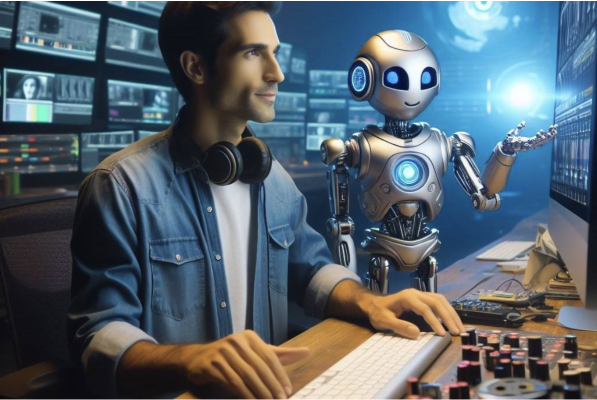
It was just two years ago when actors and writers in Hollywood went on strike, demanding protections against AI technology. Now, the use of AI has controversially entered the realms of television, movies, and video games, with two films even incorporating the technology and receiving Oscar recognition.
As the beats of '90s hip hop played in the background, computer developers interacted with industry professionals, signaling a shift in the power dynamics of the entertainment world.
Bryn Mooser, the co-founder of Moonvalley and host of the event, believes that AI’s presence in Hollywood is "inevitable." His company created an AI tool called "Marey," paying filmmakers for their consent to use their footage. While AI remains controversial, Mooser emphasizes that their product is "clean" because it compensates content creators for their work.
Mooser further believes that artists should play a central role in the development of AI tools, arguing that it's better to create tools designed for filmmakers rather than let large tech corporations dominate the industry.
Historically, AI has been portrayed as a villain in Hollywood. For instance, in The Terminator, AI used by the US military decides to destroy humanity. However, it is the creators of AI, rather than the technology itself, that have been heavily criticized. Many companies have used publicly available data, including copyrighted material shared online, to build AI models without the creators' consent, leading to accusations of theft.
OpenAI, Google, and other tech companies face lawsuits from writers, actors, and media organizations, claiming their work was used without permission to train AI. Although studios like Paramount, Disney, and Universal hold the copyright on movies and TV shows, writers have urged them to take similar legal actions, but none have yet pursued such measures.
Filmmakers are deeply invested in protecting their intellectual property. They stress that after years of fighting for copyright laws, they do not want to see their creations exploited for profit without their consent.
Hollywood has begun experimenting with AI. For example, the Oscar-nominated films Emilia Perez and The Brutalist used AI to alter voices, and Adrian Brody won the Academy Award for Best Actor with the aid of AI, which helped fine-tune his Hungarian accent for his role in The Brutalist. Additionally, AI has been used to digitally de-age actors like Tom Hanks and Harrison Ford.
The technology is becoming pervasive across the industry. OpenAI hosted a film festival in Los Angeles earlier this month, and Marvel directors Joe and Anthony Russo revealed plans to invest $400 million in developing AI tools for filmmakers.
Yet, the full impact of AI on the entertainment industry’s future remains uncertain. Generative AI, for instance, allows computers to solve problems and learn in ways that can appear human, but at a much faster pace. Many fear the technology will replace human jobs, particularly in scriptwriting, animation, location scouting, voice acting, and even live-action performances.
According to OpenAI’s popular chatbot, ChatGPT, background actors are most at risk of being replaced by AI. Meanwhile, A-list actors and directors are considered the safest since their star power and brand recognition keep them irreplaceable.
At the Moonvalley event, while discussions about AI were ongoing, few participants were willing to speak publicly about it. However, despite the rain, a significant number of influential individuals traveled from West Los Angeles to Silver Lake, which is a notable feat in the city’s notorious traffic.
Mooser and his co-founder, Naeem Talukdar, passionately discussed how AI could revolutionize Hollywood by allowing filmmakers to create high-budget films on lower budgets. While the use of AI could lead to a rise in low-quality films, it could also help discover new talent who may not have the backing of major studios.
Talukdar emphasized that AI should always be subservient to artists, and that the technology must serve their creative vision rather than overshadow it.
Hollywood’s growing engagement with AI coincides with efforts by the Trump administration to develop a national AI strategy. Tech companies argue that they cannot compete with China under the current US copyright laws and need unrestricted access to copyrighted art – from Mickey Mouse to Moana to The Matrix – to train AI models for national security purposes.
Google and OpenAI have lobbied for US government policy changes that would allow copyrighted works to be used as "fair use" for AI training. They argue that without such exceptions, they will lose their competitive edge to China.
Hollywood filmmakers have expressed concerns that tech companies are attempting to undermine the entertainment industry, which supports over 2.3 million jobs in the US. A group of more than 400 prominent Hollywood figures, led by actress and writer Natasha Lyonne, who helped develop Moonvalley, wrote an open letter to the Trump administration, urging that the AI Action Plan does not jeopardize creative industries.
Among the signatories were A-list celebrities like Ben Stiller, Paul McCartney, Cate Blanchett, and Lilly Wachowski, co-creator of The Matrix, a film that explores a dystopian future where humans are enslaved by intelligent machines.
Many in Hollywood remain anxious about how AI will impact their careers and the future of the industry. Recently, outside a Disney Character Voices office, dozens of actors protested against video game companies that refused to reach agreements on using AI in games.
The protesting actors argued that real human voices are essential to the drama and enjoyment that video games offer, as AI lacks the capacity to understand lived human experiences.
The actors are seeking a contract that guarantees their voices and likenesses will not be used without their consent to train AI models, which could eventually replace them.
Mooser believes that AI has the potential to enable filmmakers to create remarkable works of art, provided the technology is used correctly. He envisions a future where AI allows filmmakers to create elaborate sets and virtual worlds more quickly and efficiently than traditional computer graphics and visual effects methods.
He stresses that technology will inevitably play a role in all aspects of filmmaking and advocates for the need to ensure it is harnessed in a way that benefits artists rather than allowing big tech companies to take over.


