I allowed a mother and her baby to stay at my home just two days before Christmas – and on Christmas morning, a package arrived with my name on it.
Two days before Christmas, I broke all the “don’t talk to strangers” rules I was taught and brought a freezing mother and her baby into my home. I thought I was just offering a warm place for them to sleep for one night—I didn’t realize it would change our lives.
I took in a mother and her baby two days before Christmas—and on Christmas morning, a box appeared with my name on it.
I’m 33 years old and I’m a mom to two little girls, ages five and seven.
They still believe in Santa Claus as if it’s a full-time job.
They write crooked letters with upside-down S’s and argue about which cookie he’ll like more.
Their dad left three years ago.
It was a slow goodbye: texts, calls, visits, until one day I realized he hadn’t asked about them in weeks.
So now it’s just the three of us.
I work in a hospital.
I budget the grocery shopping as if I’m defusing a bomb.
I know which store has the cheapest milk, which day the bread is marked down, and how to split a pound of ground beef into three meals.
I’ve learned how to unclog drains, reset circuit breakers, and talk to our old heater.
Some days, I feel capable.
Other days, I feel like if one more thing goes wrong, I’ll sit on the kitchen floor and just stare at the wall.
The only real safety net we have is the house.
It used to belong to my grandparents.
It’s small and creaky, and the paint on the outside is sad, but it’s paid off.
No mortgage—this is the reason we’re still surviving.
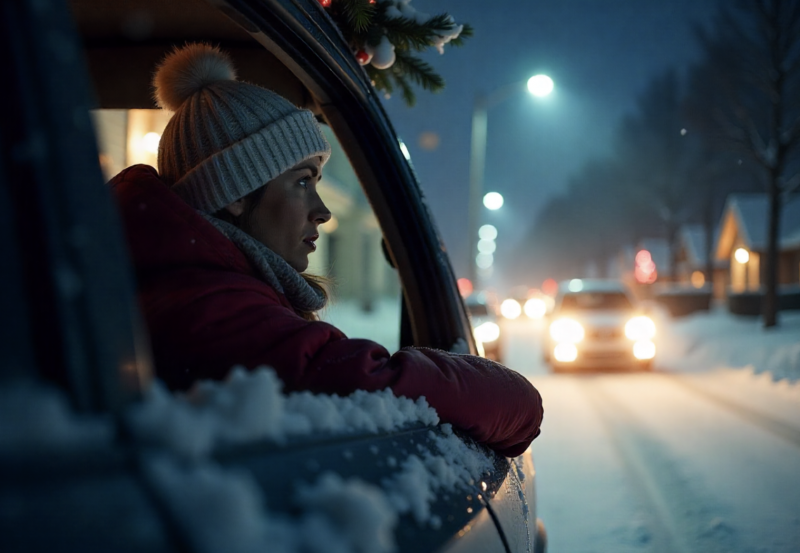
Two days before Christmas, I was coming home after an evening shift.
It was that kind of exhausted tired where your eyes burn and time feels fuzzy.
The sky was already dark.
The roads had a thin layer of ice that looks pretty but gives you a lot of fear.
Soft Christmas music played on the radio, and my brain was ticking through a to-do list.
Wrap the presents.
Hide the stocking stuffers.
Don’t forget to move the damn elf.
My girls were at my mom’s house.
They’d had hot chocolate, eaten sugar cookies, and watched way too many Christmas movies.
In my head, I could picture them already asleep in flannel pajamas, cheeks rosy, mouths open.
Warm. Safe.
I remember feeling strangely grateful and also thinking, I still have to wrap everything when I get home.
Then I saw her.
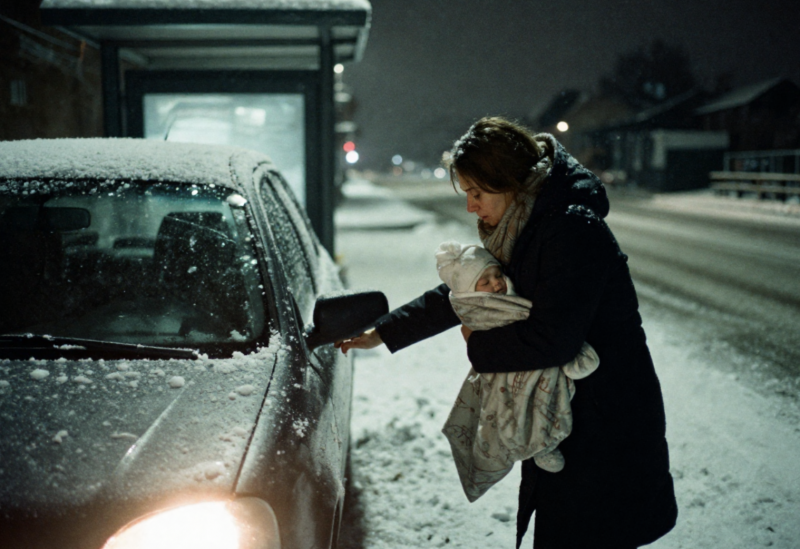
She was standing at the bus stop, half under the small plastic shelter.
A woman holding a baby tight against her chest.
She wasn’t pacing or checking her phone.
She was just... standing.
Frozen.
The wind was brutal.
The kind that cuts through any layer of clothing.
The baby was wrapped in a thin blanket, with red cheeks.
A tiny hand was sticking out, fingers curled and stiff.
My stomach sank.
I drove past.
Maybe for five seconds.
Then, all the alarms in my head went off at once.
Every conversation about “don’t pick up strangers.”
Every thought of “you have kids, you can’t take risks.”
And underneath all that, something quieter.
What if it were me?
What if it were my baby?
I slowed down.
I parked the car.
My hands were shaking as I rolled down the passenger window.
“Hey!” I called. “Are you okay?”
She jumped, then came closer.
Up close, she looked worn out.
Dark circles under her eyes, cracked lips, hair in a bun that had already given up.
“I…” She swallowed. “I missed the last bus.”
She clutched the baby tighter.
“I don’t have anywhere to stay tonight.”
She didn’t cry.
She just said it like a statement, like she’d used all her energy to accept that fact.
“Do you have someone nearby?” I asked. “Family? Friends?”
“My sister,” she said. “But she lives far.”
She looked away, embarrassed.
“My phone died. I thought there was one more bus. I got the times wrong.”
The wind sliced through the shelter.
I looked down the empty street, at the icy sidewalk, the baby’s red face.
My girls were warm in a bed at my mom’s house.
This baby was out there, freezing.
Before fear could take over, I heard myself say, “Okay. Come in. You can stay at my house tonight.”
Her eyes widened.
“What? No, I… I can’t. You don’t even know me.”
“That’s true,” I said. “But I know you’re freezing. And you’re holding a baby. Please, come in.”
She hesitated for a moment.
Then she opened the door and stepped in, still holding the baby like a shield.
As soon as the warm air hit, the baby let out a little cry.
“What’s his name?” I asked as I pulled the car onto the driveway.
“Oliver,” she said, and her whole face softened. “He’s two months old.”
She adjusted him carefully.
“I’m Laura, by the way.”
“I’m just a really tired mom,” I said. “That’s my name.”
She chuckled.
The whole drive, she kept apologizing.
“I’m really sorry.
I swear I’m not crazy.”
And, “I’ll leave first thing in the morning. You don’t need to feed me.”
“You’re fine,” I said. “You’re not a burden. I chose this, remember?”
She hesitated, then smiled.
“Okay,” she whispered.
We pulled into my garage.
The porch light made the peeling paint almost look cozy.
“You live here?” she asked quietly.
“Yes,” I said. “It used to be my grandparents’ house.”
“It’s nice,” she said, and I realized she was being serious.
Inside, the house smelled like laundry soap and old wood.
The Christmas lights on the tree blinked softly in the living room.
“Sorry about the mess,” I said automatically.
“It’s beautiful,” she said.
I led her to the small guest room.
Single bed.
Faded blanket.
Crooked dresser.
But clean sheets.
“I’ll get some towels for you,” I said. “The bathroom is right across the hall. Want something to eat?”
“You’ve done too much already,” she said, her eyes shiny. “I don’t want to take your stuff.”
“You’re not taking anything,” I said. “I’m offering. Let me offer.”
Her shoulders dropped slightly.
“Okay,” she whispered.
In the kitchen, I warmed up leftovers and garlic bread.
I put some baby carrots on the plate so I wouldn’t feel so guilty.
When I came back, she was sitting on the edge of the bed, still in her coat, rocking Oliver.
“I can hold him while you eat,” I offered.
Her eyes widened in panic.
“Oh—no, no, I’ll keep him. I’ll eat later.”
She nibbled at the food, maybe had three bites, then went back to focusing on him.
I heard her whisper into his hair.
“I’m sorry, baby. Mommy’s trying. I’m so sorry.”
That cut me inside.
I’ve never said those exact words out loud to my girls, but I’ve thought them.
More than once.
That night, I hardly slept.
Every creak of the house made me sit up and look around.
One part of my brain said, “You did a good thing.”
Another part said, “You brought a stranger into your house, genius.”
I got up once to “check the thermostat” and peeked into the guest room.
Laura was half-sitting, half-lying, leaning against the wall.
Oliver was asleep on her chest.
Her arms were around him like a seatbelt.
By morning, I woke up to quiet movements.
I got up and walked into the hall.
The guest room door was open.
Laura was there, making the bed.
The blanket she used was folded perfectly.
The towels were stacked neatly.
Oliver was once again wrapped around her.
“You didn’t need to do this,” I said.
She jumped, then smiled shyly.
“I didn’t want to leave a mess,” she said. “You’ve already done so much.”
“Do you need a ride to your sister’s house?” I asked.
“If it’s not too much,” she said. “I can meet her near the station after I charge my phone.”
“It’s not too much,” I said. “Let’s go. I’ll take you.”
At the front door, she turned and awkwardly hugged me, one arm still holding Oliver.
“Thank you,” she whispered.
“I’m glad I stopped,” I said.
I watched her walk down the path, the snow crunching under her boots, then closed the door, thinking that would be the end of it.
Fast forward two days.
Christmas morning.
The girls were finally home.
They were in their pajamas, hair a mess, practically vibrating around the tree.
“Can we open them now? Plooooomiiis?” my youngest daughter begged.
“Rock-paper-scissors,” I said. “The winner opens first. Those are the rules.”
They played.
The youngest won and did a victory dance that looked more like interpretive karate.
She was reaching for the first gift when the doorbell rang.
We all froze.
“Is it Santa Claus?” she whispered.
My older daughter made a face.
“Santa Claus doesn’t ring doorbells,” she said. “Use your brain.”
“Maybe he forgot something,” the younger one said.
I laughed.
“I’ll answer it.”
A delivery man was standing on the porch, his cheeks rosy from the cold, holding a large box wrapped in shiny gift paper.
A big red bow on top.
“Delivery for you,” he said, tipping the box so I could see the label.
My name was written on it in beautiful handwriting.
No sender listed.
I signed for it, thanked him, and carried the box into the kitchen.
The girls peeked through the door like curious little kittens.
“Is this for us?” my youngest daughter asked.
“I’m not sure,” I said. “Let me check first.”
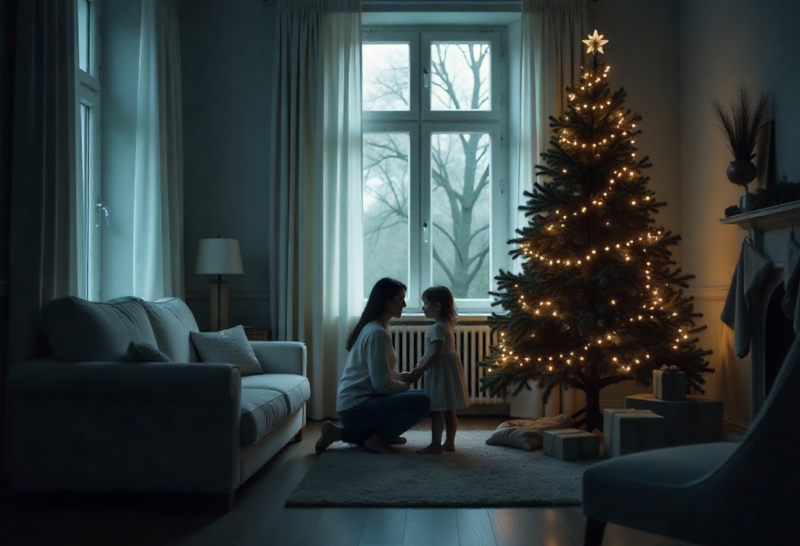
My heart was racing, and I didn’t know why.
I unwrapped the gift paper.
Underneath, there was a plain cardboard box.
I opened the flaps.
At the top, there was a folded letter.
The first line hit me like a punch.
“Dear kind stranger.”
“Mom?” my older daughter asked. “Why do you look like that?”
I didn’t realize my hands were shaking.
I swallowed hard and began reading.
It was from Laura.
She wrote that after I dropped her off at the station, someone let her charge her phone.
Her sister showed up, crying, shouting, and hugging her at the same time.
She made it home safely.
She told her family everything.
The bus station.
The cold.
My house.
The guest room.
The food.
She wrote that her family didn’t have much money.
Her parents were retired.
Her sister worked two jobs.
They couldn’t repay me in any grand way.
“But you gave us warmth and safety when you didn’t have to,” she wrote.
“If you hadn’t stopped, I don’t know what would have happened to me and Oliver.”
She said her sister had teenage daughters.
When they found out what had happened, they wanted to help.
“They searched through their clothes,” she wrote.
“They picked out things they loved. They said they wanted your daughters to feel special.”
My eyes blurred.
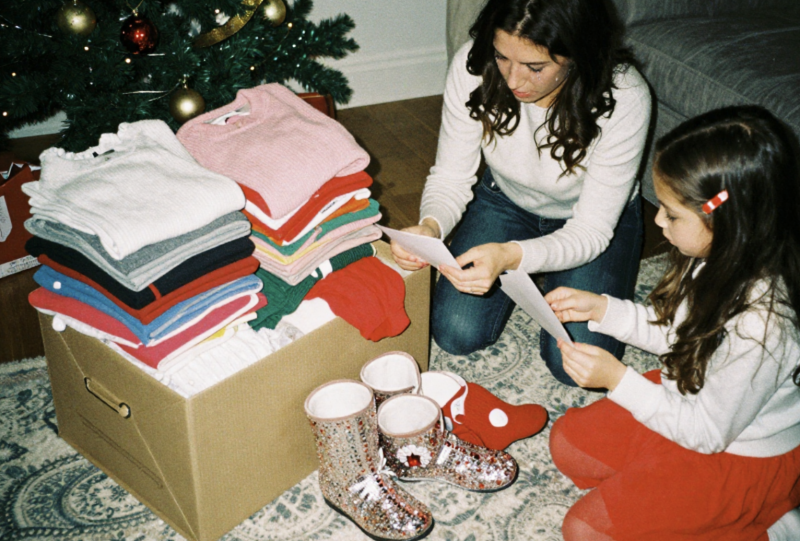
I put the letter aside and looked into the box.
Clothes.
Folded carefully.
Sophisticated sweaters in my girls' sizes.
Almost new dresses.
Jeans. Leggings. Pajamas.
Shoes in great condition.
A shiny pair of boots that made my older daughter sigh.
“Mom,” she whispered. “These are amazing.”
My younger daughter picked up a dress with stars on it.
“Is this for me?” she asked.
“Yes,” I said, my voice trembling. “It’s for you.”
At the bottom of the box were some costumes—
A princess dress, a witch costume, a superhero cape.
There was a smaller note with different handwriting.
“From our girls to yours,” it said, with a little heart.
That’s when the tears really started to fall.
“Mommy?” my older daughter asked softly. “Why are you crying?”
I knelt down and pulled them both into a hug.
“I’m crying,” I said, “because sometimes people are really, really kind. And sometimes, when you do something good, it comes back to you.”
“Like a boomerang,” my younger daughter said.
I laughed through my tears.
“Exactly like a boomerang.”
Those clothes meant more than I can explain.
I had been postponing buying new things.
Making the shoes last one more season.
Telling myself we’d make do.
That box felt like the universe saying, “Here. Breathe.”
Later that day, after the girls tried on half of the clothes and were spinning around in the living room, I sat at the kitchen table and opened Facebook.
I wrote a post.
No names.
No details that weren’t mine.
Just: I saw a mom and baby at a bus station two days before Christmas.
I brought them to my house.
This morning, a box of clothes and a letter showed up on my doorstep.
I ended it with: “Sometimes the world is softer than it seems.”
An hour later, I got a message request.
It was from Laura.
“Is this post about me?” she wrote.
My heart skipped a beat.
I replied: “Yes. I kept it anonymous. I hope that’s okay.”
“It’s more than okay,” she replied.
“I’ve been thinking about you since that night. I didn’t know how to thank you again without sounding weird.”
We chatted for a while.
She told me Oliver was healthy.
Her family insisted on sending the box, even though money was tight.
Her nieces had argued about which dress my girls would like best.
I sent a picture of my girls spinning in their new clothes, their hair flying, their faces beaming.
“They look so happy,” she wrote.
“They are,” I said. “You helped with that.”
We added each other as friends.
Now we talk every now and then.
Pictures of kids.
Messages of “good luck.”
Confessions of “I’m tired too.”
Not because of the clothes.
Not just because of the box.
But because, one cold night before Christmas, two mothers crossed paths.
One needed help.
The other was scared, but stopped anyway.
And neither of us will ever forget.