I bought an old jewelry box for just $5 at a garage sale, but the secret I discovered inside left my husband completely shocked.
I bought an old jewelry box at a garage sale for five dollars. That night, I found a photograph hidden underneath the velvet lining. The moment my husband saw the two newborn babies, he went pale and whispered: “My parents told me I was born alone.”
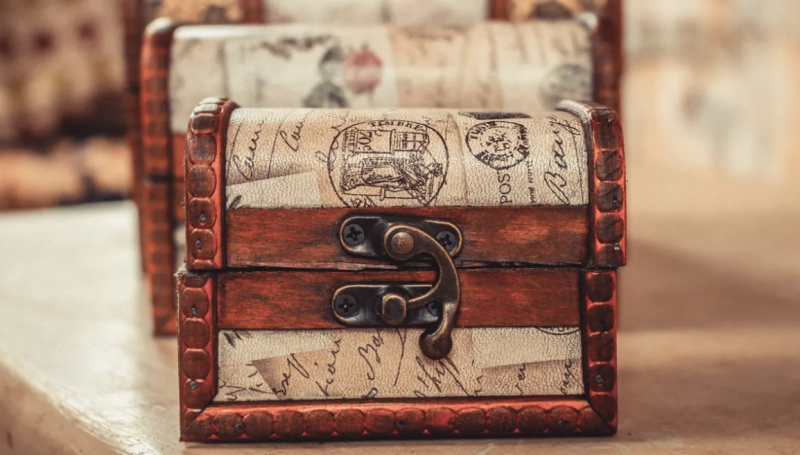
I bought an old wooden jewelry box at a garage sale for five dollars because it reminded me of one my grandmother used to keep on her bedroom dresser. I almost walked right past it. Then I noticed the loose velvet tray inside the box and found the photograph hidden underneath.
The second I looked at it, I screamed:
“Michael!”
I handed the photo to him.
My husband walked into the kitchen still holding a coffee mug.
“What happened?”
I handed him the photo.
The color drained from his face.
“Where did you get this?”
He stared at it for so long that I thought he might stop breathing.
“At a garage sale.”
He kept looking at the photograph as if he couldn’t take his eyes away from it.
“I’ve never seen this before.”
“But that’s impossible.”
The photograph had been torn in half a long time ago.
The image showed two newborn babies wrapped in the same hospital blanket, lying side by side. One of them had Michael’s exact mouth. The other had the same eyes. The photo had been torn in half many years ago.
On the back was a date, the words St. Agnes Hospital, and an address written in blue ink.
Michael sat down abruptly.
“My parents told me I was born alone,” he said.
The next morning, we drove back to the same address.
That was when the box stopped being a lucky find and became evidence.
We could barely sleep. The photograph sat on the kitchen table between us while we tried to find some explanation. We couldn’t.
The next morning, we drove back to the same address. The sale was already over. Only a few flattened boxes remained near the curb. A man loading the last items into a truck looked at the jewelry box I was holding and pointed across the street.
“The sale was my mother’s,” he said. “She’s inside. We’re taking her to a nursing home tomorrow.”
The house he pointed to was small and well-kept.
“A sale was my mother’s,” he said. “She’s inside. We’re taking her to a nursing home tomorrow.”
The house he pointed to was small and well-kept. I knocked on the door. An elderly woman opened it, looked at me, then looked at Michael, and froze.
Tears filled her eyes.
“You came back,” she whispered.
Michael frowned.
“I think you’re confusing me with someone else.”
She invited us inside, sat in a chair near the window, and looked at the photograph.
She shook her head.
“No. You look exactly like your mother.”
Her name was Evelyn. She invited us inside, sat in a chair near the window, and looked at the photograph.
“I took this picture the morning after you were born,” she said. “You were not alone in that nursery.”
Michael remained standing.
Evelyn looked at him for a long moment.
“What does that mean?”
Evelyn looked at him for a long moment.
“Have you ever seen your original birth certificate?” she asked. “Not the copy your parents kept. The original.”
He had never seen it.
Only then did she say:
“You had a twin sister.”
Michael rejected the idea immediately. He said there had to be some mistake. His parents would never hide something like that. Evelyn didn’t argue. She simply told him what she knew for certain.
“You’re saying they took one of the babies home?”
She had been a maternity nurse at St. Agnes Hospital. She was also a close friend of Michael’s mother, Carol. Carol gave birth to twins in a year when money was tight and Frank was desperate. Another couple, Linda and George, had recently lost an adoption.
“You’re saying they took one of the babies home?” I asked.
Evelyn slowly nodded.
She said Frank handled the documents personally and arranged everything quickly with a lawyer he knew.

“There was paperwork,” she said. “Frank called it a private guardianship until things improved. Carol believed it was temporary. That was the word she used.”
Michael looked at her carefully.
“Temporary?”
“Yes,” Evelyn answered. “That’s what your mother believed.”
She said Carol cried throughout the entire hospital discharge and kept asking when the baby would come home.
She said Frank handled the documents personally and arranged everything quickly with a lawyer he knew. The hospital believed the release was legal. Evelyn believed that at first too. She said Carol cried throughout the discharge and kept asking when the baby would come home.
“If you knew this,” Michael said, “why did you never tell me?”
Evelyn clasped her hands.
She looked at the photograph.
“Because afterward Frank told me the guardianship had become a legal adoption and that Carol had agreed not to reopen the case. He said Linda and George wanted privacy. Then Carol stopped answering my calls. Frank made it very clear that I was not welcome near your family. I should have pushed harder. I didn’t.”
Before we left, I asked about the address written on the back.
“I kept a copy because I never trusted him. When he found out I still had pictures, he told me to destroy them all. So I hid this one inside the jewelry box.”
Before we left, I asked about the address written on the back.
“I was the one who wrote it there,” Evelyn said. “It was Linda and George’s first home. Carol wanted to know where her daughter would be.”
When we got back to the car, Michael picked up his phone.
He looked at the torn photograph for a moment, then handed it back to me.
“I need to call my parents.”
“No,” I said.
He looked at me.
“Why?”
“Because somewhere there is a woman who may have heard the exact opposite story. Let’s find her first.”
He looked at the torn photograph for a moment, then handed it back to me.
I told Michael I wanted to go alone first.
I took the lead because I could think more clearly. The address led nowhere at first. The house had been sold twice and then replaced with a duplex. Half the day passed, and I thought the trail had ended. Then a county employee found an old transfer record under Linda and George’s last name. That led to a business record.
Rachel’s Oven.
The bakery sat on a corner, with white curtains and flower boxes in the windows.
I told Michael I wanted to go alone first.
He hated the idea.
“I should be the one who goes.”
“You will,” I said. “But not until we know what she heard.”
I almost lost my courage in that moment.
The bakery sat on a corner, with white curtains and flower boxes in the windows. When I walked in, the smell of cinnamon and coffee filled the place. The woman behind the counter tapped twice on the glass while deciding if the scones were ready.
Michael did exactly that when he was thinking.
I almost lost my courage in that moment.
She brought me my coffee.
“Did your mother ever mention someone named Evelyn?”
“Anything else?”
I asked:
“Did your mother ever mention someone named Evelyn?”
Rachel froze.
Not scared. Not confused. Frozen.
“Who are you?” she asked.
Something changed on her face.
“My name is Sarah. I’m married to Michael Bennett.”
Something changed on her face.
“My mother told me, before she died, that I had a twin brother,” she said. “She said his family never wanted contact. I never looked for him because I didn’t want to hear that rejection a second time.”
Her eyes dropped to the torn edge.
I took the photograph out of my bag.
“I think this belongs to something you already have.”
Her eyes dropped to the torn edge. She disappeared into the back room and returned with the other half.
The edges matched perfectly.
Two babies in identical blankets. A single photograph cut in half and carried in two different homes for forty years.
“Did he know about me?”
Rachel sat down.
“Did he know about me?”
“He found out yesterday.”
She gave a short laugh, and it was painful to hear.
“Yesterday for him. My entire life for me.”
Rachel looked at the torn photograph.
I let the silence remain.
After a minute, she asked:
“What exactly did Evelyn say?”
“Carol believed the arrangement was temporary.”
Rachel looked at the torn photograph.
“My mother heard the same thing. Temporary.”
Rachel agreed to take a DNA test.
That was when the true extent of the lie began to appear.
Rachel agreed to meet Michael the next morning, but before that Michael insisted on one thing.
“If we’re going to do this,” he said, “I want proof that no one can argue with.”
He was right.
The document had never been sent back. That showed us one thing clearly.
Rachel agreed to take a DNA test. The laboratory expedited the process because the three of us paid an extra fee and kept calling. While we waited, she showed us a small box where Linda kept important documents.
Inside was an old letter Linda had written asking if the twins could meet when they were older. She never received an answer. That made one thing clear.
Linda never refused contact.
Michael read the letter twice.

“If my mother never saw this,” he said, “someone made sure she never received it.”
The first meeting between Michael and Rachel was uncomfortable in the most honest way possible.
No one ran to hug anyone. No one knew where to stand. Rachel held a coffee cup with both hands. Michael kept looking at the display case of pastries instead of looking at her.
Finally Rachel said:
“You tap twice when you’re thinking.”
Michael looked at her.
“You do too.”
That made everything lighter for about ten seconds.
“I didn’t choose any of this.”
Then came the harder parts. Childhood photos. Allergies. Birthdays. Family stories. Rachel went quiet when Michael mentioned holidays with cousins and camping trips. Michael became tense when she asked whether no one had ever suspected there was another child missing from that story.
“I was a baby,” he said. “I didn’t choose any of this.”
“I know,” Rachel said, even though she was already crying.
I stepped in before the pain turned into blame.
They could compare faces and habits all day, but neither of them could answer the question that really mattered: who decided they should never know each other?
The DNA results arrived two days later.
Michael stared at the document for a long time.
Full siblings. Twin relationship confirmed.
That same afternoon, Evelyn found the second letter in a box with old nursing school notebooks. Carol had written it during Rachel’s first year. She asked when Rachel could come home and whether the arrangement was still temporary.
Michael stared at the document for a long time.
Then Rachel made the decision.
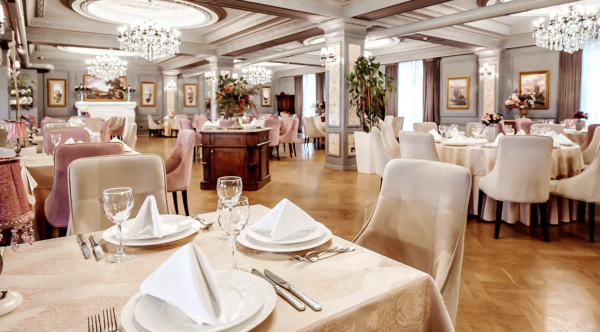
When Rachel walked into the restaurant beside Michael, the atmosphere changed before anyone even said a word.
“I don’t want to do this in secret,” she said. “He controlled this story in secret for forty years.”
Frank and Carol’s fortieth wedding anniversary dinner would take place three weeks later. Frank had invited the whole family and planned to make a speech about loyalty.
When Rachel walked into the restaurant beside Michael, the atmosphere changed before anyone even said a word.
Carol recognized her immediately. Her hand went straight to her mouth. She looked from Rachel to Michael and then back to Rachel.
“My name is Rachel. You already knew that.”
Frank half stood.
“What is this?”
Rachel answered:
“My name is Rachel. You already knew that.”
Frank’s face hardened.
Michael finally said what he had carried since the photograph.
“This is not the place.”
Michael finally said what he had carried since the photograph.
“You told me I was born alone. You knew that wasn’t true.”
No one in the room moved.
Frank tried to remain calm. He said they were overwhelmed. He said difficult decisions had to be made. He said both children had good homes.
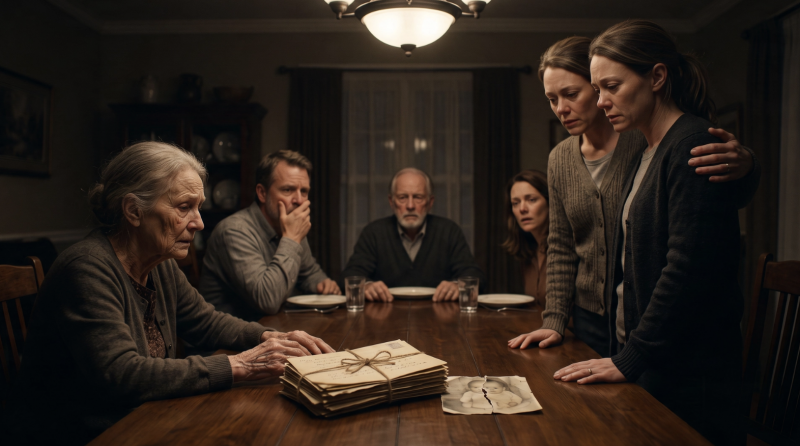
Then Evelyn placed the two letters on the table.
Rachel looked at him and said:
“Temporary for you. My entire life for me.”
Then Evelyn placed the two letters on the table.
Carol read hers first. Her hands shook so much I thought she would drop it.
“I wrote ‘temporary’ three times,” she said. “How did you turn that into forty years?”
Frank opened his mouth, but Michael’s aunt spoke before he could answer.
That was the moment the room stopped belonging to him.
“You let all of us celebrate one child every year while pretending the other one didn’t exist?”
That was the moment the room stopped belonging to him.
Frank made one last defense. He said there was no reason to destroy the family now.
Carol looked directly at him.
“Fear may explain my silence,” she said. “But it does not justify it.”
She stayed with us for several nights afterward.
Then she stood up, held Rachel’s hand and then Michael’s, and left with them.
She stayed with us for several nights afterward.
The consequences were not loud. They were permanent. Michael and his sisters removed Frank as the administrator of the family trust. He stopped organizing holidays. Whenever Rachel was invited somewhere, her comfort came first.
A few weeks later, I gave the jewelry box to Rachel.
Carol started therapy. She did not ask Rachel to call her mother. She only asked for opportunities to tell the truth without hiding behind fear.
Michael and Rachel built a relationship slowly. Sunday breakfasts twice a month at the bakery. Then phone calls. Then the first birthday they celebrated together, where they argued about frosting colors as if they had been doing it for years.
“Why did you do all of this for someone you didn’t even know?”
A few weeks later, I gave the jewelry box to Rachel. I had repaired the hinge and replaced the lining, but I kept the secret compartment. Inside it was a frame holding the two halves of the photograph together.
Rachel looked at me for a long moment.
“Why did you do all of this for someone you didn’t even know?”
I placed the box in her hands and said:
“Because no man has the right to cut a family in half and walk away without consequences.”