I helped a young pregnant woman off the street — a month later, my boss told me 'You've messed everything up,' and it all came crashing down.
When I was 35 years old, a tired single mom rushing home from work, I stopped to help a hungry, pregnant girl outside a supermarket and thought I would never see her again. Years later, a random phone call proved I was very, very wrong.
I’m 35 (F), and the day that changed everything in my life was supposed to be an ordinary day.
Nothing dramatic, nothing transformative, just a Tuesday when I left work late, hoping the bus wouldn’t delay me even more in getting home.
Home is a cramped apartment on the second floor of a weathered brick building, the kind that always smells like someone else’s food in the hallway and whose radiators scream when they wake up.
Inside this small box is my world—two kids, aged 8 and 6, and Mrs. Turner, who lives next door, is over 80 years old and still insists on looking after the kids when my shift runs late.
That day, I left the huge glass-and-steel business complex where I work as an administrative assistant, just another anonymous woman in low heels and a clearance blazer, clutching my purse as if it were my entire personality.
The doors of the lobby spit me out into the biting wind and the noise of traffic, and I checked the time on the cracked screen of my phone, calculating how much longer I could be late before my kids would start to worry.
Every minute after six in the evening feels like a failure to the girl I once was, the child in foster care no one expected, the one who learned early that no one would come, so you had to learn to get up on your own.
I crossed the street to the corner supermarket, the one with the blinking "Open 24 Hours" sign that lies every time the card reader breaks, and grabbed a cart with a wheel that doesn’t work properly.
My mind did the usual tired math—milk, cereal, fruit if it’s on sale, snacks for school, frozen veggies, maybe something quick for dinner so Mrs. Turner wouldn’t feel like she needed to "help" cook again.
I was in the middle of the cereal aisle, rubbing the spot on my foot where my cheap shoes always hurt, when something outside, in the big front window, caught my attention and wouldn’t let go.
It was a girl on the sidewalk, just beyond the glass, pressed against the brick wall as if she was trying to keep herself upright with sheer willpower.
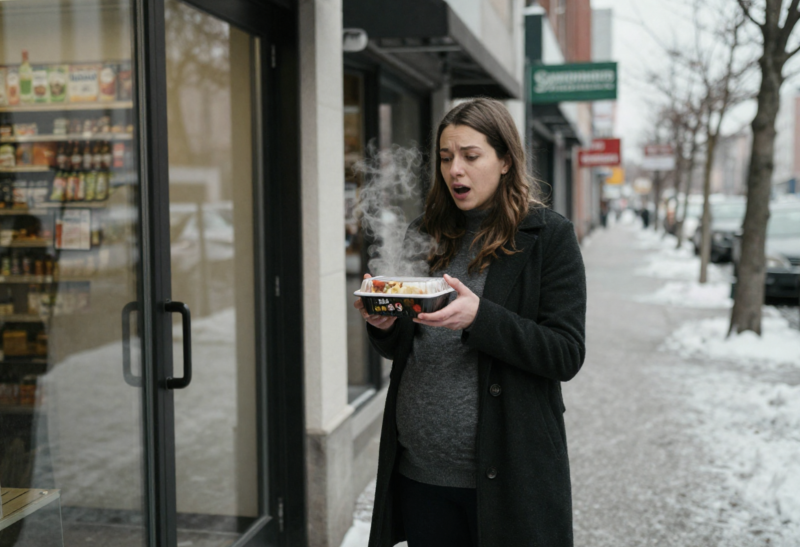
She couldn’t have been more than 20, maybe 21, with a huge pregnant belly stretching the very thin coat, one hand propped against the wall and the other holding her stomach, like she was trying to keep everything together.
People passed her by in both directions—suits, backpacks, headphones, cell phones raised like shields—and no one stopped, no one slowed down.
I remembered when I was 19 and pregnant and invisible, riding the bus with my hands on my belly, wondering what kind of mother I could be if I’d never really had one.
Before even knowing what I was doing, I abandoned my cart and went through the automatic doors outside, into the cold.
"Hey," I called, keeping my voice soft, like I was speaking to a scared animal. "Are you okay?"
She slowly, heavily lifted her head, her eyes glazed, as if she was trying really hard not to pass out, fall down, or cry.
"I… I’m okay," she whispered, which is exactly what women say when they’re not okay at all. "I’m just hungry."
Hungry.
That word hit me harder than the wind.
"When was the last time you ate?" I asked.
She looked at the ground, as if the answer were written in the cracks of the sidewalk.
"Yesterday," she murmured. "Maybe. I don’t remember."
I wanted to cry right there, cry for her, for me at 19, for every child I’d ever seen come in and out of foster homes with trash bags instead of suitcases.
Instead, I took a deep breath, because my kids needed dinner, and this girl needed food fast, and I only had a limited amount of time to fix it all.
"Listen," I said. "I’m going to get you dinner. Please stay here."
She shook her weak head. "You don’t have to—"
"I know I don’t have to," I interrupted. "I want to."

Before rushing back inside, I took one of my work business cards from my wallet and pressed it into her hand.
"If you need help later, call me," I said. "Seriously. I mean it."
Inside, I grabbed one of those hot containers from the deli, the kind that looks like it might melt the plastic, filled it with mashed potatoes and chicken with gravy, added a big bottle of water, and paid without thinking about my bank balance.
When I came out, she looked honestly surprised that I had returned, as if she’d spent her whole life being someone people just walk away from.
"Thank you," she whispered, repeatedly, holding the food like it was fragile and sacred at the same time.
I asked if I could call someone for her, or take her to a safe place, or at least walk her to a shelter I knew a few blocks away.
Every time, she shook her head.
"You’ve already done enough," she said. "This gave me strength. Now I can move on."
She promised to wait outside while I finished my shopping.
But when I came back, again with two heavy bags and the weight of guilt on my chest, she was already gone.
No sign of her, no trace, as if the sidewalk had swallowed her whole.
I asked a few people outside if they had seen a pregnant girl with a thin coat, but got shrugged shoulders and blank stares, and a guy telling me to mind my own business.
I went home with my groceries and an emptiness I couldn’t shake, that kind of emptiness that whispers you should have done more, even without knowing what that "more" would have been.
For weeks after that, I searched her face in every crowd, but life kept demanding from me—homework, bills, sick days, my boss’s endless requests—and the memory was getting filed away in the stack of things I worried about at three in the morning.
Then, one morning, about a month later, my boss stormed into my office like a thunderstorm with teeth.
"My office. Now."
His voice was so sharp that people in line next door ducked.
I followed him down the hall with my stomach doing flips because in that building, you’re usually only called like that if you’ve done something very wrong or if someone needs a scapegoat.
He slammed the office door so hard the blinds rattled, then turned to face me with a look like I had personally set his house on fire.
"What did you do," he hissed, "with that pregnant girl?"
My mouth went dry. "I don’t know what you’re talking about."
He grabbed a manila folder off the desk and slammed it down so hard the papers inside slid out.
"It’s about the trouble you caused a month ago," he said. "The pregnant girl."
At the top of the stack, I saw a hospital logo, then a copy of a birth certificate, then printed emails, screenshots, and messages—a whole paper trail of someone else’s disaster.
"She is my son’s mistress," he spat, as if the word itself burned his tongue.
The room tilted sideways for a second.
He went on, his voice rising, telling me how she had "harassed" his precious son and his son’s fiancée, sending proof of the pregnancy, begging for help, for child support, for anything.
He said his son laughed it off, called her crazy, called the baby a mistake, said she was nothing.
And when she broke down, she told the fiancée, through tears, "The only person who treated me like a human was a woman who helped me on the street."
Then, because she was young and honest and still believed being honest would save her, she gave them the only contact she had.
My business card.
It felt like the floor dropped out from under me.
"I didn’t know," I stammered. "I had no idea who she was connected to. I saw a starving pregnant girl and bought her food. That’s all."
"Save it," he snapped. "You got yourself involved in a private family matter. You embarrassed my son. You jeopardized this company."
"By feeding a hungry person?" I asked, hearing my voice shake.
He didn’t answer that.
He just told me to pack my things.
It took me a second to understand.
"You’re firing me?" I said, dumbly.
"Effective immediately," he replied, already looking past me at his computer screen, as if I’d turned into part of the furniture.
Just like that, years of showing up early, staying late, covering for people, learning everyone’s coffee orders, making the machine run—gone.
I went home that day with a cardboard box of desk junk and a knot of terror in my gut, wondering how to explain to two kids that you lost your job because you were nice to someone.
Friends told me to let it go, find another job, move on, but something in me snapped sideways and refused to accept that helping someone could get you punished like that.
So I filed a complaint.
Wrongful termination, retaliation, every phrase the free legal clinic could think to cram onto the paperwork.
His company had lawyers who probably billed more per hour than I made in a week.

They threw everything they could think of at me — said I had violated "professional conduct," falsified timesheets, brought "personal drama" into the workplace, created a "hostile environment" by getting involved with a "family issue."
They lied so smoothly it made my skin crawl.
The whole thing dragged on for years — letters, hearings, ugly conference rooms where I sat in Goodwill blazers across from men in thousand-dollar suits who called me "ma’am" while painting me as some kind of troublemaker.
Meanwhile, I picked up whatever work I could — temp gigs, evening shifts at a call center, cleaning offices on weekends — anything that paid enough to keep the lights on and my kids in shoes that fit.
There were nights I lay awake listening to the radiator hiss, wondering if I’d ruined our lives over one impulsive act of compassion.
But every time I pictured her on that sidewalk, hand on the wall, saying, "Just hungry," something inside me dug in my heels and refused to be sorry.
In the end, I got a settlement so small it felt almost insulting.
It didn’t even cover the credit card debt I’d racked up keeping us afloat while I fought.
The lawyers shrugged and said, "This is the best we can do."
I walked out of that last meeting feeling wrung-out and hollow, but not defeated.
I’d lost the battle, sure, but I still didn’t regret handing a stranger a hot meal.
If anything, all those hearings just carved the belief deeper into me that kindness matters the most when it costs you something.
Life moved on, the way it always does, even when you’re not ready.
I found a new job doing admin work for a small clinic, less pay but better people, the kind who actually say thank you when you stay late.
The kids got older, more independent, more eye-rolly, but they still curled up next to me on the couch on movie nights, still called Mrs. Turner "Grandma Turner" even though we weren’t related by anything except love and proximity.
The lawsuits became stories I told in past tense, like, "Back when I worked in corporate," or, "That time I almost got eaten alive by rich people."
I stopped checking every unknown number twice to see if it might be a lawyer.
I stopped expecting anyone to apologize.
Every once in a while, the memory of the girl on the sidewalk would float up — her hand on the brick, her voice saying "Just hungry" — and I’d wonder where she ended up.
Did she have the baby?
Was she safe?
Did anyone love her in the way nobody had ever really loved me when I was young?
But eventually, even that faded into just another unanswered question, and life filled up every available inch of my brain with more immediate worries — rent, grades, Mrs. Turner’s health, the price of groceries.
One rainy Thursday night, I was standing at the sink scrubbing a pan that would not come clean when my phone buzzed on the counter.
Unknown number.
Normally, I’d let it go to voicemail, but for some reason, my wet, soapy hand reached for it.
"Hello?" I said, tucking the phone between my ear and my shoulder.
There was a pause, then a soft voice I didn’t recognize asked, "Is this… the woman who helped me outside the grocery store?"
My heart stopped like someone had pulled the plug.
I leaned against the counter because my knees suddenly didn’t trust the floor.
"Yes," I managed. "This is she."
The voice shook. "Oh my God. I found you."

She told me her name then, and I recognized it from the paperwork I’d seen scattered across my old boss’s desk years before.
I slid down the cabinets until I was sitting on the kitchen floor, phone pressed to my ear, listening to her breath.
"I’ve been looking for you for years," she said. "I didn’t know your last name. I lost the card. All I remembered was the company name and that you had kind eyes."
My throat closed up.
"Did… did you have the baby?" I asked because my brain had apparently decided to skip over normal conversation and dive straight into the question that had haunted me for years.
She laughed, this wet, broken laugh that turned into a sob halfway through.
"Yeah," she said. "A little girl. Her name is Hope."
Something inside me unclenched that I hadn’t even known was tight.
She told me everything then, words spilling out like they’d been corked up too long.
How she’d gone to the hospital not long after I saw her, how complications scared her half to death, how she stared at the ceiling and thought about walking into traffic before remembering a stranger who’d said, "Call me if you need help."
How she’d told the nurses about my card, but by then it was gone, lost in the shuffle of shelters and couch-surfing and one awful stay with a relative who called her baby a mistake to her face.
How she’d finally left the boss’s son for good, even when he sneered that she’d come crawling back, how she’d bounced between shelters until one counselor helped her apply for programs and find a tiny studio with peeling paint and a door that locked.
How she’d met a man named Marco at a community center parenting class, a guy who brought snacks for kids that weren’t his and stayed late stacking chairs just because someone had to.
How he’d fallen in love with her and Hope at the same time, no hesitation, no resentment, just this quiet, steady presence who showed up again and again until she finally believed he was real.
She said they ran a small cleaning business now, and I sat on my floor crying quietly there.
"I couldn’t move forward without finding you," she whispered. "You saved me once. Please let me return that kindness now. For your family."
She fought to find me, just to repay my kindness, a kindness I’d never expected payment for.