I hired a teenager to mow my lawn all summer, but I never expected to discover the real reason he picked my yard.
When a teenager knocked on my door asking to mow my lawn, I thought he was just looking for a summer job. It wasn’t until I caught him inside my locked garage that I realized he had been coming to my house for a reason he was too afraid to tell me.
I signed the papers for my new house on a Thursday.
By Saturday morning, I was standing in the front yard wondering why I had ever thought owning a house was supposed to be relaxing.
The lawn looked like it had given up weeks ago.
The grass reached my ankles.
Weeds were growing through the flower beds.
The previous owner had clearly stopped taking care of the place long before deciding to sell it.
I had just carried another box inside when someone knocked on the front door.
A teenage boy stood on the porch, one hand resting on the handle of an old red lawn mower, its paint peeling and its front wheel slightly tilted to one side.
He looked about 15 years old.
His baseball cap was faded from years of sunlight, and his sneakers had been patched so many times that I couldn’t tell what color they originally were.
“Are you the new owner?” he asked.
“I am.”
Instead of answering, he looked over my shoulder into the house.
It wasn’t just a quick glance.
He studied the place.
His eyes moved from the front porch to the upstairs windows before settling on the detached garage behind the house.
He stared at the garage for a second longer than everything else.
A small smile appeared on his face.
“Good,” he said quietly.
“I was hoping someone would finally move in here.”
I frowned.
“What do you mean?”
He looked embarrassed.
“Sorry. Empty houses always make me a little sad.”
Then he gave an awkward smile.
“Anyway… I was wondering if you needed someone to mow your lawn.”
He nudged the mower with his foot.
“My name is Chase.”
“I’m Rick.”
“My mom and I live at Cedar Creek Trailer Park. I’m trying to save some money before school starts.”
He said it simply.
No rehearsed speech.
No attempt to make me feel sorry for him.
Just the truth.
“How much do you charge?”
“Twenty-five dollars.”
I almost laughed. It was less than half of what a landscaping company would charge.
“I’ll give you 50.”
His eyebrows lifted.
“Are you serious?”
“If you do a good job.”
A smile spread across his face.
“I will.”
He pulled the starter cord.
The mower coughed twice before starting up.
I spent the next hour unpacking boxes while the steady sound of the engine came through the open windows.
Every time I looked outside, Chase was working.
No phone.
No headphones.
No disappearing to take breaks.
Just making careful rows that slowly transformed the yard.
When he finally finished, it looked like a completely different property.
I handed him the money.
He counted it once before looking back at me.
“You’re too kind. I only asked for 25.”
“And you earned 50.”
For a moment, he just stared at the bills.
“Thank you.”
As he put the money into his wallet, I noticed it again.
His face looked strangely familiar.
I couldn’t figure out where I knew him from, but it bothered me.
As he pushed the mower down the sidewalk, I kept watching until he disappeared around the corner.
Where had I seen that face before?
At the grocery store?
At a neighbor’s barbecue?
In an old photograph?
Nothing made sense.
The following Saturday, Chase returned exactly at eight o’clock.
Not a minute early.
Not a minute late.
“Good morning, Mr. Rick.”
“Good morning.”
He went straight to work.
Around nine, I brought him a bottle of water.
“You deserve a break.”
He accepted it with a grateful smile.
“Thank you.”
While he drank, his eyes wandered toward the detached garage.
He stared for several seconds.
“Have you ever been inside?”
“Never.”
He looked surprised.
“Really?”
“I’m still unpacking.”
He nodded.
“Makes sense.”
Then he grabbed the mower and left before I could ask why he wanted to know.
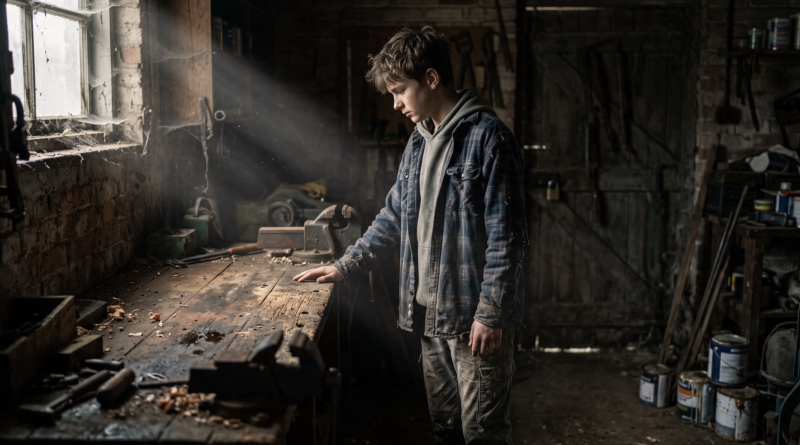
The following Saturday, I found Chase standing beside the garage before he even started mowing.
His fingers lightly touched the weathered siding.
He didn’t notice me until I spoke.
“Everything okay?”
He pulled his hand away so quickly it looked like the wood had burned him.
“Yeah.”
“Are you sure?”
He nodded.
“I was just looking.”
“At what?”
“The garage.”
“What about it?”
He hesitated.
I watched as he walked back toward the mower.
For a second, he looked disappointed.
I couldn’t understand why.
But it stayed with me.
Weeks passed, and a comfortable routine formed.
Every Saturday morning, Chase showed up with the same old mower.
Every Saturday afternoon, my lawn looked perfect.
I started paying him a little more each week.
Every week, he complained.
Every week, I won.
“You really don’t have to keep doing this,” he said one afternoon.
“You really don’t have to keep arguing.”
He laughed.
“Fair enough.”
The more I got to know him, the more that feeling of familiarity bothered me.
Sometimes it was the way he smiled.
Sometimes it was the way he stood at the end of the driveway with one hand in his pocket.
I caught myself staring at him, convinced I was one second away from remembering.
Then the memory disappeared again.
One night, my curiosity won.
I searched through the photos from the house listing, wondering if I had somehow seen Chase before.
There wasn’t a single person in them.
I leaned back in my chair, annoyed with myself.
Maybe he just had one of those familiar faces.
I closed the folder and tried to forget.
I couldn’t.
One month after hiring him, my boss canceled an afternoon meeting.
I arrived home shortly after three.
The lawn mower was in the yard.
The engine was still running.
A strip of grass remained partially cut.
“Chase?”
No answer.
I walked around the side of the house.
“Chase?”
Still nothing.
Then I noticed the detached garage.
The door was open.
I stopped walking.
That wasn’t possible.
I had never used that garage.
The only key hung on a hook beside the kitchen door.
I knew I hadn’t left it open.
“Chase?”
A few seconds later, he came running out of the garage.
The moment he saw me, he froze.
“I didn’t hear your truck.”
“I noticed.”
I looked into the dark garage.
“How did you get in there?”
He blinked.
“The door was open.”
“It wasn’t.”
He frowned.
“It was when I got here.”
I reached into my pocket and showed him the key.
“I’ve had this key with me since the day I moved in.”
His eyes moved toward the garage before returning to me.
“It was really hot.”
“I just wanted to go inside for a little while to cool off.”
His answer wasn’t what bothered me.
It was what he said afterward.
He looked back at the garage.
Then at me.
A genuine confusion appeared on his face.
“You keep it locked now?”
I had never told him it had ever been unlocked.
“What did you just say?”
Chase’s eyes widened.
“I…”
“You asked if I keep the garage locked now.”
He looked at the open garage before looking back at me.
“I should go.”
“Chase.”
He stopped.
“If you don’t tell me what’s going on, don’t come back.”
For a long moment, he didn’t move. Then he whispered:
“I’m sorry.”
He turned off the mower, lowered the handle, pushed it down the driveway, and disappeared around the corner.
He didn’t even ask for payment.
That bothered me almost as much as what he had said.
The following week, I couldn’t stop thinking about the garage.
How did a 15-year-old boy know it had once been unlocked?
The next Saturday passed.
No Chase.
The Saturday after that, I accepted that he wasn’t coming back.
Three days later, leaving the grocery store, I saw Chase getting into the passenger seat of a brand-new black SUV.
For a second, I thought I had mistaken him for someone else.
The faded cap was gone.
So were the patched pants and worn-out sneakers.
He wore a designer polo shirt, spotless white shoes, and a watch that looked ridiculous on someone his age.
Then he looked up.
It was definitely Chase.
The SUV drove away before I could call his name.
I stood there watching the car disappear, wondering if I had imagined everything he had told me.
The following Saturday, there was another knock at my door.
I opened it and found Chase standing there with the old mower.
“I know you told me not to come back.”
“I did.”
“I wanted to explain.”
I stepped aside and let him in.
“Then explain.”
He didn’t sit.
He stood in my living room, twisting his cap in his hands.
“The man in the SUV…”
“My father.”
I waited.
“I live with my mom. The judge says I have to stay with him every other weekend.”
I frowned.
“So the clothes…”
“They stay at his house.”
He shrugged.
“I call them my weekend clothes.”
He tried to smile.
He couldn’t keep it.
“My dad likes people to think he takes care of me.”
“And does he?”
“He buys expensive things.”
He looked down at the cap in his hands.
“I’d rather he showed up to one of my baseball games.”
The room went silent.
“So why were you mowing my lawn?”
He closed his eyes.
“Because I wanted to be here.”
He opened his eyes again.
“My family owned your house.”
Everything clicked.
“The garage.”
He nodded.
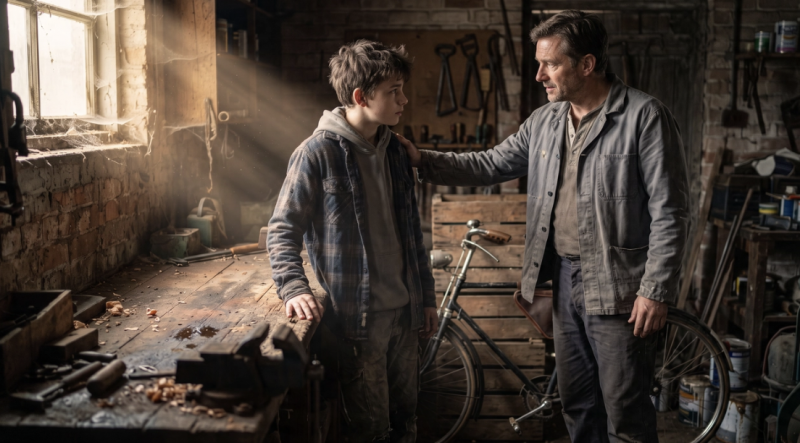
“My grandfather built the workbench. I learned how to ride a bike on that concrete floor. When it rained, we’d sit inside and listen to the rain hitting the roof.”
His voice cracked.
“After my grandfather died, everything fell apart. My mom couldn’t keep up with the mortgage. We lost the house.”
“When was that?”
“Three years ago.”
“And your father?”
“He wasn’t around.”
I remembered the expensive SUV.
“He had money?”
“He always had money. But he fought not to help us.”
The bitterness in his voice was quiet.
Somehow, that hurt even more.
“When the court finally ordered child support, it was already too late.”
“We had already packed everything.”
He swallowed.
“I kept riding my bike past the house. Then I saw the ‘for sale’ sign. When you moved in, I thought…”
He laughed softly at himself.
“I thought that if I couldn’t live here again…”
He looked at the garage.
“…maybe I could still take care of it.”
“You asked for the lawn job.”
“It was the only reason.”
“You weren’t looking for work.”
“I was looking for a home.”
Neither of us spoke for several seconds.
Finally, I asked:
“What happened the day I found you in the garage?”
“I sat on my grandfather’s workbench. That’s all. I remembered where everything was.”
He looked embarrassed.
“When I arrived and the door was locked…” He shook his head. “I forgot it wasn’t ours anymore.”
Those words hit harder than anything else he had said.
I forgot it wasn’t ours anymore.
“You didn’t take anything.”
“I didn’t want anything. I missed my grandfather.”
I believed him.
Every word.
“I’m sorry I lied.”
“You should have told me.”
“Would you have let me?”
“Probably not.”
That made both of us laugh.
The tension finally disappeared.
“Go mow the lawn,” I said.
“You still want me to do it?”
“I have a feeling you’re the only person who actually cares how it looks.”
Chase smiled and grabbed the mower.
He almost reached the driveway when he stopped.
“Can I ask something?”
“Sure.”
“If my dad wanted to see the garage…”
I looked at him.
“Would it be allowed?”
“Why would he want to?”
“I finally told him why I kept coming here.”
I waited.
“He didn’t know.”
“Didn’t know what?”
“That this house meant more to me than anything he ever bought.”
He looked at the mower.
“I think… he finally wants to understand.”
“If he really wants to understand,” I said, “he can come.”
The next month, Saturdays returned to normal.
Except now, after mowing the lawn, we sat in lawn chairs beside the garage and drank cold soda.
He told me stories about his grandfather.
How he fixed bikes for neighborhood kids.
How every Christmas they built birdhouses together.
How he said every scratch on the garage floor had a story.
One afternoon, I asked:
“Do you tell your father all this?”
“I used to.”
“What happened?”
“He’d say, ‘Let’s create new memories.’”
Chase looked at the concrete floor.
“But he never had time.”
The following Saturday, I was trimming bushes when a familiar black SUV entered my driveway.
I recognized it immediately.
Christian stepped out alone.
“Chase said I should come see the garage,” he said.
“He thinks I’ll understand if I see it.”
He looked at the old building.
“I’m not sure I will.”
“Maybe not,” I said.
“But it’s a start.”
He nodded.
“I wanted to thank you.”
“For what?”
“For giving him a job. He talks about this place all the time.”
I crossed my arms.
“He does?”
Christian nodded.
“I didn’t realize how important this house was to him.”
I didn’t answer.
He looked at the garage for a long moment.
“I honestly thought I was doing enough.”
“The child support.”
“The clothes.”
“The weekends.”
I looked at him.
“Were you?”
He didn’t answer immediately.
Finally, he shook his head.
“Probably not.”
For the first time, I didn’t see a villain.
I saw a man who confused providing with being a father.
“They’re not the same thing,” I said calmly.
“I know.”
He looked older than he had five minutes earlier.
“I just wish I had learned sooner.”
That afternoon, father and son talked in my backyard for almost an hour.
I stayed inside.
It wasn’t my conversation to have.
When Christian finally left, Chase knocked on the back door.
“He apologized.”
“How was it?”
“I still don’t know.”
He shrugged.
“But it was the first conversation we had that wasn’t about grades or money.”
“That’s something.”
“I think so.”
A few days later, I decided to finally clean the garage.
Boxes from the previous owner still filled one wall.
Cobwebs covered the beams.
While sweeping years of dust from the back wall, my broom hit something.
Pencil marks almost faded away.
I knelt down.
There were names.
Dates.
Heights.
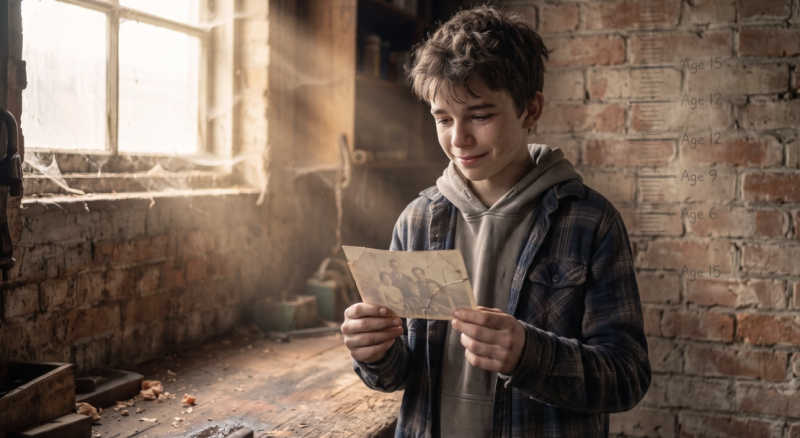
“CHASE - 8 YEARS OLD.”
“CHASE - 10 YEARS OLD.”
“CHASE - 12 YEARS OLD.”
Higher up were older marks.
His mother’s.
And above them, one simply labeled:
“GRANDPA.”
When I moved another dusty box, something fell onto the concrete floor.
A small framed photograph.
The glass was cracked, but the picture was clear.
An older man stood beside a boy holding a bicycle.
I recognized the boy immediately.
That was why his face looked so familiar.
I had seen that photograph hanging in the hallway during the showing before the real estate agent removed it.
I just stood there.
Somehow, the garage had preserved all those memories.
The following Saturday, Chase arrived with the mower.
I didn’t say anything.
I simply opened the garage door and pointed toward the wall.
He froze.
I handed him the photograph.
“That’s why your face looked familiar.”
He took it carefully.
A slow smile appeared on his face.
“I thought we lost this.”
He ran his thumb over the cracked glass.
“My grandfather loved this picture.”
Slowly, he walked toward the wall.
His fingers touched the highest mark with incredible care.
“I thought they would be gone.”
He smiled through tears.
“My grandfather always said we’d need a bigger wall someday.”
I looked at the paint roller leaning in the corner.
I had planned to paint the entire garage that weekend.
Instead, I put the roller back on the shelf and closed the paint can.
“I’m not painting over these marks.”
He looked at me.
“Are you sure?”
“Some things deserve to stay exactly where they are.”
He nodded.
We stood together in the old garage, looking at a family’s story written in pencil.
Houses don’t remember people, and walls don’t miss families.
But sometimes, they keep the proof that someone was loved there.
Sometimes, that is enough to help someone find their way back home.