I made a promise to God before adopting a baby, and 17 years later, she broke my heart.
I wanted to be a mother more than anything. After years of losses and disappointments, my prayers were finally answered — and my family grew in a way I never imagined. But, 17 years later, a quiet phrase from my adopted daughter broke my heart.
I was sitting in my car in the parking lot of the fertility clinic, watching a woman walk out with an ultrasound picture.
Her face was glowing as if she had been handed the world.
I was so empty that I couldn't even cry anymore.
At home, my husband and I danced around each other, choosing words like a board game, trying not to step on the wrong spots.
A few months later, as my next fertile phase approached, the tension returned to our house.
“We can take a break.” My husband's hands were on my shoulders, his thumbs making small circles.
“I don’t want a break. I want a baby.”
He didn’t argue. What could he say?
The miscarriages came one after another.
Each one seemed faster than the last, colder in some way.
The third happened while I was folding baby clothes. I had bought them on sale, I couldn’t help it.
I was holding a little shirt with a duck on the front when I felt that familiar, terrible warmth.
My husband was kind and patient, but the losses were taking a toll on our relationship.
I could see the silent fear in his eyes every time I said, “Maybe next time.”
He was afraid for me, afraid of my pain, afraid of what all this desire was doing to us.
After the fifth miscarriage, the doctor stopped using hopeful language. He sat in front of me in his sterile office, with those cheerful baby photos on the walls.
“Some bodies just… don’t cooperate,” he said softly. “There are other options.”
John slept that night, and I envied his peace. I couldn’t find it anywhere.
I got out of bed.
I sat alone on the cold bathroom floor, my back against the tub. The cold seemed right somehow. Appropriate. I looked at the cracks between the tiles and counted the fractures.
It was the darkest moment of my life. I was desperate, sinking, and then I sought something to end my sadness.

I prayed out loud for the first time in my life.
“Dear God, please… if you give me a child… I promise I will save one too. If I become a mother, I will give a home to a child who has none.”
The words hung in the air, and I felt… nothing.
“Can you hear me?” I sobbed.
I never told John. Not even when I received the answer to that prayer.
Ten months later, Stephanie was born, screaming, pink, and furious at the world.
She came out fighting, demanding, alive in a way that took my breath away.
John and I cried as we held each other, wrapping our little one in all the love we had waited so long to share with her.
Joy consumed me, but the memory sat silently beside me.
I had made a promise when I prayed for this baby, and now I needed to fulfill it.
A year later, on Stephanie's first birthday, as the guests sang and the balloons touched the ceiling, John and I slipped into the kitchen.
I put the adoption papers in a folder that I covered with wrapping paper. John smiled and raised an eyebrow when I handed them to him, along with a pen tied with a ribbon.
“I just wanted it to look nice. To welcome the newest member of our family.”
We signed the adoption papers.
We brought Ruth home two weeks later.
She had been abandoned on Christmas Eve, left near the main Christmas tree in the city, with no note.
She was small, quiet — completely different from Stephanie.
I thought that difference would make the girls complement each other, but I didn’t realize how deeply their differences would mark them as they grew.
Ruth watched the world as if she were trying to understand the rules before anyone could catch her breaking them.
I noticed right away that Ruth didn’t cry unless she was alone.
“She’s an old soul,” my husband joked, gently rocking her in his arms.
I hugged her tighter.
I never would have imagined that this precious baby would grow to break my heart.
The girls grew up knowing the truth about Ruth's adoption. We told them simply:
“Ruth grew in my heart, but Stephanie grew in my belly.”
They accepted that as easily as children accept that the sky is blue and the water is wet. It just was.
I treated them the same and loved them with the same intensity, but as they grew, I began to notice friction between the girls.
They were so different… like oil and water.
Stephanie drew attention without even trying. She entered rooms as if she owned them and asked questions fearlessly that made adults uncomfortable.
Stephanie did everything from math homework to dance classes as if medals were being handed out.
She was determined and focused on being the best at everything.
Ruth was cautious.
She studied moods the way other kids studied words for spelling tests. She learned early how to disappear when she felt too much, and how to make herself small and quiet.
At some point, treating both of them the same started to feel like it wasn’t really the same.
Rivalry began subtly at first. Small things that you could almost overlook if you weren’t paying attention.
Stephanie interrupted. Ruth waited.
Stephanie asked. Ruth waited.
Stephanie assumed. Ruth wondered.
At school events, the teachers praised Stephanie’s confidence and Ruth’s kindness. But kindness is quieter, right? It’s easier to overlook when confidence is right next to it, with its hand raised in the air.
Loving them equally began to feel unfair when the girls didn’t experience love in the same way.
How could they? They were different people, with different hearts, different fears, different ways of measuring if they were enough.
When they reached their teenage years, their rivalry grew.
Stephanie accused Ruth of being “spoiled.” Ruth accused Stephanie of “always needing to be the center of attention.”
They fought over clothes, friends, and attention.
It was just normal sister stuff, I told myself. Just normal stuff.
But underneath it all, there was something deeper. Something I couldn’t name.
Sometimes, in the silence that followed the arguments and doors slamming, I felt there was something toxic beneath the surface of our family, like an abscess waiting to burst.
The night before the prom, I stood at the door of Ruth's room, phone in hand, ready to take pictures.
“You look beautiful, honey. That dress looks great on you.”
Ruth clenched her jaw. She didn’t look at me, but I could feel something shifting between us.
“Mom, you’re not going to my prom.”
I smiled, confused. “What? Of course I am.”
She finally turned to face me. Her eyes were red, her jaw tight, her hands trembling slightly at her sides.
“No, you’re not. And after prom… I’m leaving.”
“What?” I swear my heart stopped. “You’re leaving? Why?”
She swallowed hard.
“Stephanie told me the truth about you.”
The room went cold.
“What truth?” I whispered.
Ruth narrowed her eyes. She had never looked at me like that before…
“Don’t pretend you don’t know what I’m talking about.”
“I don’t. What did Stephanie tell you?”
Her voice shook when she finally said it.

“That you prayed for Stephanie. You promised that if God gave you a baby, you’d adopt a child. That’s why you adopted me. That’s the only reason you took me in.”
I sat down on the edge of her bed, the phone still in my hand, forgotten.
“Yes,” I said calmly.
“I prayed for a baby, and yes, I made that promise.”
Ruth closed her eyes. She seemed to be hoping I would tell her it was all a lie.
“Then I was a deal. A payment for your real child.”
“No, honey, it’s not… transactional. I don’t know how Stephanie found out about this, but let me tell you the truth about that prayer. I never told you both this because it happened during the hardest time in my life.”
I told her about the night I was sitting on the bathroom floor, grieving my fifth miscarriage, and the prayer that came from a place so deep that I didn’t even know I had it inside me.
“Yes, Stephanie was the answer to that prayer, and yes, the promise I made stayed with me, but I never saw it as some kind of debt to be repaid.”
“When I saw your picture and heard your story, I started loving you right away. The vow didn’t create my love for you. My love for Stephanie taught me that I had more love to give, and the vow showed me where to put it.”
Ruth listened. I know she did. I could see her processing it, trying to fit this new information into the story she had been telling herself.
But she was 17, she was hurt, and sometimes being “right” doesn’t matter when someone is already suffering.
Still, she went to prom alone, and didn’t come home that night.
I waited all night.
John fell asleep on the couch around 3 AM, but I couldn’t. I was at the kitchen table, staring at my phone, wishing it would ring.
Stephanie was the first to break the silence. She came into the kitchen at dawn, her face swollen and red from crying.
“Mom,” she said. “Mom, I’m so sorry.”
She told me how she had heard my conversation with her sister months earlier, about the prayer, the promise, how grateful I was that God had given me both of my daughters.
She also told me how she had distorted that information and used it to hurt Ruth during a fight, words said to wound, to win.
“I never thought she would actually leave. I didn’t mean to say any of that. I didn’t want to say it.”
I hugged my loud, fierce, and broken daughter and let her cry.
The days passed slowly. John kept saying she’d come back. That she just needed time. I wanted to believe him.
On the fourth day, I saw her through the front window.
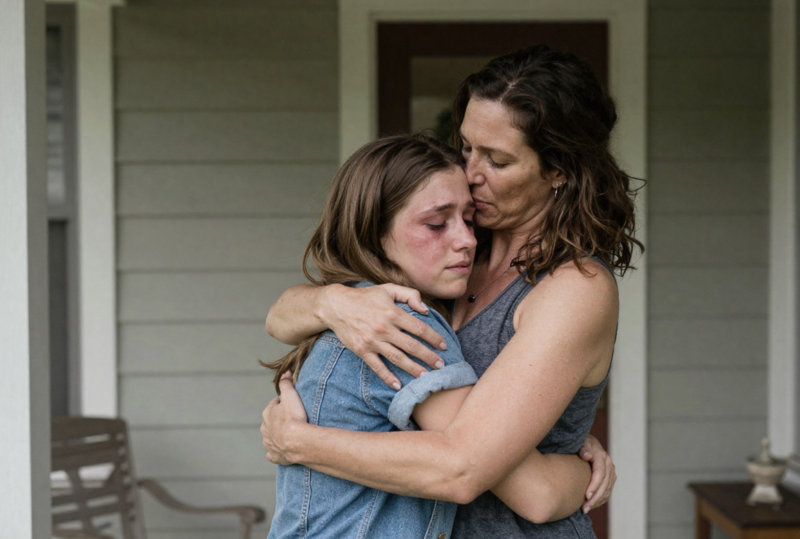
She was standing on the porch with her handbag, hesitant.
I opened the door before she could knock.
She looked exhausted.
“I don’t want to be your promise,” she said. “I just want to be your daughter.”
I hugged her tightly.
“You always were, honey. You always were.”
Then she cried. Not the careful, quiet tears she had learned to shed, but the kind of sobbing that shakes the entire body.