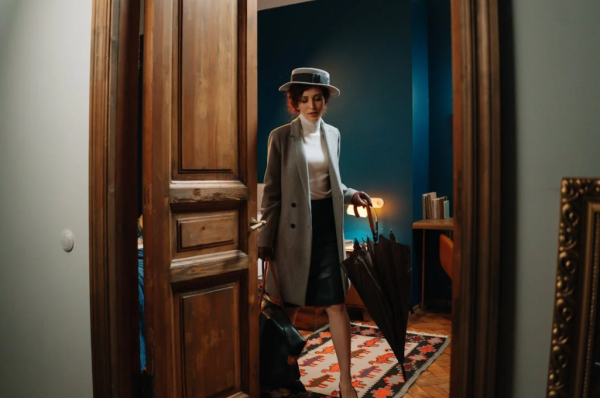
I shared my lunch with an elderly man by the dumpsters — the following morning, a black limousine stopped next to my tent.
I was homeless, eating leftovers behind a café, when I shared my only sandwich with a hungry stranger nobody else would acknowledge. I thought it was just a simple act of kindness in a fast-paced world. Little did I know, that moment was about to change my life.
My parents were both surgeons, and in our house, being a doctor wasn’t just a career — it was the only acceptable future.
Medicine was the plan. It always had been.
My father talked about the day I would join his practice like some dads talk about teaching their sons to drive.
At 18, I told him it wasn’t going to happen, and I saw the certainty on his face fade into something much colder.
I wanted music. I had wanted it since I was nine, when my uncle left an old acoustic guitar at our house over the holidays. I taught myself three chords that weekend, and I never really stopped.
Music wasn’t just a hobby for me; it was my life. It was the only language I had ever felt fluent in.
But my parents didn’t see it that way.
“Pack your bags and go,” Dad said, flat and final, like a door slamming shut.
By sunset, my key no longer worked in the lock.
I stood on the porch of the house I grew up in, with a duffel bag and a guitar case, and for the first time, I understood what it felt like to be completely on my own.
I found a spot under a bridge on the east side of town — a small patch of ground set back from the path where most people didn’t notice it. I set up my cheap tent I bought with the last of my birthday money and told myself it was temporary.
That was three months ago.
I got a part-time job at a café downtown. I mostly washed dishes and wiped tables when they needed extra help. My manager, Pat, let me take any unsold food at the end of the day.
Most nights, that was my dinner.
My guitar case sat in the corner of my tent every night, like a quiet promise I was still trying to keep.
I was tired, yes. But I hadn’t let go of what mattered most.
And then, one Thursday afternoon, everything changed with half a sandwich.
Pat had let me take the last leftover turkey sandwich that afternoon, the last one in the display case. It was a little dry, but still good. I took it to the alley behind the café and sat on an overturned crate near the dumpsters.
From the alley, I had a clear view of the sidewalk out front. That’s when I saw him.
He was old, maybe in his mid-70s, wearing a coat that had been washed so many times it had lost its original color, and shoes held together by sheer will.
He was walking slowly along the sidewalk, stopping people one by one, with his hand out, his voice low.
The first woman shook her head without breaking her stride. A man in a suit waved him off like he was an inconvenience. Two others passed without acknowledging him at all.
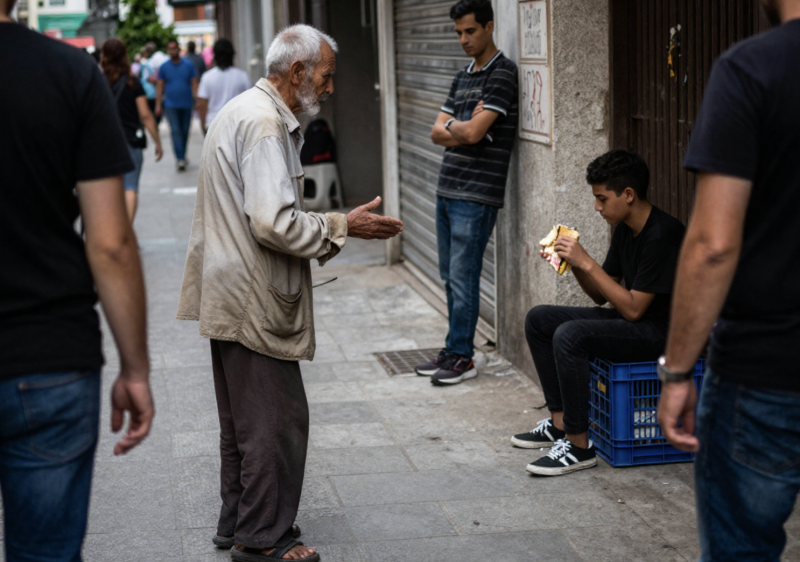
After the fifth rejection, the old man turned toward the alley, and that’s when I called out.
“Hey,” I said. “Are you hungry?”
He stopped and looked at me like someone who’d stopped expecting anything good, and then something good happened.
I broke the sandwich in half and handed him the bigger piece.
The old man took it, sat down beside me on the curb, and ate slowly.
After a few minutes, he looked over at me. “What’s your name, son?”
“Mike.”
“Where do you sleep, Mike?”
“Under the bridge on the east side of town. I’ve got a tent.”
He studied my face for a moment, not with pity, but with something more thoughtful than that.
“You shouldn’t live like this,” he said softly.
I almost smiled. “Neither should you.”
He stared at me for a beat. Then he stood up, nodded once, and walked back toward the sidewalk. I watched him walk away, sure I’d never see him again.
I finished my sandwich and went back to my tent. I played guitar for a bit and then fell asleep, thinking it was just another regular day.
The next morning, I woke to the sound of an engine idling nearby. I unzipped the tent and stepped out.
A black limousine was parked at the curb a few feet away. The driver stood beside it in a dark suit, staring directly at me.
“Are you Mike?” he asked.
“Yes.”
“I’ve been asked to take you somewhere. That’s all I can say.”
My mind raced through every possibility. I hadn’t broken any laws, hadn’t argued with anyone, and hadn’t done anything that should send a limo to a tent under a bridge.
Unless my parents had changed their minds.
I stepped back and called my dad. He picked up after the second ring.
“Dad, I…”
“Don’t call this number,” he exploded. “Only a doctor can be our son. A street musician cannot. Don’t call again.”
The line went dead.
I stood there with the phone in my hand, the rejection fresh even though it wasn’t new. My eyes stung. I blinked to hold it back.
The driver cleared his throat gently. “Sir. Whenever you’re ready.”
I looked at the car, took a slow breath, and got in because I had absolutely nothing to lose.
We drove 40 minutes out of town to a neighborhood where the houses sat so far back from the road you could barely see them. The driveway beyond the gate was lined with flowers in full bloom.
The house at the end of the driveway was enormous, with a stone façade, tall windows, and an entrance wide enough to drive through.
I stepped out and stood on the front path, wondering if this was some kind of prank.
“Go inside,” the driver said. “He’s expecting you.”
I slowly walked through the front door, taking in the high ceilings, curved staircase, and framed photographs lining the walls.
“Hello?” I called.
“You’re finally here.” The voice came from the top of the stairs.
I looked up… and stopped.
At the top of the stairs, dressed in a well-fitted suit with his white hair neatly combed, was the old man from the alley. He came down slowly, watching my face the whole way.
The torn coat was gone. The worn shoes were gone. He looked completely different.
“My name is Graham,” he said at the bottom of the stairs. “And I owe you an explanation, son.”
“Is there a camera crew somewhere?” I asked. “Because if this is a show, I want it on record that I’m not okay with this.”
He laughed. “No cameras. Sit down, Mike. Please.”
We sat near an unlit fireplace. Above it, on the mantle, were photographs — Graham and a woman at various stages of a shared life. A garden. A kitchen table with coffee cups.
“My wife,” he said. “She passed away eight months ago. We never had children. The family I do have has been circling for years. They know what I’m worth, and that’s all they know.”
“I don’t understand…” I interrupted.
Graham looked at the photographs. “I’ve been going out like that for about three weeks. Not to run a test. I just wanted to feel invisible for a while. To see who would stop.” He looked at me. “You were the only one, Mike. In three weeks.”

"I wasn't doing anything extraordinary," I told him. "I was just hungry, and you were hungry too."
"Exactly," Graham replied. "Come with me."
Graham walked me through his home. Room after room of a life well-lived: a library with more books than I'd seen anywhere outside of a school, a music room with a grand piano no one had played in months, and a garden his wife had planted herself.
"I want to fund your future," Graham said as we stood in the garden. "Music school. Living expenses. Whatever you need."
I looked at him for a long moment. "I can't accept something this big from a stranger. I shared half a sandwich with you. That doesn't make me your heir."
"It makes you the most decent person I've met in a very long time," he replied.
"My parents are surgeons downtown," I said, and I don't know why I said it right then, except it felt relevant to the person I was trying to become. "They kicked me out because I wouldn't study medicine. I want to be a musician. I've wanted it my whole life."
"Then let me help you get there," Graham offered.
"I can't."
He looked at me for a long time. Then, without warning, he pulled me into a hug. A hug an older man gives a younger man when words fall short.
"Your parents," Graham said quietly, "are very lucky people who don't yet know what they have."
I rode back to town in the limo with my hands in my lap, feeling something I hadn’t felt in three months. Not rich. Not fixed. Just seen.
And sometimes, when you've been invisible long enough, that’s the most important thing.
My shift at the café that evening was just like every other: hot water, soap, the clatter of plates, and the low hum of the kitchen after a dinner rush. I stood at the sink, working through the pile of dishes.
At one point, I stopped and looked at my hands under the running water. Dish-raw, dry at the knuckles.
I thought of the music room in Graham’s house. The piano no one played. And I thought of my guitar case sitting in my tent, waiting.
I smiled at my own hands. Then I dried them off and finished my shift.
Pat let me take a leftover slice of pizza on my way out, and I walked back toward the bridge in the dark, thinking about Graham, his wife, their garden that had been planted over 30 years, and how a life could be so big and still feel empty if the wrong people were in it.
I was so lost in my thoughts that I almost didn’t see them until I was 10 feet from my tent.
Two figures were standing near the entrance to my campsite. One turned when they heard my footsteps. Even in the dim light under the bridge, I recognized the posture immediately: straight back, squared shoulders, with the stillness of a man who rarely shows up anywhere without a purpose.
My father.
My mother stood beside him, arms crossed over her chest, her eyes doing something I hadn’t seen them do in a very long time.
Before I could say a word, my father covered the distance between us in three steps and put his arms around me.
I stood there for a moment, not quite believing it. Then I held on.
"I'm sorry, Mike," Dad said into my shoulder. "I was wrong. I couldn’t see what was right in front of me, and I’m sorry."
My mother didn't say anything. She just nodded, her eyes wet but steady.
"How..." I started.
"Come home first," Dad said. "There’s something waiting for you there."
I didn’t ask any more questions. I just picked up my guitar case and went.
The envelope was on the kitchen table when we got home. No stamp or return address. Just my name written across the front in careful, unhurried handwriting.
Dad said a man had come to the hospital earlier that day. Older, well-dressed, and white-haired. He asked around until he found out who my parents were, then sat with them for 20 minutes.
He told them about a young man living under a bridge, who had shared half his only meal without being asked, and then turned down a fortune because it didn’t feel right to take it.
I opened the envelope. Inside was an acceptance letter to a respected music conservatory, with a smaller folded note beneath it.
The note read: "Talent is a gift. Character is rarer. You have both. Don’t waste either. — Graham."
I read it twice. My mom put her hand on my shoulder. My dad placed his on the other.
I looked up at the ceiling for a moment, not saying anything, just letting the full weight of it settle in.
Somewhere across the city, an old man named Graham was sitting in a quiet house full of photographs, and I hoped it felt a little less empty than it had the day before.
He’d given me back my future. And all it had cost me was half a sandwich and the simple decision to see another person as worth seeing.
Turns out, kindness travels faster than any limousine.