I spent 22 years raising my triplet nieces, and something they did at their college graduation left me so overwhelmed that I collapsed to my knees.
There were many nights when I wondered if I was doing enough or getting anything right. Now I can look back and point to a single choice I made on an ordinary October evening as the moment everything began.
The porch light in October kept flickering, casting a thin yellow glow across the wooden boards. I had just finished a double shift, still smelling of sawdust and engine oil, keys already in my hand, when I nearly stumbled over them.
Three child seats. One diaper bag. And a note on a gas station receipt.
I picked up the receipt first, because my mind refused to process what was in the seats. My brother Daniel’s handwriting was tilted sharply to the right, as always.
“I’m sorry, Noah. I can’t do this.”
That was all. No address. No number. Nothing.
Daniel’s wife, Patricia, had been buried 11 days earlier. My brother had managed less than two weeks after that.
I was 27, single, living above the hardware store where I swept floors and cut keys. I had $312 in my bank account and a futon that didn’t even fully unfold.
One of the babies made a small sound, a wet hiccup, as if she was trying not to disturb anything.
I knelt on the porch. Two of them were asleep. The third, the smallest, stared at me with gray eyes like my mother’s.
“Hey,” I whispered. “Hey there.”
That was when Mrs. Hunter from next door came out in her robe, slippers slapping the ground. She had been my neighbor for years, never once staying out of anything, which now felt like a blessing.
Patricia had brought the babies over twice that summer, and Mrs. Hunter had held them on the porch while she talked about names and weights like it was a mission briefing.
“Noah? What is happening?”
“Where is he?”
“Gone,” I said.
She looked at the note, then at me, then pressed a hand to her chest.
“You can’t raise three babies alone.”
“I know.”
“You don’t even know how to warm a bottle.”
I let out a breath.
She knelt beside me. I was about to agree with her and call someone when the smallest baby reached out and grabbed my finger. Tiny. Warm. Certain.
It made no sense how strong that grip felt.
“That’s June,” Mrs. Hunter said softly. “Patricia said the smallest would be June.”
“June,” I repeated, like I was checking if I could still speak.
The baby didn’t let go. She didn’t know anything about money, abandonment, or loss. Only that someone was there.
“I’ll call social services tomorrow,” Mrs. Hunter said gently. “There are families who can do this.”
I opened my mouth to agree.
“Okay,” I said instead. “Okay… I’ve got you.”
She went quiet. The porch light flickered again.
I carried them inside one by one. Somewhere between the second and third trip, something shifted. I stopped being just Uncle Noah. I became something I didn’t have a name for yet.
Uncle Noah… then father… almost by accident.
Twenty-two years passed like a long shift—slow in the middle, gone at the end.

I packed lunches with the wrong bread. I braided hair so badly that Mrs. Hunter would fix it before school.
“You’re going to traumatize them, Noah,” she joked once while combing Ava’s hair.
“I’m trying my best.”
“I know. That’s the problem.”
I worked double shifts at the hardware store, sometimes triple when bills piled up—braces, school projects, new shoes that suddenly didn’t fit.
There were fevers, science fairs, and nights I just sat with them on the couch making grilled cheese while they cried.
At different times, all three of them turned against me. June slammed doors at 13. Claire refused to speak to me at 15. Ava told me I didn’t understand anything at 17.
She was right. I didn’t. But I stayed.
I missed things too—a wedding in Denver, a fishing trip I promised myself, even the idea of a normal family life. And Diana.
Diana stayed longer than she should have.
“I’m not asking you to choose,” she said once at the door. “I’m asking if there’s space.”
“There isn’t,” I told her. “Not the kind you deserve.”
She left a sweater behind. I never gave it back.
Daniel appeared only in fragments. A birthday card with no return address. A Christmas card from somewhere unknown. When the girls were 12, he finally called.
“I want to reconnect,” he said. “Be a dad.”
I gripped the phone until my hand hurt.
“Being a father isn’t something you think about on my phone bill,” I said.
He never came. The calls stopped.
Some nights I lay awake doing mental accounting—not of money, but of effort. Did I do enough? Did they know I loved them? Or just that I was tired?
And beneath everything, a fear I never said out loud: that they were still waiting for the man who left them.
That I was only the one who stayed.
On the morning of their graduation, I sat in my truck for 20 minutes before getting out.
I was 49. Gray in my beard. A bad knee that never healed right. A cheap camera shaking in my hand.
In my wallet was still Daniel’s old note, worn and folded.
I kept wondering if they would wish he was there instead of me.
The auditorium smelled like polish and perfume. I sat far back, trying not to shake.
Ava went first, crying before her name finished. Claire waved at me wildly, like when she was a child.
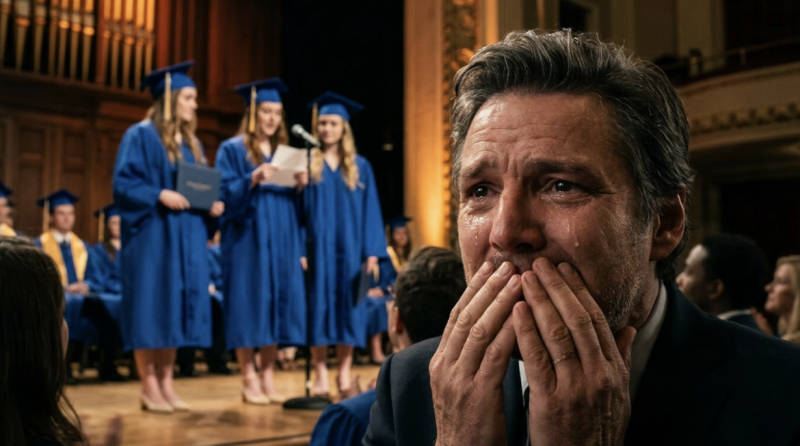
Then June.
She didn’t smile. Just crossed the stage like she was carrying something heavy no one could see.
Then everything changed.
She stepped up to the microphone.
“Our father couldn’t be here today,” she said.
My chest tightened.
Daniel.
I thought that’s who she meant.
But Ava and Claire came back on stage together. June spoke again.
“We found the notebook,” she said.
My stomach dropped.
They began reading.
“To my girls…”
I knew those words.
Because I had written them.
Years ago, alone at a kitchen table above the hardware store, writing to babies who were asleep in a crib I couldn’t afford.
June continued reading:
“I don’t know how to do this. I’m scared. But I’m not leaving.”
My vision blurred.
That was me.
Ava read next, voice breaking:
“I promise I’ll be here. Even when I’m tired. Even when I fail.”
Claire finished:
“I love you more than I knew a person could love anything.”
The room tilted.
June stepped down and placed a document in my hands.
“We finalized it last week,” she said.
Ava spoke into the microphone.
“You were never our uncle. You were always our dad.”
I couldn’t breathe.
The room stood. I don’t remember leaving.
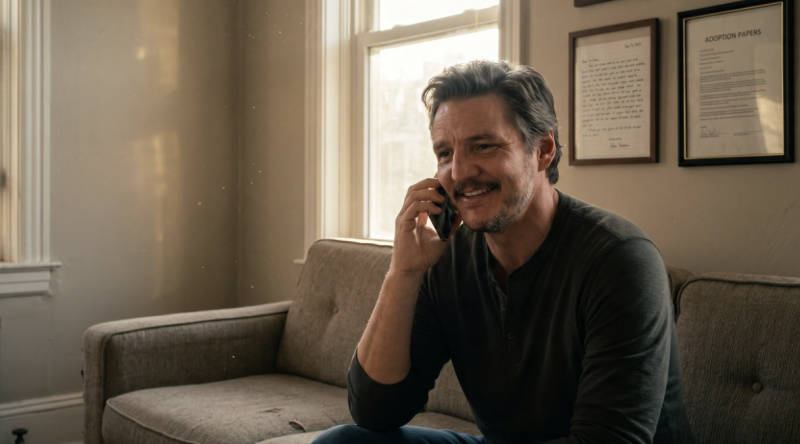
Three weeks later, I was back above the hardware store. Two frames on the wall.
The gas receipt note on one side.
The adoption papers on the other.
I stood there a long time.
For years I called it sacrifice.
Now I saw it differently.
It wasn’t something taken from me.
It was something I had chosen—and that had chosen me back.
I sat down, picked up my phone, and found a number I hadn’t called in 12 years.
Diana.
I pressed call before I could change my mind.
She answered on the second ring.