My neighbor spent 30 years working at a daycare while raising two sets of twins — when they returned to celebrate her birthday, their heartfelt visit moved the entire town to tears.
Everyone thought Miranda’s story was one of quiet sacrifice and loneliness. But when Olive, Olena, Harry, and Hayden arrived at her doorstep holding an old legal envelope, her birthday became the day when a buried past came back to life.
When I first moved to Briar Lane, I thought Miranda’s house was empty.
It stood between my small blue bungalow and the old maple tree at the end of the street, arranged like a postcard, but silent in a way that made you lower your voice as you passed by.
The curtains were always open at sunrise. The porch was swept every morning. A row of clay pots sat beneath the front window, overflowing with marigolds in the summer and brown, empty soil in the winter.
But I never saw anyone coming in or going out.
Then, on my third morning there, I dropped a box of dishes on my porch steps. It burst open, and my grandmother’s soup bowls rolled across the ground as if they were trying to escape.
Before I could even properly swear, a woman wearing a pale yellow cardigan rushed out of the house next door.
— Oh, dear, don’t move — she called. — There’s glass near your shoe.
That was how I met Miranda.
She was 63 years old at the time, though she looked older when she was tired and younger when she smiled. Her hair was silver and pulled back with a kind of care that made me think she had once prepared herself for a life that never arrived.
She helped me gather the broken pieces, made a disapproving sound when she saw the chipped bowls, and insisted on making tea.
— I’m Irina — I told her when we sat at my kitchen table, still covered with unopened boxes.
— Miranda — she replied. — And if anyone on this street gives you trouble, send them to me.
I laughed because she was so small and spoke so softly that the idea seemed impossible.
Then she raised an eyebrow.
— I’m serious.
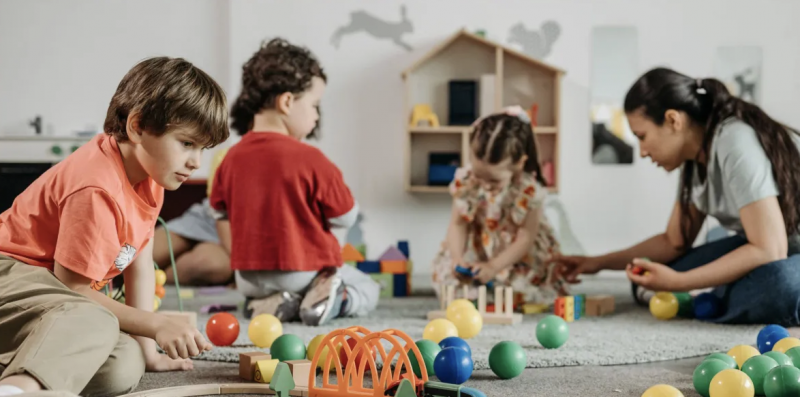
By the end of that week, I discovered what everyone in the neighborhood already knew. Miranda had worked at a local daycare for 30 years, raising two sets of twins as if they were her own children.
That was how people said it, almost word for word, as if the sentence had traveled from porch to porch until it became part of the town’s history.
— Miranda practically raised half this town — my mail carrier, Sonya, told me one afternoon.
But when people talked about her, their voices changed. They became softer. They looked at her small house as if it held both a blessing and a wound.
Ever since I moved to that neighborhood, everyone knew her story. Miranda’s husband had died suddenly in a construction accident decades earlier, leaving her completely alone.
His name was Pavel. She showed me a photograph of him once, after a storm knocked out the power and we sat in her kitchen with candles between us. In the picture, he had one arm around her waist and a smile so wide it seemed to open the world.
— He was 28 — she said, touching the edge of the frame. — I was 25. We thought we had time.
I didn’t know what to say.
I was 36 years old then, recently divorced, carrying my own private shame inside cardboard boxes and folders of legal documents. But a pain like hers seemed larger than anything I had ever survived.
— I’m sorry — I whispered.
Miranda handed me the photograph, then carefully took it back.
— Everyone is sorry, dear. That’s the problem with death. It leaves people feeling sorry, but it doesn’t leave anyone useful.
She was a young widow with almost nothing, forced to take a low-paying job at the daycare just to survive. She told that part without drama, as if she were reciting a grocery list.
— I needed work — she said. — They needed help. Babies don’t care if your heart is broken. They still need their bottles warmed.
That was Miranda. She could say something that cut straight through you and then stand up to check whether the kettle was boiling.
For 30 long years, she devoted her life to that daycare.
Everyone in town remembered how difficult those years had been for her.
Mothers who were now grandmothers still stopped to talk to her at the pharmacy. Grown men with beards and work boots bent down to hug her in the produce aisle.
Teachers, cashiers, nurses, mechanics, and bank employees called her “Miss Miranda,” even though many of them were old enough to have teenage children of their own.
Somehow, she never complained.
Not about the pay. Not about the long hours. Not about how her hands grew stiff in the winter after decades of buttoning coats, tying shoes, wiping faces, and washing tiny plastic cups. Not even about the loneliness waiting for her when she returned home.
I complained enough for both of us.
— You should have retired earlier — I told her one night while helping her carry groceries inside. — Or demanded better pay. Or at least let people help you more.
She laughed and placed a carton of eggs in the refrigerator.
— Irina, I survived too long to receive a lecture from a woman who thinks coffee counts as dinner.
— It counts when you add milk.
— It doesn’t count.
She always smiled, especially when she talked about two specific pairs of twins she had cared for over the years.
Olive and Olena were the girls.
Harry and Hayden were the boys.
The names appeared so often that, after a while, I felt as though I knew them, even though I had never seen them except in old photographs kept inside Miranda’s sewing basket.
Olive was the brave one, always climbing too high and declaring she wasn’t afraid, even with tears running down her face. Olena was quieter, the kind of child who gave her cookies to other children and cried when someone stepped on a beetle.
— Olive walked into a room like she owned the place — Miranda once told me, laughing as she drank her tea. — And Olena came right behind her, apologizing for the noise.
Harry and Hayden were different.
According to Miranda, Harry had serious eyes even when he was little. He lined up toy cars by color and became upset if anyone moved them. Hayden had curls, dimples, and an endless talent for getting into places where no child should have been able to go.
— I once found Hayden inside the laundry basket with a stolen banana — Miranda said.
— How old was he?
— Three.
I smiled.
— That seems impossible.
— With Hayden, nothing was impossible. That boy could escape a locked room with a spoon and a smile.
Whenever she talked about them, something inside her face lit up. She cared for those children as if they were her own, sacrificing her own dreams to make sure they were safe and loved every single day.
At first, I thought she was simply proud of having done her job well.
But the more I knew her, the clearer it became that Olive, Olena, Harry, and Hayden were not just children she cared for. They were the way her love found a place to go after Pavel died. They had filled the spaces in her heart that grief had emptied.
She never had children of her own.
When I asked once, carefully, she looked out the window toward the old maple tree and said:
— Not in the way people mean.
Then she smiled.
— But I had children in all the ways that mattered back then.
I stopped asking after that.
Over time, those children grew up, their families moved away, and Miranda remained in her small quiet house, growing older and more alone.
The daycare closed three years before I moved there. A new private preschool opened across town, with security cameras, colorful murals, and tuition that an ordinary family couldn’t afford. The old building became a dental office.
Miranda pretended not to care, but I saw it when she slowed down every time we passed by.
— That used to be the nap room — she said once, pointing at a window with a teeth-whitening advertisement stuck inside. — Olena hated sleeping. She used to tell stories quietly to the ceiling.
Her voice became faint.
I changed the subject because I didn’t know how to handle that kind of sadness.
As the years passed, I became part of her routine, and she became part of mine. I brought soup when her arthritis flared up. She watered my plants when I traveled for work.
We watched old movies on Friday nights, although she always fell asleep before the ending and insisted the next morning that she had only “rested her eyes.”
She corrected my posture, criticized my burnt toast, and left muffins on my porch when she knew I was pretending not to cry.
I loved her for that.
The whole town loved her too, in its own distracted way. People waved. People remembered her at Christmas. People said, “We need to visit Miss Miranda,” and then returned to their busy lives.
I was guilty of that sometimes too.
I told myself I was tired.
I told myself she understood.
Then, about a week before her birthday, Miranda appeared at my house looking happier than I had seen her in years.
I was trimming a stubborn hedge near my entrance, losing a battle against a branch that kept snapping back toward my face, when I heard her gate open.
— Irina — she called, and there was something bright in her voice.
I turned so quickly I nearly cut through my glove.
She was standing on the sidewalk wearing her blue dress, the one with tiny white flowers, holding her phone with both hands.
— What happened? — I asked.
Her cheeks were pink. Her eyes were shining.
— They called.
— Who?
She pressed the phone against her chest like it was a letter from heaven.
— The twins — she whispered. — Olive and Olena. Harry and Hayden. They called me.
For a moment, I just stared.
Then I dropped the scissors and ran down the path.
— Miranda, that’s wonderful.
— They remembered my birthday. After all these years, they remembered. They said they’re coming to celebrate with me.
Her mouth trembled on the last word. She tried to smile, but couldn’t.
I hugged her carefully because she looked as fragile as blown glass.
— Oh, Miranda.
She hugged me back, laughing and crying at the same time.
— I told them not to make such a fuss. I said, “I’m an old woman now. You don’t need to drive all this way for me.” But Olive said, “Miss Miranda, this time you’re not arguing with us.”
That sounded exactly like the Olive from her stories.
The news spread through Briar Lane before sunset. By the next morning, everyone knew. Sonya brought a card. Mrs. Albright from the corner offered to make lemon bars.
My neighbor Suri suggested balloons. Even grumpy old Desmond from house number 14 said he could set up folding chairs if needed.
The entire neighborhood was genuinely happy for her. After everything Miranda had sacrificed, it seemed like she would finally receive the beautiful moment she deserved.
Miranda tried to pretend she was calm, but she cleaned the windows twice. She ironed the tablecloth. She bought four types of tea because she couldn’t remember which ones the twins liked when they were children.
— They’re adults now — I gently reminded her.
— I know that — she said, rearranging a bowl of wrapped candies on the coffee table. — But people keep parts of who they used to be. Harry liked mint. Or was it Hayden? No, Harry liked mint. Hayden tried to eat a crayon.
I smiled.
— Maybe leave the crayons out.
She looked at me.
— Very funny.
The night before Miranda’s birthday, I helped her set the plates on the table.
She had placed the old photographs on the fireplace, not too visible, but not hidden either. Olive and Olena wearing matching red coats. Harry and Hayden holding paper crowns. The four of them around Miranda, their little arms wrapped around her legs.
She touched the edge of one frame.
— I hope they remember me kindly.
— They’re coming from so far away for you — I replied. — Of course they remember.
She nodded, but her hands trembled as she folded the napkins.
On Miranda’s birthday morning, the entire street seemed to wake earlier.
I made coffee at seven and saw Suri tying ribbons to Miranda’s porch railing. Mrs. Albright arrived with lemon bars covered in foil. Desmond carried two folding chairs in each arm, complaining that birthdays shouldn’t start before breakfast.
Miranda opened the door at nine, wearing the blue dress again, with a pearl necklace I had never seen before.
— Pavel gave me this — she said when I complimented her. — On our second wedding anniversary.
— You look beautiful.
She touched her hair, embarrassed.
— I’m nervous.
— You are loved.
That made her eyes fill with tears, so I pretended to adjust a ribbon.
At ten in the morning, half the neighborhood had found reasons to be outside. People swept already-clean sidewalks. Checked mailboxes. Watered plants that were already wet. Nobody wanted to interfere, but nobody wanted to miss the moment either.
Miranda stood inside the doorway, peeking through the lace curtain every few minutes.
Then a sleek black car stopped in front of the house.
It was the kind of car that didn’t belong on our cracked little street, polished so perfectly that it reflected the houses like a dark mirror. The engine shut off, and for a strange moment, nobody moved.
I was on my porch holding a tray of paper cups.
The doors opened.
Four adults stepped out.
Two women first, tall and elegant, with the same dark eyes and different ways of carrying themselves. One walked quickly, shoulders firm. The other stood beside the car and looked at Miranda’s house as if preparing for something difficult.
Olive and Olena, I thought.
Then came the men. One adjusted his suit jacket before even closing the car door. The other ran a hand through his hair and looked around the street.
Harry and Hayden.
I expected flowers. A cake. One of them to laugh and run up the porch steps like the children from Miranda’s stories.
But they carried no gifts or flowers.
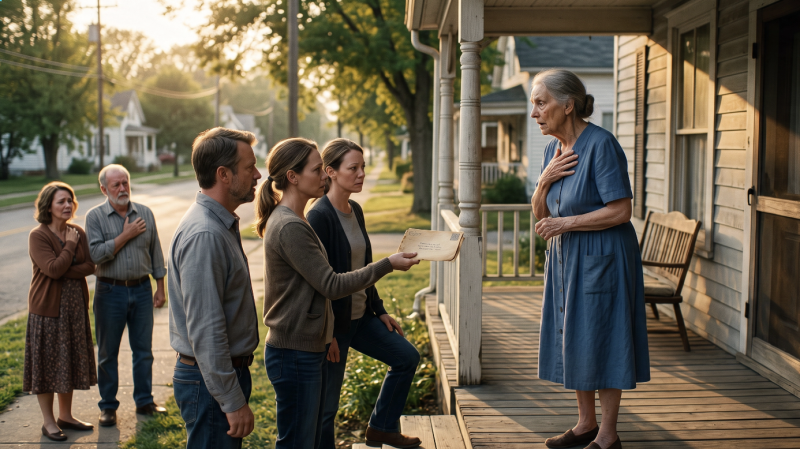
Instead, the oldest-looking man held an old legal envelope that looked official.
Something inside me tightened.
Miranda opened the door before they could knock.
For half a second, joy completely transformed her face. She lifted both hands to her mouth, and I heard her whisper their names.
Then the man with the envelope stepped forward.
Miranda’s face lost all color.
She didn’t look happy.
She looked completely terrified.
I stepped toward the stairs, but stopped. The entire street had gone silent around me. Even Desmond, who always had something to complain about, stood still beside the folding chairs.
I watched from my porch as they pulled out an old 30-year-old contract, and before I could understand what was happening, one of the twins looked directly at her.
He didn’t raise his voice, but everyone on Briar Lane seemed to hear him.
— You remember this, don’t you?
Miranda’s lips parted, but no sound came out. Her hand reached for the doorframe, gripping it so tightly her knuckles turned white.
The man holding the envelope looked like the serious little boy Miranda had described so many times.
Harry. It had to be Harry. His face was older, more marked, more defined, carrying something that looked a lot like pain, but his eyes held the same weight she always mentioned.
Beside him, Hayden stared at the porch floor as if he couldn’t face her yet. Olive had her arms crossed over her chest, while Olena covered her mouth with one trembling hand.
— Harry — Miranda whispered.
Hearing his name, his hardened expression broke for a moment.
I stepped off my porch without thinking.
— Miranda?
She turned her head just enough to see me, and I saw the fear in her eyes.
Not surprise.
Not confusion.
Fear.
— Please — she said, though I didn’t know if she was speaking to them or to me.
Harry opened the wrinkled pages. The paper was yellowed with age, and the edges were worn from being handled so many times.
— We found this in their safe — he said.
Miranda trembled.
Olive’s voice shook when she spoke:
— After our parents died, we had to organize everything. Bank documents, insurance papers, old deeds. We thought it was just another pile of legal documents.
— Our parents — Hayden repeated quietly, his mouth twisting as if the words tasted bitter.
Olena lowered her hand. Tears were already streaming down her face.
— Then we saw your name.
For a moment, nobody moved. The entire street seemed to hold its breath.
Miranda looked like she was shrinking inside her blue dress. The pearl necklace around her neck reflected the morning light, bright and cruel.
— I never wanted you to find out this way — she said.
— This way? — Olive asked, her voice breaking. — We grew up calling you Miss Miranda.
Miranda closed her eyes.
That was the moment I realized the story I knew, the story all of us knew, was only the safe half of her.
Harry looked at the contract and began reading, not loudly, but clearly enough that the porch, sidewalk, and nearby open windows could hear.
— This agreement prohibits Miranda from revealing any biological relationship with the adopted minors. Any violation will result in immediate termination of employment, loss of all permitted visitation access within the daycare environment, and financial penalties as described below.
A sound moved through the neighbors, low and full of shock.
I felt my hand move to my chest.
Miranda had once told me she never had children of her own.
“Not in the way people mean.”
Now I understood what she meant.
Olena stepped forward.
— We had to read this five times. We kept thinking it couldn’t be true.
Hayden finally looked at Miranda. His eyes were red.
— Were we yours?
The answer shattered Miranda.
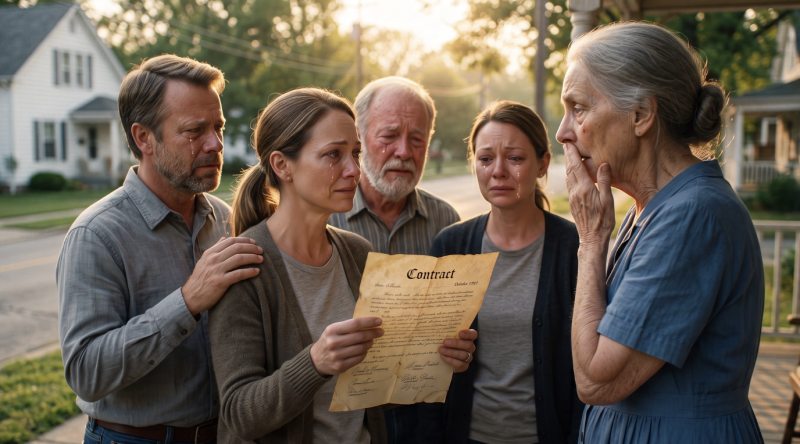
She covered her mouth with both hands, and for a second, she looked 25 years old again: young, widowed, and trapped by a world that had no mercy for poor women.
— Yes — she whispered. — God forgive me. Yes.
Olive made a small sound, almost a sob, but stayed standing.
Harry tightened his grip on the contract.
— Why?
That single word seemed to break Miranda apart.
She stepped back, and I thought she might fall, so I rushed to her.
She didn’t resist when I touched her arm.
— Because Pavel died — she said, her voice weak. — Because there was no money, no nearby family who could help, no time to grieve. I had two newborn babies and a landlord demanding rent, and some days I was so tired I forgot my own name.
Olena cried openly now.
Miranda looked from one face to another, as if trying to memorize them before they disappeared again.
— I tried — she continued. — You have to believe me. I tried to keep you. I sold my wedding ring first. Then the furniture. I watered down soup until it was barely soup. I went to every church, every office, every woman who had ever smiled at me. But I was young, poor, and alone.
— Who adopted us? — Hayden asked, though he probably already knew the answer.
— Your parents — Miranda answered softly. — The people who raised you. They had money. They had a home. They could give you doctors, warm beds, schools, and everything I couldn’t.
Harry swallowed.
— And they made you sign this?
— They offered me a way to stay close to you.
Miranda’s voice broke on the word “close.”
— Your adoptive mother knew the daycare needed workers. She said that if I signed, they would enroll you there. All of you. Olive and Olena first, then Harry and Hayden when you were old enough. I could hold you when you cried. Feed you. Watch you take your first steps. But I could never tell the truth.
Olive’s arms fell to her sides.
— They bought your silence — she said.
Miranda shook her head as tears fell freely.
— No. They bought my fear. My silence came from loving you more than I loved myself.
That sentence destroyed me.
Behind us, Mrs. Albright started crying over the foil covering her lemon bars. Suri brought both hands to her mouth. Desmond turned away, but not before I saw him wipe his eyes.
— I used to wonder — Olena whispered. — I wondered why I felt safer with you than with anyone else.
Miranda’s shoulders shook.
— I sang to you — she said. — To all of you. The same lullaby your father sang the night before he died. I thought that if I could give you that, maybe some part of him would remain with you.
Hayden let out a broken laugh.
— I remember that song.
— You do? — Miranda asked.
He nodded, tears running down his face.
— I didn’t know where it came from. I only knew it made me feel like I belonged somewhere.
Harry looked again at the contract. For the first time, anger appeared on his face, but it wasn’t directed at Miranda.
— They threatened to destroy you — he said.
— Yes.
— Take you away from the daycare.
— Yes.
— Make sure you could lose us twice.
Miranda pressed a fist against her heart.
— I was a coward.
— No — Olive said suddenly.
Miranda looked at her.
Olive stepped onto the porch. Her voice trembled, but her eyes were steady.
— No. You were trapped.
Harry stood beside her. Olena followed. Hayden came last, still crying, still looking at Miranda as if afraid she would disappear.
— We came here because we needed to hear it from you — Harry said. — But we also came to end this.
He lifted the contract.
Miranda’s breath caught.
— Harry, don’t do that. I don’t know what this still means legally. I don’t know what they put in this document.
— They’re gone — he replied. — Their lawyers are gone. Their threats are gone. We talked to an attorney. This has no power over you anymore.
Olena held one side of the paper.
Then Olive held another.
Hayden grabbed the bottom.
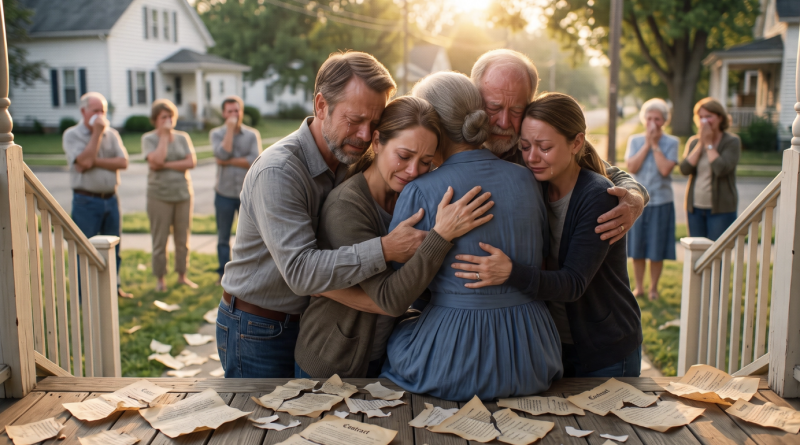
Together, the four of them tore the contract in half.
The sound was small, just paper ripping in the morning air, but it felt bigger than thunder. They tore it again. And again. And again.
The yellowed pieces floated down onto Miranda’s porch like dead leaves.
Miranda stared at them, one hand covering her mouth.
Harry stepped over the torn pieces and stood in front of her.
For the first time since the car arrived, his face became completely gentle.
— The secret is over, MOM — he said.
The word hit Miranda so hard she stumbled. I caught her, but only for a second, because all four of them reached her at once.
Olive wrapped her arms around Miranda’s shoulders. Olena pressed herself beside her, crying. Hayden lowered his head against her hair like a lost child. Harry embraced them all, eyes squeezed shut.
Miranda released a sound I will never forget.
It wasn’t just crying.
It was pain leaving a body after being trapped inside it for 30 years.
— My babies — she sobbed. — My beautiful babies.
— We’re here — Olena cried. — We’re here now.
— I loved you every day — Miranda said against them. — Every day. I never stopped.
— We know — Harry whispered. — Now we know.
Then, as if someone had given the entire town permission to breathe again, everyone started crying.
Mrs. Albright placed the lemon bars on the porch steps and hugged Suri. Desmond removed his cap and stared at the sky. Sonya, who had come around the corner carrying a stack of mail, stopped in the middle of the sidewalk and cried without hiding it.
I stood beside the door, tears running down my face, feeling both honored and heartbroken to witness a family being reborn in public after being buried in secrecy for so long.
After some time, Miranda stepped back enough to look at them.
— I don’t deserve to be called that — she whispered.
Hayden wiped his tears with the back of his hand.
— Too bad. We waited too long.
A tearful laugh moved through all of us.
Olive held Miranda’s hand.
— We can’t get back the lost years.
— No — Miranda answered.
— But we have today — Olena added.
Harry pointed inside the house.
— And tomorrow, if you want us.
Miranda looked at their faces, one by one, as if the answer was too precious to rush.
Then she smiled.
It wasn’t the polite smile she gave the neighbors, or the brave smile she wore when old memories hurt.
It was a smile that came from somewhere deep, young, and healed.
— I have had room for you since the day you were born.
They went inside together after that, stepping over the torn contract without looking down.
The birthday decorations swayed gently in the breeze. The lemon bars waited on the steps. The elegant black car remained forgotten in the street.
And on Briar Lane, where people once thought Miranda’s small house was quiet because her life had become small, we finally understood the truth.
Her love was never small.
It was simply silent.
It had been threatened, hidden, and wounded by fear.
But that morning, with her children holding her and finally calling her “Mom,” it became the strongest and loudest thing in the entire town.