My two eldest sons didn’t acknowledge my 50th birthday at all, but the gift my youngest daughter brought was so touching that it left me overwhelmed with emotion.
After a lifetime of putting everyone else first, Lana hoped her special birthday would make her children realize how much she meant to them. But as the evening became colder and her sons remained quiet, her youngest daughter arrived carrying something connected to the past. Was Lana prepared for what she was about to discover?
I had always believed that having three children meant I would never truly be alone in this world.
That belief carried me through nights when the house was freezing because I had chosen to spend money on food instead of turning on the heat. It carried me through mornings when I prepared their lunches with a smile while my own stomach was empty.
It carried me through school appointments, childhood illnesses, worn-out shoes, unpaid bills, and the silent fear that came with raising children while pretending everything was under control.
My name is Lana, and for most of my life, I believed that being a good mother meant giving everything I had, even when there was almost nothing left of me.
Today was my 50th birthday.
I should have been proud of reaching that age. Fifty years meant I had endured. Fifty meant I had raised three children, kept a home standing, and survived moments that once felt impossible to overcome.
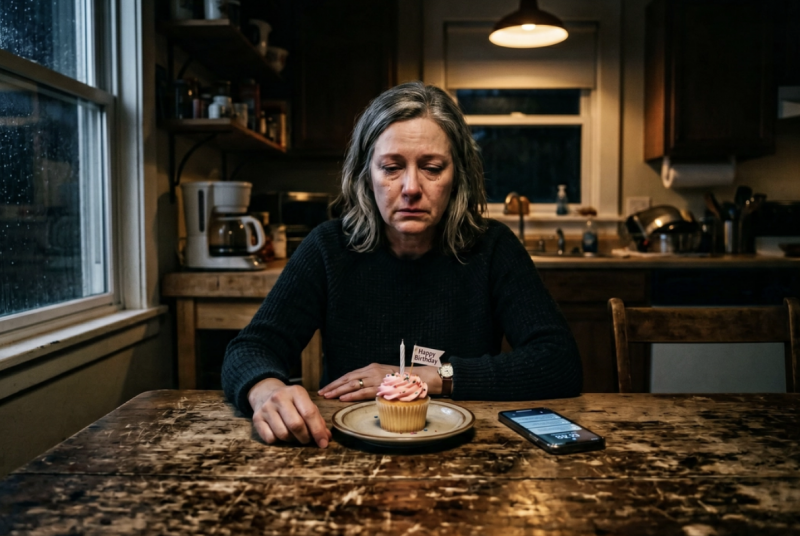
Instead, I sat alone at my kitchen table, looking at a single cupcake with a candle that had never been lit.
The cupcake came from the small grocery store nearby. It was vanilla with white frosting and a few silver decorations that were already sinking into the icing. I bought it after work because I could not handle the thought of returning to a house where no one had remembered me.
The old clock above the stove sounded louder than usual. The sink held only one coffee cup and one cracked plate. The aging wooden table carried marks from years of homework, spilled drinks, and birthday cakes I somehow managed to provide even when money was tight.
For Leo’s tenth birthday, I stayed awake until two in the morning making a chocolate cake that looked like a soccer field. For Marcus’ eighth birthday, I walked several blocks through heavy rain to find the action figure he had been asking for. For Clara, my youngest, I gave up an extra cleaning job so I could buy her a used pink bicycle.
I remembered every birthday candle I had ever lit for them.
But that evening, my own candle remained untouched.
My phone suddenly vibrated.
My heart jumped so quickly that I nearly knocked over the glass beside me. For one brief moment, I truly believed it was one of my older sons, Leo or Marcus.
Maybe they had remembered at the last second.
Maybe they were calling to laugh and say, “Mom, did you really think we forgot?”
Maybe there would be a knock on the door soon, followed by flowers, balloons, and an apology I would forgive before they even finished speaking.
I grabbed my phone and looked at the screen.
Leo had sent me a request for $400 to help pay for his wife’s upcoming spa weekend, followed by a short message:
“Hey Mom, can you send this as soon as possible?”
No “Happy Birthday.”
No “How are you doing?”
Nothing that showed he remembered the day.
Only another request for something from me.
I read the message again, hoping somehow the words would change into something kinder. They did not.
My finger stayed above the screen out of habit.
Approve. Send. Help. Fix.
That was what I had always done.
When Leo married, I convinced myself things would eventually be different. I told myself he was creating his own family and simply needed support while he adjusted.
His wife enjoyed expensive things, but I kept telling myself that young couples faced struggles I did not understand. Spa days, trips, new furniture, expensive meals. Whenever money became a problem, somehow Leo always remembered me.
Not for birthdays.
Not for the little moments mothers quietly treasure.
Only when something needed to be paid.
Marcus was no different. He usually called when his wife wanted another designer item.
Marcus had once been the little boy who followed me around the kitchen and begged to help stir dinner. He was the child who cried when he noticed I looked exhausted. He used to put his tiny hands on my face and promise, “When I’m older, I’ll buy you the biggest house, Mom.”
Now his calls were careful and distant.
“Mom, it’s only temporary.”
“Mom, you know I wouldn’t ask unless I really needed it.”
“Mom, don’t make me look bad in front of my wife.”
I kept making excuses for them.
I told myself they were busy. I told myself they loved me differently. I told myself that mothers were supposed to keep giving without expecting anything in return.
I repeated those comforting lies because accepting the truth hurt too much.
But when the clock passed 8 p.m., the heaviness of their silence finally became impossible to ignore.
The candle on the cupcake leaned slightly to the side, almost as if it had stopped believing it would ever be lit.
Fifty years old.
Three children.
Two sons who had forgotten me.
One daughter who was probably still working or attending her evening class. Clara was only 20, still trying to discover her own path in life. I never wanted her to feel responsible for taking care of me.
But deep inside, I wished that just once, someone would remember without being reminded.
A tear slipped down my face before I could stop it.
I quickly wiped it away, even though there was no one around to see.
Then another tear followed.
And another.
I sat there feeling invisible to the two sons I had sacrificed my entire youth to raise.
I thought about the years after my ex-husband left us with almost nothing. I remembered Leo holding onto my leg, Marcus asking when his father would return, and little Clara crying at night because there was not enough formula until payday arrived.
Maybe I had not been a mother to them.
Maybe I had only been someone they could depend on.
Just as another tear reached my cheek, the front door opened.
I immediately froze.
The hallway light turned on, and quiet footsteps moved toward the kitchen.
It was Clara.
Her dark hair was tied into a loose braid, and the cold air had left her cheeks slightly red. She was carrying no flowers, no balloons, and no birthday cake.
Her eyes moved from my face to the lonely cupcake and then to the phone still glowing in my hand.
She said nothing.
But her silence felt completely different from the silence that had filled the house all evening.
This silence was not empty.
It carried something I could not understand.
Clara slowly walked closer, pulled out the chair beside me, and sat down.
I forced a small smile.
She looked at me with eyes that seemed far older than twenty years.
Then she reached into her bag.
She pulled out two things.
The first was a faded blue leather diary I had not seen in more than fifteen years—the diary I wrote in during the year my husband left and our lives changed forever.
The second was a carefully prepared travel itinerary.
I stared at both objects sitting on the old wooden table.
My hands shook as I touched the diary.
I knew every mark on that cover.
I knew the small tear near the binding.
I knew the faded coffee stain in the corner from one of those nights when I wrote because sleep would not come and crying felt impossible.
I had hidden that diary away.
Or at least, I thought I had.
Then my eyes moved toward the travel itinerary.
I looked at the destination written on the page, then looked back at Clara, completely confused.
What she told me next, and the way she had managed to make it happen, changed something inside me forever.
“What is this?” I asked, although my voice sounded so quiet that it barely felt like my own.
Clara placed her hand gently over mine.
“It’s your birthday gift.”
I blinked and looked down at the itinerary again.
Rome.
The word stood there clearly, bold and unbelievable, like it belonged to a dream I had forgotten I once had.
“Clara,” I whispered, “this isn’t possible.”
“It is.”
I shook my head slowly.
“No. No, sweetheart. You don’t understand. This is too much.”
Her lips trembled slightly, but she kept looking directly at me.
“I understand more than you think.”
My eyes fell back to the faded blue diary.
My chest tightened.
“In the storage room,” she explained. “I was searching for the old Christmas decorations last month. It slipped out of a box filled with your old papers, our drawings, and tax documents.”
I swallowed.
“You read it?”
Her expression softened with regret.
“At first, I didn’t plan to. I thought it was one of my old notebooks. Then I saw your handwriting. Then I saw my name.”
My fingers tightened around the diary.
Suddenly, I was no longer sitting at my kitchen table on my 50th birthday.
I was thirty years old again.
Exhausted.
Afraid.
Writing beneath the weak yellow light of a cheap lamp while my three children slept in the next room.
Clara opened the diary carefully and turned to a page she had marked.
Her voice became emotional as she began reading.
“I almost bought the ticket today. One seat to Rome. I stood outside the travel agency for twenty minutes, staring at the picture of the Colosseum. For the first time in years, I wanted something only for myself.”
My eyes filled with tears.
But Clara continued softly.
“Then the mortgage notice arrived. If I miss another payment, we could lose the house. So Rome will have to wait. The children need a home more than I need a dream.”
The room around me became blurry.

I remembered that day so clearly it almost felt like I was living it again.
I had saved quietly for almost two years.
A few dollars from cleaning houses.
Birthday money from a relative I rarely spoke with.
Loose change collected after grocery shopping.
Little by little, I built that dream.
I had wanted to visit Italy since I was a young girl. I imagined walking through narrow streets, drinking coffee at a small outdoor table, and standing beneath ceilings painted by artists who had been gone for hundreds of years.
But then the mortgage payment arrived.
So I opened the jar.
I used every saved dollar.
I saved our home instead.
I told myself that dreams were things mothers could not always afford.
Clara closed the diary and wiped away a tear.
“You gave up Rome for us.”
I tried to smile.
“That was a long time ago.”
“You were just children.”
“And now I’m not.”
Something about her voice made me look at her carefully.
“Clara, how did you pay for this?”
She took a slow breath.
The silence before her answer made my heart sink.
“I sold my car.”
I stared at her.
For several seconds, I could not speak.
“Your car?”
She nodded, tears falling down her face.
“I sold it last week.”
“Clara, that car meant something to you.”
“I know,” she said quietly. “But it was still only a car.”
“It took you to work. It helped you get to school.”
I pushed away from the table, shaking my head.
“No. No, I can’t accept this. We’ll cancel it. We’ll get your money back.”
“We can’t.”
“Then we’ll find another way.”
“Mom,” she said firmly. “Stop.”
I became silent because Clara had never spoken to me like that before.
She reached for my hands.
“You have spent your entire life trying to solve everything for everyone else. For Leo. For Marcus. For me. Even for Dad after he walked away. You keep cutting pieces of yourself away and giving them to people who don’t even appreciate them.”
I looked down.
Because I knew she was right.
My phone vibrated again.
It was Leo.
Another message appeared beneath his first one.
Clara noticed it before I could turn the screen away.
Her expression changed.
“Did he wish you a happy birthday?”
I stayed quiet.
“That’s what I thought.”
“He’s stressed,” I whispered.
“No,” Clara answered calmly. “He knows you will always say yes.”
A moment later, Marcus called.
His name appeared on my screen, and my body reacted automatically.
I reached for the phone.
But Clara gently placed her hand over it.
“Let it ring.”
“He might need something.”
“He does need something,” she said. “That’s why he’s calling.”
The phone continued ringing until it stopped.
Then a message appeared.
“Mom, can you call me? My wife found a bag on sale, and I need help before someone else buys it.”
I stared at the words.
Not a single question about me.
Not a single mention of my birthday.
Not one sign that they remembered.
Something inside me became quiet.
Not empty.
Not broken.
Just clear.
I opened Leo’s request.
My finger hovered over the button.
But this time, I did not press approve.
I rejected it.
Then I typed:
“Leo, today is my 50th birthday. You forgot. I love you, but I will not be paying for a spa weekend.”
My hands trembled when I pressed send.
Then I opened Marcus’s message.
“Marcus, I’m not buying the bag. I am tired of being treated like a source of money. I love you, but my answer is no.”
After sending both messages, I waited for the guilt to come.
I expected regret.
I expected fear.
Instead, I felt something I had not felt in years.
Peace.
Clara started crying harder, and I wrapped my arms around her.
“I’m sorry,” I whispered into her hair. “I’m sorry you felt like you had to give up something you loved.”
She pulled away and smiled through her tears.
“I didn’t lose something I loved. I traded it for something I love more.”
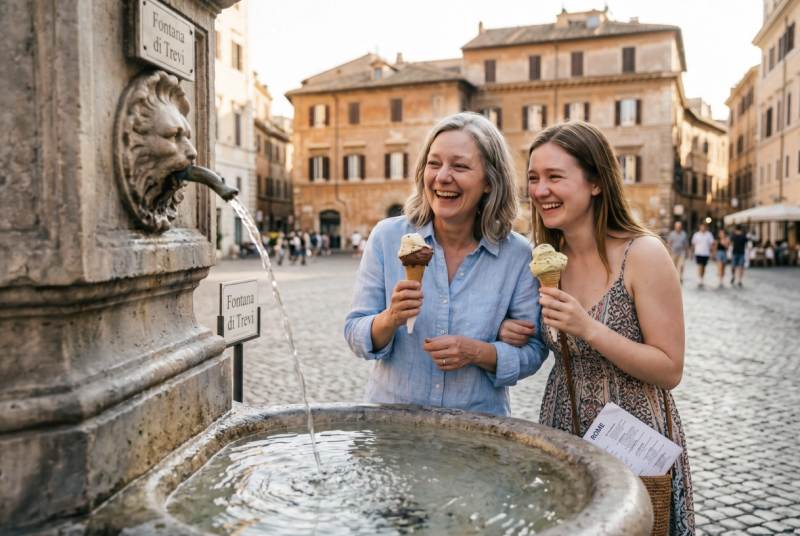
Two weeks later, Clara and I were standing in Rome.
Our hands were filled with gelato, and our hearts were filled with memories we would carry forever.
We visited the Colosseum first.
I started crying before we even reached the entrance.
Clara laughed softly and linked her arm with mine.
“Come on, birthday girl,” she said. “You waited twenty years for this.”
We threw coins into the Trevi Fountain.
We ate pasta in a small restaurant with red checkered tablecloths. We wandered through streets we had never seen before, got lost more than once, and laughed because for the first time in a long time, we were not worried about rushing somewhere or fixing someone else’s problems.
At night, we sat together on the balcony of our little hotel room, watching the lights of Rome shine beneath us.
The city looked golden.
Beautiful.
Peaceful.
And for those moments, everything felt exactly as it should.
The messages from my sons continued.
First angry ones.
Then confused ones.
Then quiet ones.
I did not answer immediately.
I responded only when I felt ready, and only with words that were honest instead of words that came from guilt.
By the time our trip ended, I finally understood something I should have learned many years earlier.
Being a mother did not mean that I had to erase myself.
Love was not supposed to require me to completely empty my own heart.
And family was not only defined by the people who shared my blood.
Family was made of the people who noticed my pain, valued my sacrifices, and cared enough to protect my heart.
On our final morning in Rome, Clara took a picture of me standing beside a fountain.
The sunlight touched my face, and I was smiling in a way I had almost forgotten how to smile.
“You look so happy, Mom,” she said. “I have never seen you like this before.”
I looked at my daughter.
The child who found the dream I had buried.
The child who picked up a piece of my past and returned it to me.
I smiled.
“I am happy, sweetheart. I truly am.”