Silent Rescue: A Mother’s Unseen Fight to Save Her Son
After her teenage son moves in with his dad, Claire tries not to interfere—until the silence from her son speaks louder than words. When she discovers what’s really happening in that house, she does what mothers do best: she shows up. This is a quiet but powerful story about rescue, resilience, and unconditional love.
When my 14-year-old son, Mason, asked to live with his dad after the divorce, I said yes.
Not because I wanted to (trust me, I would have preferred having him with me). But because I didn’t want to come between a father and son trying to reconnect. Mason still stayed with me on weekends and whenever he wanted. He just wasn’t with me every day.

He missed Eddie—his fun, goofy dad who made pancakes at midnight and wore baseball caps backward at soccer games. And Eddie seemed ready to step up. He wanted to be involved. To be more responsible.
So I let Mason go.
I told myself I was doing the right thing. That giving my son space wasn’t abandoning him.
At first, Mason called often. He sent silly selfies and talked about pizza and movie nights with his dad. He shared photos of half-burnt waffles and goofy smiles.
I saved every picture. Watched every video over and over. I missed him, but I told myself this was good.
This was what he needed.
He sounded happy. Free. And I wanted to believe that meant he was okay.
But the calls started to fade. The messages became less frequent. Conversations shrank to one-word answers.
Then, silence.
And then, the teachers started calling.

A concerned teacher emailed me about missed assignments.
—“He said he forgot, Claire. But that’s not like him.”
Another called during her lunch break, maybe between bites of a sandwich.
—“He seems disconnected. Like he’s here but not really... Is everything okay at home?”
And the worst call was from his math teacher.
—“We caught him cheating on a test. That’s not typical of him. Just wanted you to know... he seemed lost.”
That word stuck with me, like an electric shock.
Lost.
Not rebellious. Not troubled. Just... lost.
It settled cold on my chest. Because that wasn’t my Mason. My son had always been thoughtful, careful. The kind of kid who double-checked his homework and blushed when he didn’t get an A.
That night, I tried calling him. No answer. I left a message.
Hours passed. Nothing.
I sat on the edge of my bed, phone in hand, staring at the last photo he’d sent—him and Eddie holding a burnt pizza as a joke.
But it didn’t seem funny anymore. Something was wrong. And the silence screamed.
I called Eddie. Not to accuse, just worried. My voice soft, neutral, trying to keep the peace.

Walking a tightrope that divorced moms know too well, where one wrong word can get you labeled “controlling” or “dramatic.”
His answer?
A sigh. A tired, dismissive sigh.
—“He’s a teenager, Claire,” he said. “Sometimes they slack off. You’re overthinking again.”
Overthinking. I hated that phrase.
It hit a nerve. He used to say that when Mason was a colicky baby. When I hadn’t slept three nights straight and sat crying on the bathroom floor, holding our screaming baby while Eddie snored.
—“You worry too much,” he’d murmur then. “Relax. He’ll be fine.”
And I believed him. I wanted to. Because the alternative—being alone in that fight—was too heavy to carry.
And here it was again.
Mason was still crying, just silently now. And Eddie kept turning away, pretending everything was fine.
But this time? My silence had consequences.
This wasn’t a newborn with reflux. This was a child quietly falling apart in another house.
And something deep inside me—the part that always knew when Mason needed me—started to scream.
One rainy Thursday afternoon, I didn’t ask Eddie’s permission. I just went to Mason’s school and picked him up. The rain was a soft drizzle that blurred the edges of the world. The kind of weather that feels like time is holding its breath.
I parked where I knew he’d see me. Turned off the engine. Waited.
When the bell rang, kids poured out in groups—laughing, shouting, dodging puddles. Then I saw him, alone, walking slowly, like each step cost him something.
He climbed into the passenger seat without a word.

And my heart broke.
His sweatshirt stuck to him. His shoes were soaked. His backpack hung off one shoulder like a meaningless accessory. But it was his face that shattered me.
Sunken eyes. Pale, cracked lips. Shoulders hunched like he wanted to disappear.
I handed him a granola bar with trembling hands. He looked at it but didn’t touch.
The heater hummed softly, warming the space between us but not enough to melt the ache in my chest.
Then, barely above the sound of rain on the windshield, he whispered:
—“I can’t sleep, Mom. I don’t know what to do…”
That’s when I knew my son wasn’t okay.
The words came slowly. Like he was holding them tightly with both hands to keep from dropping them. Like letting go might break him.
Eddie had lost his job. Just weeks after Mason moved in. He told no one. Not Mason, not me. He tried to keep up appearances—the same routines, the same smile, the same tired jokes.
But behind the curtain, everything was falling apart.
The fridge was almost always empty. The lights flickered constantly. Mason said he stopped using the microwave because it made a weird noise when running too long. Eddie was out almost every night.
—“Job interviews,” he said. But Mason said he didn’t always come back.
So my son managed on his own. Ate cereal—sometimes dry because there was no milk. Washed his clothes when he ran out of socks. Ate spoonfuls of peanut butter straight from the jar and called it lunch. Dry cookies for dinner.
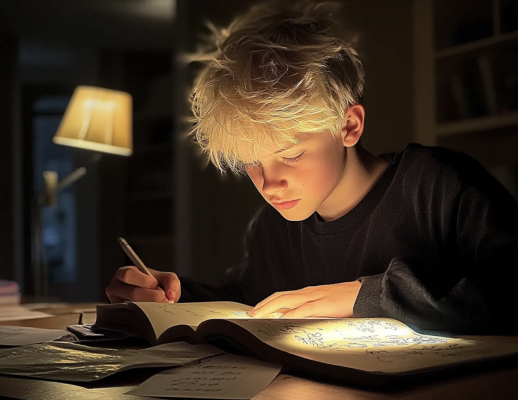
He did homework in the dark, hoping the Wi-Fi lasted long enough to submit assignments.
—“I didn’t want you to think badly of him,” Mason said. “Or of me.”
There it was—the truth. He wasn’t lazy. He wasn’t rebelling.
He was drowning. And all along, he was trying to keep his dad afloat. Holding together a house that was already breaking. Protecting two parents from breaking even more.
And I hadn’t seen it.
Not because I didn’t care. Because I told myself not stepping in was respectful. That giving them space was right.
But Mason didn’t need space. He needed someone to call him back home.
That night, I brought him back with me. No court orders. No calls. Just instinct. He didn’t argue at all.
He slept 14 hours straight. His face relaxed, like his body finally felt safe enough to let go.
The next morning, he sat at the kitchen table and asked if I still had that old robot mug—the one with the broken handle.
I found it hidden at the back of the cabinet. He smiled at it, and I left the room before he could see the tears in my eyes.
—“Mom?” he asked a little later. “Can you make me something to eat?”
—“How about a full breakfast?” I asked. “Bacon, eggs, sausage... the works.”
He just smiled and nodded.
I quietly filed for custody change. I didn’t want to break anything. Didn’t want to break either of them. I knew my ex was going through hard times too.
But I didn’t return Mason until trust was rebuilt. Until Mason felt he had a choice. A place to just breathe, knowing someone was holding the air for him.
It took time. But healing always does, doesn’t it?
At first, Mason barely spoke. Came home from school, dropped his backpack by the door, and slipped onto the couch like a ghost. Watched TV without really watching.
Some nights, he barely touched his food, as if it weighed too much.
I didn’t pressure him. Didn’t flood him with questions or watch him with worried eyes.
I just made the space soft. Predictable. Safe.
We started therapy. Gently. No pressure. I let him choose the schedule, the therapist, even the music on the way there. I told him we didn’t have to fix everything at once—just keep showing up.

And then, quietly, I started leaving notes on his bedroom door.
—“Proud of you.”
—“You’re doing better than you think, kiddo.”
—“You don’t have to talk. I see you anyway.”
—“There’s no one like you.”
For a while, they stayed untouched. I found them with folded corners, yellowed tape. But I left them there.
One day, I found a note stuck on my nightstand, written in shaky pencil.
—“Thanks for seeing me. Even when I said nothing. You’re the best, Mom.”
I sat on the edge of the bed and held that note like it was sacred.
A month later, Mason was in the kitchen one afternoon, backpack slung over one shoulder.
—“Mom, is it okay if I stay after school for robotics club?”
I froze, stirring something, sauce bubbling on the stove.
—“Sure,” I said, trying not to sound too excited. “Of course. Sounds great.”
His eyes looked up, almost shy.
—“I think I want to build things again.”
And I smiled because I knew exactly what that meant.
—“Go for it, kiddo,” I said. “I’ll make garlic bread and pop it in the oven when you get back.”
Two weeks later, he brought home a model bridge made of popsicle sticks and hot glue. It fell apart the moment he picked it up.
He looked at it for a second and then laughed. Really laughed.
—“It’s okay,” he said. “I’ll make another one.”
God, I wanted to freeze that moment. Bottle it. Frame it. I wanted that moment to last forever. Because that was my son.
The one who built LEGO cities and dreamed out loud of being an engineer. The one who’d been buried under silence, shame, and survival.
And now he was finding his way back. One stick, one smile, and one note at a time.
In May, I got an email from his teacher. End-of-year assembly.

—“You’ll want to be there,” she wrote.
They called his name, and my hands started shaking.
—“Most resilient student!”
He walked on stage, unhurried and unashamed. Stood tall and proud. Paused, looked at the crowd, and smiled.
One hand raised toward me, the other toward Eddie, sitting quietly in the back row, tears shining.
That gesture said everything we hadn’t been able to say. We were in this together. Healing.
Eddie still calls sometimes. Briefly—“How was school today?” or “Still into the robots, son?”
Sometimes they talk about movies they used to watch together. Sometimes there are awkward silences. But Mason always answers.
It’s not perfect. But it’s something.
Mason lives with me full time now. His room is messy again—in the good way. The lively way. Clothes draped over the chair. Music too loud. Cups mysteriously migrating to the bathroom sink.
I find little notes he writes to himself stuck on the wall above his desk.
Things like:
—“Remember to breathe.”
—“One step at a time.”
—“You’re not alone, Mase.”
He teases me about my old phone and gray hair. Complains about the asparagus I serve with grilled fish. Tries to convince me to let him dye his hair green.
And when he comes through the kitchen asking for help, I drop whatever I’m doing and help.
Not because I have all the answers. But because he asked me to. Because he trusts me enough to ask. And that’s worth more than any solution.
I forgave myself for not seeing it sooner. Now I understand that silence isn’t always peace. Distance isn’t always respect.

Sometimes love is strong. Sometimes it’s showing up uninvited. Sometimes it’s saying: I know you didn’t call, but I’m here anyway.
Mason didn’t need freedom. He needed to be rescued. And I will never regret reaching out when he was sinking.
Because that’s what moms do. We dive in. Hold tight. And don’t let go until the breathing calms, the eyes open, and the light comes back.