Someone Sent Me a Gift with Black Balloons on the Day I Gave Birth – When I Opened the Box, I Gasped
The morning after the birth of the daughter her late husband never got to hold in his arms, Shirley was trying to survive the weight of grief and new motherhood at the same time. Then a nurse walked in carrying black balloons and a small gift box, giving her one last act of love she never expected.
On the day Steve and I found out I was pregnant, he laughed so hard that he started crying.
We were standing in our kitchen at six in the morning, both still half-asleep, staring at two pink lines as if they had personally offended us with the timing of their appearance.
I looked at the test, then at him, and then at the test again.
"Are you seeing this?" I asked.
He took the test from my hand like he didn’t trust my eyesight. Then he stared at it for about three seconds before making that choked, surprised sound.
"Oh my God," he said. Then, louder: "Oh my God."
I started laughing because he looked completely shocked.
"Steve."
He looked at me with tears already forming in his eyes.
"We're having a baby?"
"Apparently."
He dropped the test onto the counter, held my face with both hands, and kissed me so hard that I had to steady myself against the kitchen island.
Then he pulled away and said:
"No. No. Wait. We need to take another one. I don’t trust this one. It looks too confident."
That was Steve. Even his panic was charming. We took two more tests.
1
After that, we sat on the kitchen floor in our pajamas, with our tea growing cold on the counter, and talked about names, cribs, and whether the baby would have his smile or my laugh.
He placed his hand on my stomach and said:
"Hi, little bean. Your dad is already completely in love with you."
I said:
"If it’s a girl, you’re not naming her after a science fiction character."
He looked offended.
"You don’t know that."
"I absolutely do."
He smiled.
"Okay, rude."
That was the happiest morning of my life.
Three months later, Steve started having a headache that wouldn’t go away.
At first, it was just a headache. Then came the dizziness, and he started forgetting simple things. One night, he dropped a glass in the kitchen because, according to him:
"My hand just forgot for a second what it was doing."
I told him we were going to the doctor.
He kissed my forehead and said:
"You’re getting bossy."
"I’m pregnant. Maybe my hormones are just hyper-alert."
But by the time anyone realized how serious it was, it was already too late.
An undiagnosed brain condition. Complications. Too fast, too cruel, too impossible to understand while it was happening.
One month, he was painting our daughter’s room and arguing with me about whether yellow was too cheerful. The next, I was sitting beside a hospital bed, 26 weeks pregnant, begging my husband not to leave me.
He tried so hard to stay.
That is what I need people to understand.
He tried.
The last real thing he said to me was:
"I love you and her, in this life and the next."
Then he died before he ever met our daughter.
I spent the rest of my pregnancy in a kind of stunned survival mode. I ate because people reminded me. I went to appointments because I had to. I bought tiny clothes, diapers, and a car seat while feeling like I was living through someone else’s tragedy.
My parents and friends helped.
My mother-in-law, Eileen, did not.
At first, she was just cold.
Then she became cruel.
"Maybe if you had noticed something sooner, he would still be here."
"You were with him every day. How did you not notice?"
"You had time for all those medical appointments for yourself, but not for him?"
She said those things to me while I was carrying his child.
She said them as if I hadn’t lost him too.
At the funeral, she barely looked at me. When she did, it was with that hard, accusing expression that made me feel dirty somehow, as if my grief itself had become evidence against me.
After that, I stopped trying.
I was too pregnant, too broken, and always exhausted.
I went into labor three weeks later, but Eileen didn’t show up. I told myself I was relieved.
The truth was more painful than that.
A part of me still hoped she would come.
That was her granddaughter. The only living piece of Steve left in the world. I thought maybe seeing the baby would soften something inside her. Maybe she would look at that tiny face and remember that we were both suffering from losing the same man.
She didn’t come.
Not during labor or the birth. Not even a message asking if the baby was healthy.
The next morning, I had practically accepted it.
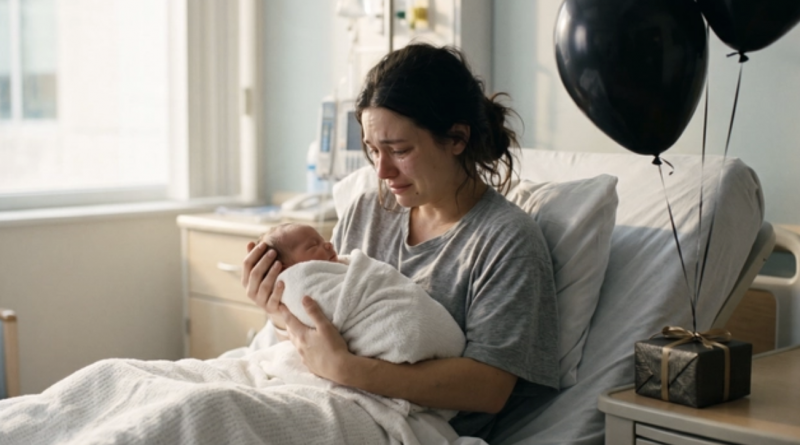
I was lying in my hospital bed, sore, exhausted, and functioning on maybe forty minutes of sleep. My daughter, Ivy, was sleeping in the bassinet beside me with one tiny fist tucked under her chin. She already had Steve’s mouth. That soft curve at the corners, like she was about to smile at a private joke.
I had cried several times whenever I looked at her.
Not because I wasn’t happy.
Because I was. But happiness with grief inside it feels sharp. Like the heart doesn’t know whether it is breaking or growing.
There was a knock on the door.
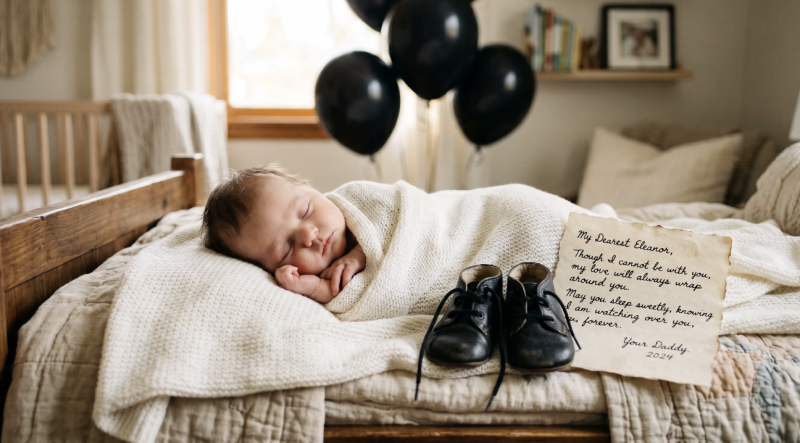
A nurse walked in carrying a set of black balloons.
I remember I actually frowned.
Black balloons in a maternity ward seemed wrong.
Attached to the strings was a small black gift box with a white envelope tied to the top.
"This was delivered for you," the nurse said.
My whole body tensed.
After everything with Eileen, my mind immediately went to dark places.
I pulled Ivy a little closer to my chest and stared at the balloons. They floated silently, shiny and black against the bright hospital walls.
I think the nurse noticed my expression because she added:
"Would you like me to take them away?"
I almost said yes. Then I noticed something.
The ribbon tied around the box was dark blue, not black.
And suddenly I heard Steve’s voice in my head from hundreds of random moments over the years.
"People always think black is sad. Black is elegant."
"Black goes with everything."
"If we have a daughter, I’m buying her black baby shoes."
It had been his favorite color since the day I met him.
My throat tightened.
"No," I whispered. "It’s okay."
The nurse placed everything on the small table beside the bed and left.
I stared at the box for a long time.
Then I carefully placed Ivy in the bassinet, picked up the envelope, and opened it.
"Shirley,"
"If you’re reading this, then two things are true."
"First, I’m sorry I’m not there."
"Second, our daughter arrived safely, and that means you made it too."
"Good. I was counting on you."
My vision blurred so quickly that I had to stop.
I recognized Steve’s handwriting immediately. Messy, but somehow confident, like the letters were in a hurry to get somewhere.
I sank back into the pillows and kept reading.
"Black balloons because you know I would never send anything in pastel colors for our daughter on principle."
"Also, because I wanted you to laugh at least once before you cried."
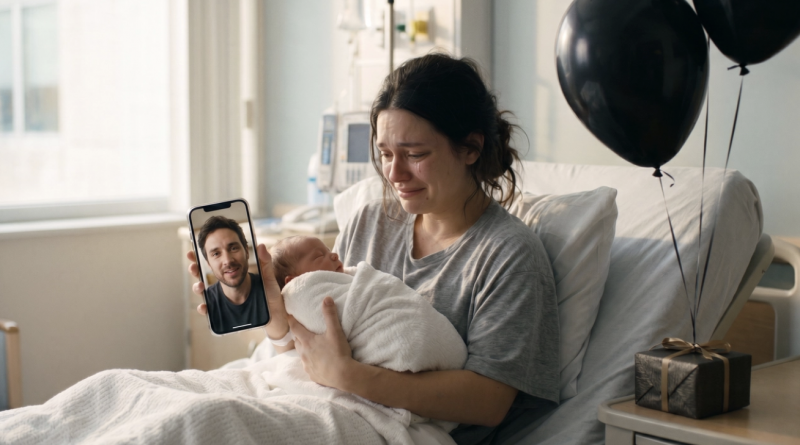
Too late, I thought, already crying hard.
There was more.
"Inside the box is everything I could think of that might help me stay present, even when I’m no longer here."
I set the letter aside with trembling hands and opened the box.
The first thing I saw was a tiny pair of black baby shoes.
I let out a horrible, broken sound and covered my mouth with my hand.
Under the shoes was a picture of Steve standing in the almost-finished nursery, holding a stuffed giraffe with a serious expression, like he was giving a press conference.
On the back, he had written:
"For Ivy’s room. Tell her I had excellent taste."
Below that was a flash drive with a label:
FOR IVY - BIRTHDAY VIDEOS: ONE THROUGH AGE 20
I just stared at it.
Then I pulled out a stack of envelopes, all marked in Steve’s handwriting.
"For Ivy at age 1."
"For Ivy at age 5."
"For Ivy at age 10."
"For Ivy at age 16."
"For Ivy at age 20."
Every year until she turned 20.
At the bottom of the box was a folder.
Inside were life insurance documents, investment papers, and a letter from his lawyer explaining that Steve had changed everything as soon as he understood how sick he was.
The house, the savings, the policies, everything was protected in my name and in a fund for Ivy.
I remember reading the first page and then laughing through my tears because, of course, he had done that.
Of course, while I was falling apart trying to keep him alive, he was quietly building a future for us anyway.
There was one last envelope at the bottom.
"For Shirley. Open last."
My hands were shaking so badly that I tore part of the edge when I opened it.
"My love,"
"I know you. So I know you are trying to survive all of this by being practical. You will make lists. You will drink water because I told you to. You will act stronger than you feel because now there is a baby, and you will think that means you don’t have permission to fall apart."
"You do."
I had to stop again because I could hear his voice so clearly.
I looked at Ivy sleeping in the bassinet and whispered:
"Your father was an incredible man."
Then I returned to the letter.
"You have permission to feel angry. You have permission to hate me a little for leaving, even though it wasn’t my choice. You also have permission to laugh again, and I need you to know that when it happens, it will not be a betrayal."
"Please don’t let grief turn our daughter into a monument. Let her be loud. Let her get dirty. Let her wear ridiculous clothes. Tell her I loved her before I ever met her. Tell her I talked to her when you were asleep. Tell her I cried in a hardware store buying crib screws because suddenly I realized I was going to be someone’s father."
By that moment, I was crying so hard I could barely see the page.
Then I reached the final part.
"And one more thing."
"My mother started speaking negatively about you in front of me the moment she realized how seriously ill I was. If she ever makes you feel like this was your fault, I need you to remember something very clearly:
You loved me well. Until the end."
"None of this is your fault."
I read that sentence three times.
Then I completely broke down.
I folded the letter and cried the way I wished I had cried in the hospital, at the funeral, and during every silent drive home since the diagnosis.
The kind of crying that empties you from the inside.
Later that afternoon, when the room was quiet and Ivy finally woke up to feed, I connected the flash drive to the hospital television.
The first file was labeled:
FOR IVY - IF YOU’RE WATCHING THIS, I MADE IT
Steve appeared on the screen, sitting in the chair in her room, wearing the gray sweater I always stole from him.
He looked thinner than I remembered, but his smile was exactly the same.
"Hi, little one," he said to the camera.
"If this worked, then I deserve a prize because technology and I have always had a complicated relationship."
I laughed and cried at the same time.
Then he said:
"I haven’t met you yet, at this moment when I’m sitting here. But I already love you enough to love you a lot."
I held Ivy against my chest and watched her father talk to her after the worst thing that had ever happened to us.
That was when I understood the true meaning of the black balloons.
They weren’t about grief.
They were about Steve.
His dark humor and his quiet love. His favorite color floating above the room where our daughter had just arrived without him.
His way of walking in anyway.
He worked so hard to keep loving us after he knew he was going to die.
And the most beautiful part is that he succeeded.
Ivy is three months old now.
There are still days when I cry in the shower. Nights when I reach for the other side of the bed before remembering. Moments when Eileen’s words come back and hurt more than I would like.
But Steve’s letter is on my nightstand. The black shoes are on Ivy’s shelf. The birthday videos are saved in three places because I know my husband, and if one of them got corrupted, he would personally haunt me.
And sometimes, when it rains, I take Ivy to the window and say:
"Your father loved watching raindrops fall."
Then I tell her about the morning we discovered she existed.
About how he laughed. About how he cried. About how he loved her before he ever got to hold her in his arms.
And about how, the day after she was born, he still found a way to be there.