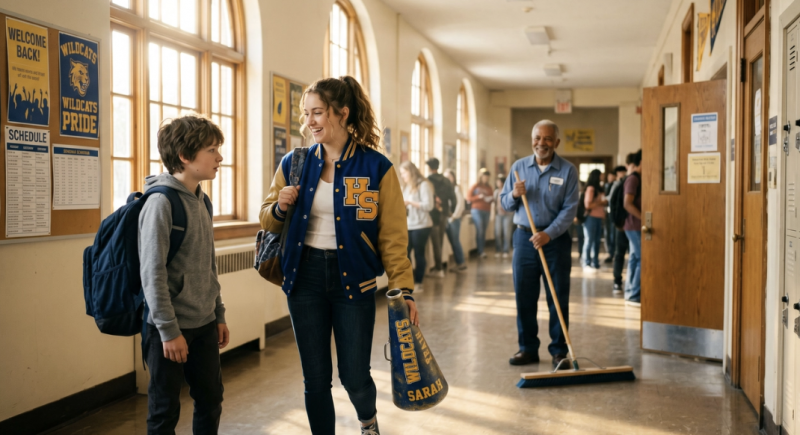
The Cheerleading Coach Said I 'Wasn't Quite the Image the Team Was Looking For' Because of My Weight.
Mrs. Christina watched me for less than two minutes before deciding that my body was “wrong” for her team. I walked away believing I had disappointed my late mother. Then the school custodian found me beside the trophy case, asked me to meet her before dawn, and promised I would understand why soon.
The tryout lasted one minute and 43 seconds.
I know this because the clock above the gym doors read 4:16 when Mrs. Christina called my number.
It read 4:18 when she lowered her clipboard.
The tryout lasted one minute and 43 seconds.
“That will be enough, Eva.”
The music was still coming from the speakers, cheerful and bright in a way that made the interruption feel worse.
I slowly lowered my arms.
Around the gym, 16 girls waited on the bleachers wearing matching shorts and white sneakers. Some had already performed. The others held numbered cards against their thighs.
“That will be enough, Eva.”
Mrs. Christina looked at the assistant coach and then turned her eyes back to me.
“You learned the routine quickly,” she said.
For a second, I thought that might be enough.
Then she gave me that practiced smile adults use when they want cruelty to sound reasonable.
“But you’re not exactly the image the team is looking for.”
I thought that might be enough.
She didn’t need to explain.
Her eyes had already done it.
They moved from my face to my body, then back to the clipboard.
I stood still beneath the gym lights, sweat cooling between my shoulder blades.
Her eyes had already done it.
“Is there another routine I can try?” I asked, holding my breath as I waited for her answer.
Mrs. Christina moved the pencil in her hand.
“This team represents the school at games, competitions, and community events. Presentation matters.”
A girl on the lower bleacher looked down at her shoes.
Another hid a smile by pretending to cough.
“Is there another routine I can try?”
Mrs. Christina’s voice stayed calm.
“You simply don’t fit, Eva.”
The word “fit” followed me out of the gym.
It stuck behind my teeth as I pushed open the double doors.
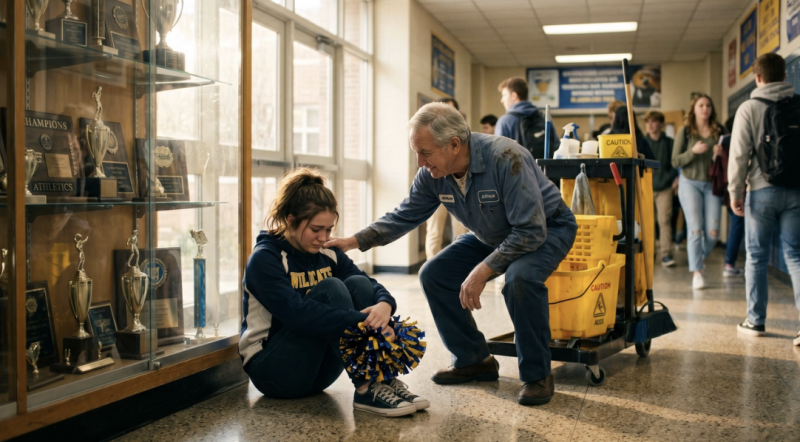
It sat beside me when I lowered myself onto the hallway floor near the trophy case.
The word “fit” followed me out of the gym.
I kept my face turned toward the glass.
Inside, old photographs showed cheerleaders from different decades arranged in organized rows. Blue skirts. Gold bows. White shoes positioned at identical angles.
My mother was in one of those photographs.
Second row.
Third from the left.
My mother was in one of those photographs.
Even through the faded film, she looked like the whole world had just told her a joke.
I spent weeks pretending I didn’t expect to make the team.
That wasn’t true.
I wanted one hour wearing the same colors my mother once wore.
One practice in the same gym.
One small thing grief hadn’t transformed into something unrecognizable.
That wasn’t true.
Instead, the coach looked at the body grief had left me with and decided it didn’t belong near my mother’s memory.
I wiped both cheeks with my palm before anyone walked through the doors.
Someone did anyway.
A mop bucket stopped beside me.
Mrs. Evelyn lowered herself onto the floor with the careful patience of someone whose knees had been arguing with her for years.
She didn’t ask why I was crying.
That was one of the reasons I trusted her.
For almost a minute, she just sat beside me, smoothing the front of her faded work shirt.
The gym doors opened.
Two girls walked out laughing and then lowered their voices when they saw us.
Mrs. Evelyn watched as they disappeared down the hallway.
“Did she say it clearly?” she asked.
I looked at the trophy case.
“Clearly enough.”
Mrs. Evelyn folded both hands over one knee.
“What did she say?”
“She said I wasn’t the image they wanted.”
“Did she say it clearly?”
I repeated the phrase.
Not exactly the image.
Saying it out loud made it sound smaller and uglier.
Mrs. Evelyn’s mouth tightened into a line.
Then she tapped the floor between us lightly, as if settling an argument with the building itself.
“Meet me behind the school tomorrow morning.”
Saying it out loud made it sound smaller and uglier.
I looked at her.
“What?”
“At six.”
“For what?”
She stood using the mop handle.
“No one can know.”
“For what?”
I almost laughed; Mrs. Evelyn was well over 70 years old and had never done anything mysterious in her life.
She labeled leftover cupcakes.
Carried peppermint candies in both pockets.
Corrected students who called the cafeteria workers “lunch ladies” because they all had names.
Even so, something in her face stopped me from making a joke.
Mrs. Evelyn was well over 70 years old.
“Six?” I repeated.
“Six.”
Then she pushed the bucket down the hallway without saying another word.
Grandpa knew something had happened before I even took off my coat.
He was sitting at the kitchen table fixing the clasp on an old fishing box. His glasses rested low on his nose, and a mug of hot chocolate waited for me on the other side of the table.
Grandpa knew something had happened.
He had already prepared.
He always seemed to hear sadness at the front door.
“How bad was it?” he asked.
I hung my coat on the wrong hook, fixed it, and then sat down.
“I didn’t make it.”
“How bad was it?”
Grandpa turned the small metal clasp between his fingers.
“Did you finish?”
“No.”
His eyes lifted.
That was all it took.
I looked at the mug. The steam was already beginning to disappear from the surface.
“Did you finish?”
“No,” I said. “Mrs. Christina said I wasn’t the image they wanted.”
The clasp clicked shut beneath Grandpa’s thumb.
He set the fishing box aside with more care than it deserved.
For a while, neither of us spoke.
Our house had gotten used to silence after the accident.
“At 14 years old, I lost my mother, my father, and my older brother on the same wet road.”
I survived because I had stayed home with the flu.
People called that luck.
For months, the word made me angry enough to leave rooms.
After the funeral, I moved into Grandpa’s house.
People called that luck.
I slept until afternoon.
Ate standing in the pantry so he wouldn’t watch me.
Stopped answering messages.
The medication helped me get out of bed, but it also changed my appetite. Grief did the rest.
It changed my appetite too.
By my sophomore year of high school, my old jeans no longer buttoned.
Classmates who hadn’t seen me since middle school stared half a second longer before pretending they hadn’t noticed.
Grandpa never commented on my weight.
He worried about other things.
Grandpa never commented on my weight.
The curtains still closed at noon.
Shoes untouched by the door.
The way I stopped humming while brushing my teeth.
One night, he slid a cheerleading application across the table.
“Your mother loved this team,” he said.
I had stopped humming while brushing my teeth.
I accused him of trying to fix me.
He shook his head.
“Sweetheart, I wouldn’t even know where to start.”
Then he touched the paper.
“I just thought maybe you wanted one hour that belonged to something besides the accident.”
I accused him of trying to fix me.
That was why Mrs. Christina’s words hurt.
I didn’t want applause.
I wanted closeness.
Grandpa pushed the hot chocolate closer.
“Your mother came home after every game exhausted.”
I wanted closeness.
I managed a small smile.
“She looked happy in the pictures.”
“Pictures don’t show blisters on your feet, Eva, sweetheart.”
He leaned back.
“One time she lost her voice for four days and still tried to order pizza by whispering.”
That made me laugh despite everything.
“She looked happy in the pictures.”
Grandpa watched the sound disappear from me.
Then he looked at the family photograph attached beside the refrigerator.
Mom wore her cheerleading uniform in it. Dad had one hand on her shoulder. My brother held a pom-pom above his head like a trophy.
I was a baby in Mom’s arms.
Mom wore her cheerleading uniform in it.
“She wasn’t memorable because of that uniform,” Grandpa said.
I looked at my mug.
“Everyone says she was captain, Grandpa.”
“She was.”
“So what made her memorable?”
Grandpa ran his thumb over the fishing box clasp.
“So what made her memorable?”
Before he could answer, the kitchen clock struck six.
The sound startled both of us.
He smiled.
“Maybe you should find out yourself, sweetheart.”
At 5:45 the next morning, I almost stayed in bed.
The sound startled both of us.
Rain tapped against the window, and the sky outside still hadn’t decided if it wanted to become morning.
Then I imagined Mrs. Christina lowering her clipboard.
I got dressed.
Grandpa was already awake.
He was at the stove making toast, wearing slippers and the old plaid robe he always denied owning whenever anyone visited.
Grandpa was already awake.
“Where are you going?” he asked.
“School.”
“At six?”
I grabbed my coat.
“Mrs. Evelyn asked me to meet her.”
Grandpa stopped spreading butter on the toast.
“Mrs. Evelyn?”
“Mrs. Evelyn asked me to meet her.”
“She said not to tell anyone.”
He thought about that.
“Technically, you already failed.”
“You’re my emergency contact, Grandpa.”
“Fair point!”
“She said not to tell anyone.”
He wrapped the toast in a paper towel and handed it to me.
“For courage.”
“It’s burned.”
“For texture.”
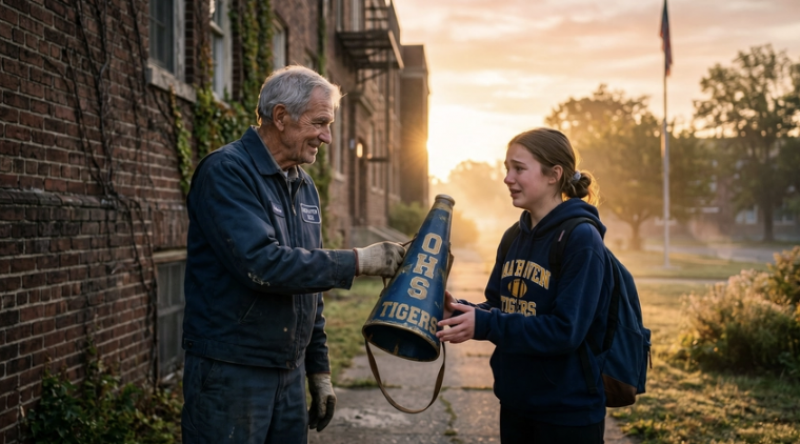
Mrs. Evelyn waited behind the school near the loading area.
Her canvas bag sat on the bench beside her. Two paper cups were at her feet.
Mrs. Evelyn waited behind the school near the loading area.
She wore the same work coat she’d had since I was in elementary school, with shiny sleeves at the elbows.
“I was starting to think I’d have to drink both coffees,” she said.
“I don’t drink coffee.”
“Then I was starting to think I’d have to drink one coffee and one hot chocolate.”
She handed me the right cup.
Only then did she open the canvas bag.
She handed me the right cup.
I expected a stack of old photographs.
Maybe one of Mom wearing the uniform.
Instead, Mrs. Evelyn pulled out an old blue and gold megaphone.
The paint had chipped around the edge. One side was dented inward, and the white cord attached to the handle had yellowed with age.
I expected a stack of old photographs.
She placed the object in my hands.
The weight surprised me.
“What is this?”
Mrs. Evelyn pointed to the handle.
“Look inside.”
I turned the megaphone over.
“Look inside.”
Three initials were written beneath the bracket in faded black ink.
L.M.H.
My mother’s initials.
My thumb stopped over the H.
“How do you have this?”
My thumb stopped over the H.
“Your mother forgot it on graduation day.”
“You kept this for twenty years?”
Mrs. Evelyn smiled.
“I did.”
“Because she was captain?”
“No, Eva.”
“You kept this for twenty years?”
She placed a wrinkled hand over the chipped blue paint.
“I kept it because your mother was the kindest student who ever walked through those doors.”
I looked at the initials again.
Every story I knew about Mom started with cheerleading.
Mrs. Evelyn shook her head as if she could hear the list forming.
“No one remembers the routines,” she said. “But I remember exactly how your mother made people feel.”
Then she sat beside me and began with a Tuesday no one else had bothered to remember.
She could hear the list forming.
Mrs. Evelyn told me about a freshman who ate lunch alone for three weeks because she spoke almost no English.
My mother noticed her on a Tuesday.
She carried her plate to the girl’s table, sat down, and started pointing at the food until both of them began laughing.
By Friday, half the cheerleading team had joined them.
My mother noticed her on a Tuesday.
Another winter, the team raised money for new warm-up jackets. My mother convinced everyone to buy jackets for students who needed them instead.
“She knew the name of every custodian,” Mrs. Evelyn said. “Every cafeteria worker too.”
I ran my fingers over the dented part of the megaphone.
“Why are you telling me this?”
“She knew the name of every custodian.”
“Because yesterday you tried to become your mother’s uniform, sweetheart.”
Mrs. Evelyn placed both hands over mine.
“I think she would rather you become her heart.”
Before I left, she gave me a challenge.
“Help three people nobody else notices.”
“I think she would rather you become her heart.”
That morning, I found a freshman trying to read classroom numbers backward.
At lunch, I helped a boy pick up papers after his binder broke open.
After school, I carried a box for the cafeteria manager, whose back was beginning to hurt.
None of it felt important.
That was the point.
None of it felt important.
For the next week, I kept paying attention.
A transfer student standing alone near the buses.
The librarian organizing donated books without help.
The more I looked, the more the lonely places seemed full.
For the next week, I kept paying attention.
Teachers started asking me to welcome new students.
Grandpa noticed I was humming again while washing dishes.
Then Mrs. Christina stopped me outside the classroom.
“I’ve heard good things about you,” she said.
I was humming again while washing dishes.
Her clipboard was pressed against her chest.
“I judged you too quickly, Eva. If you want to try out again, I can arrange one.”
I looked at the old megaphone beneath my arm.
“Thank you.”
She waited.
“But I think I already found the part of cheerleading my mother wanted me to inherit.”
“I judged you too quickly, Eva.”
That night, I cleaned the megaphone in Grandpa’s garage.
When I loosened the handle, a folded yellow note fell to the floor.
Mom’s handwriting covered five words.
“Find who is alone first.”
A folded yellow note fell to the floor.
The next morning, a sixth-grade girl stood outside the school doors, taking one step forward and then stopping.
I walked over to her.
“First day?”
She nodded. Her eyes went to the worn megaphone.
“Are you a cheerleader?”
I looked at Mom’s note safely tucked inside the handle.
“Something like that.”
“Are you a cheerleader?”
We walked inside together.
In the hallway, Mrs. Evelyn watched beside her cleaning cart. She smiled once and then went back to work.
The insecurity had disappeared long ago.
My invisible days were over... because now I knew exactly who to look for first.
My invisible days were over.