The Flight of Dignity: A Journey from Grief to Courage
They called me a “bum,” mocked me in front of the entire cabin, and treated me like garbage in business class. But when the plane landed, those same people who had laughed… stood up to applaud me.
I’m 73 years old, and my hands tremble as I write this. Three years ago, my daughter Claire passed away. She was my only child. If you’ve ever buried a child, you know there’s no such thing as “moving on.” People say time heals, but every morning still feels like I’ve been hit by a truck. That day, I stopped living.
I stopped going out. I didn’t answer calls. My son-in-law, Mark, did everything he could. He’d come to my door, knock until I opened, and try to encourage me to reconnect with the world.
One night, sitting across from me at the kitchen table, he spoke gently:
“Robert, come to Charlotte. It’ll do you good.”
“I don’t belong anywhere anymore,” I mumbled.
He leaned forward.
“Yes, you do. With your family. Please.”
I wanted to say no. I wanted to stay in my little dark cave where memories were all I had left. But the look in his eyes—tired, hopeful, desperate—broke me. Against everything in me, I said yes.
That’s how, two weeks later, I found myself staring at a plane ticket for the first time in decades. Just holding it made my stomach churn. Airports, crowds, strangers… it felt like walking straight into a storm without an umbrella.
The morning of the flight, I made an effort. I wore the best I had—a dark jacket Claire gave me for Father’s Day. I even shaved.
“For you, sweetheart,” I whispered. “For you… and for Mark.”
But fate had other plans.

On the way to the airport, I took a side street downtown. That’s when I was stopped—by a group of loud, cocky young men.
“Hey, old man,” one said mockingly, stepping in front of me. “Where you headed all dressed up?”
Before I could answer, another shoved me hard against a wall. My shoulder popped. They ripped off my jacket, tearing the sleeve, and took the few bills I had in my wallet.
“Please… that’s all I have,” I managed to say.
The tallest one laughed in my face.
“This old guy already looks like a homeless bum. No one’s gonna care.”
Their laughter echoed even after they left. They left me bruised, with a split lip, and no wallet.
When I entered the airport, my jacket hung in tatters. People stared, some stepped aside, others whispered. To them, I was just a vagrant who had wandered in.
I walked toward security with my head down, burning with shame. Claire’s jacket—her last gift—was ruined.
I thought once I reached the gate, things would settle down. I just wanted to sit, wait, and get it over with.
I was wrong.
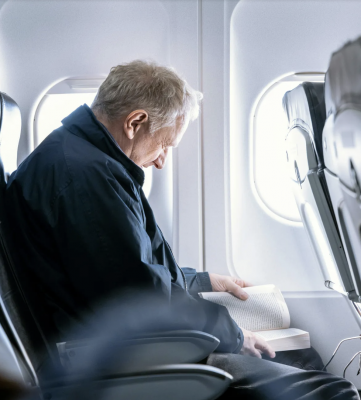
When they called business class passengers, I clutched the ticket Mark had bought for me. I’d never flown like this in my life. My palms were sweating as I stepped onto the carpeted jet bridge, feeling like I was sneaking into a place I didn’t belong.
I entered the cabin.
Silence.
Dozens of heads turned at once. Conversations died. You could feel the judgment in the air. I knew, in that moment, the flight would be worse than I feared.
I looked exactly how they imagined: torn jacket, no luggage, grief carved into my face. The woman in seat 2B clutched her purse tighter as I passed, knuckles white.
A man in 4C muttered loudly enough for all to hear:
“Do they even screen people before letting them in here?”
The laughter that followed was quick, sharp—like knives. And then there was the man in 3A.
Impeccable navy suit, Rolex flashing under the lights, hair slicked back like a model. He looked at me with pure contempt as I neared my seat.
“Hey,” he snapped his fingers at me like I was a waiter. “You lost, buddy? Economy’s that way.”
My throat went dry.
“No. This is my seat.”
He laughed out loud.
“Sure. And I’m the Pope.”
I showed him my ticket with trembling hands. It only made him smirk more.
“Excuse me,” he called to the flight attendant, “can you explain why someone who looks like he crawled out of a dumpster is sitting in business class?”
She checked the ticket, her face turning red, and said softly,
“Sir, he’s in the correct seat.”
He scoffed loudly:
“Unbelievable. I pay thousands for this seat and this is what I get? What’s next, stray dogs?”
Some laughed. Not all. But enough. My face burned. I sat in silence, wishing I could disappear.
The flight attendant brought him champagne. He raised his glass with a mocking smile and muttered just loud enough:
“Maybe you could bring my neighbor a shower and a sandwich.”
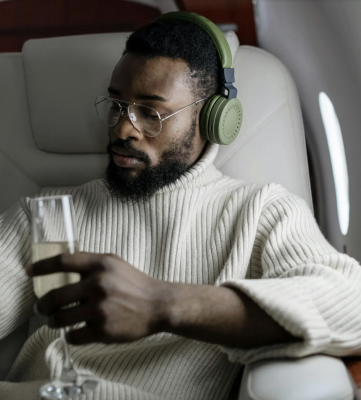
Snickers followed. Some looked at me with pity. Most didn’t look at all. To them, I was a mistake.
I turned toward the window. Claire loved clouds. As a child, she used to say they looked like cotton candy.
I clung to that memory like a shield. It was the only thing keeping me from breaking.
Hours passed. I didn’t eat. I didn’t drink. I just waited. Every cruel laugh, every sideways glance, every whisper… weighed like a stone.
When the wheels touched the ground, I felt relief. I thought I could slip away unnoticed. Disappear. Never fly again.
But then the captain’s voice came over the intercom:
“Ladies and gentlemen,” he said warmly, “this is your captain…”
Something in his voice hit me in the chest. I knew it. Painfully well.
“Before we disembark, I want to say something. Today, one of our passengers reminded me what real strength and dignity look like.”
The cabin shifted. Eyes darted around.
“You may have judged him. You may have laughed. But that man… is my father-in-law.”
My heart stopped. Mark.
The entire cabin turned to look at me. Pale faces. Shock.
“I lost my wife—his daughter—three years ago,” Mark continued, his voice trembling. “I was an orphan, and Robert here became the father I never had. He’s the reason I keep going. The reason I fly. You saw a broken man. I see the man who saved me.”
Utter silence. Someone sniffled. Another sighed. The Rolex man in 3A looked like he wanted to crawl under his seat.
“Before you leave this plane,” Mark concluded, “remember: you sat next to the bravest man I know. And if first class means anything, it should start with decency. Some of you forgot that today.”
Applause erupted. At first soft, then rising, filling the cabin. People stood. They clapped. Some cried.
I just sat there, stunned. My chest full, my face soaked… but for the first time in three years, I didn’t feel invisible.
Through the applause, the man with the Rolex leaned toward me. Pale.
“Sir… I didn’t know.”
I looked him in the eye and replied, calmly:
“You didn’t want to know.”