
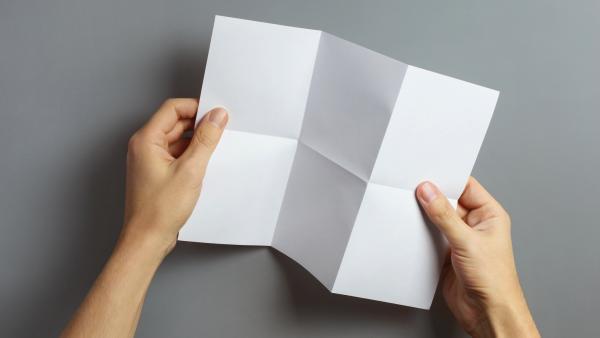
The myth of folding paper: Why you can't fold A4 paper more than eight times
The idea that you can’t fold a piece of A4 paper more than eight times is a piece of trivia that has intrigued many for years.
It's often mentioned in casual conversations or used as a fun challenge, but the story behind this belief is much more interesting than it first appears.

When you fold a piece of paper, its thickness doubles each time. As you continue folding, the paper gets thicker and harder to manipulate.
For example, a typical A4 sheet of paper starts at a thickness of about 0.1mm, and after one fold, it’s 0.2mm thick. With each subsequent fold, the thickness increases, and the force needed to make the fold grows as well.
As the paper gets thicker, the challenge of making further folds becomes exponentially harder. Essentially, the size and thickness of the paper are working against you, making it increasingly difficult to fold it beyond a certain point.
The real reason behind the supposed eight-fold limit lies in the physics of folding. With each fold, the area of the paper that can be folded decreases, while the thickness increases rapidly.
This means that after several folds, the paper becomes too thick and too small to continue folding. Paper has a limited capacity to stretch and bend, and this is what restricts how many times you can fold it.
In 2002, however, a high school student named Brittany Gallivan proved that the eight-fold rule wasn’t as fixed as it seemed. She set out to fold a much larger piece of paper than the standard A4 sheet and was able to fold it 12 times.
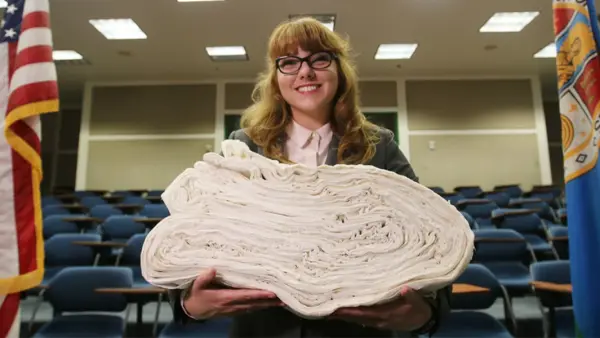
Her success showed that with a larger sheet of paper, the physical limitations become less of a factor. She demonstrated that the real obstacle wasn’t an inherent limit to the number of folds, but rather the size of the paper you’re using.
Gallivan’s experiment involved using a very large roll of toilet paper, and she found that the length of the paper needed for each fold could be calculated with a formula.
The formula she developed takes into account the thickness of the paper, the number of folds, and the size of the sheet. This formula proved that by adjusting the dimensions of the paper, you could push past the seemingly unbreakable eight-fold barrier.
This discovery highlights an interesting point: the size of the paper plays a critical role in how many folds you can achieve. A standard A4 sheet simply doesn’t have enough area to withstand more than a few folds.
But with a much larger sheet, there’s more room to fold, and the resistance caused by the increasing thickness is manageable. It was this insight that allowed Gallivan to fold the paper more than the previously thought possible.
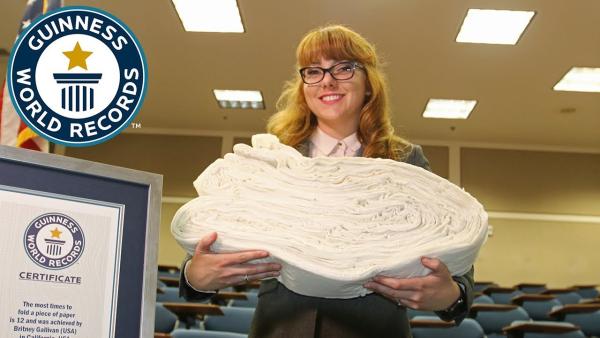
The fascination with folding paper stems from the blend of simplicity and complexity in this task. What seems like a trivial act is actually a demonstration of exponential growth and the constraints of materials.
The process of folding paper challenges our understanding of physical limits and reminds us that the most basic objects, like a simple sheet of paper, can lead to remarkable discoveries.
It also shows that sometimes, all it takes to break a so-called limit is a fresh perspective — or in Gallivan’s case, a larger piece of paper.
The myth that you can’t fold A4 paper more than eight times is a great starting point for exploring physics and problem-solving.

While it might seem like a small, everyday challenge, it serves as a reminder that there are often deeper, more fascinating factors at play in even the most mundane activities.
By pushing the boundaries of what we think is possible, we can discover new ways to think about the materials and forces around us. So next time you fold a piece of paper, consider that the limits we assume might just be waiting for someone to challenge them.


