The Night Silence Fell: A Child's Trust, A Family's Reckoning
When my husband’s best friend, Brian, came over for what was supposed to be a casual family dinner, I never imagined that night would change our lives forever. But after that evening, our daughter stopped speaking—and as the silence stretched on, we uncovered a devastating betrayal that shattered her innocence.
I still don’t know how to make sense of it all. Maybe writing it down will help me understand. Maybe someone out there will read this and tell me I’m not crazy for feeling the way I do.

It all began with a simple dinner. Tom’s best friend, Brian, was coming over—just like so many times before. He and Tom had been inseparable since high school, practically like brothers.
Brian was part of everything—big events and small, ordinary days. If something broke, he’d show up with his toolbox. If we had a barbecue, he’d arrive with a cooler and a big grin. He wasn’t just a friend. He was family.
Emily, our daughter, adored him. She would run to the door every time he came, nearly bursting with excitement. “Brian! Brian!” she’d shout, wrapping her little arms around his legs, her big eyes shining. He’d always laugh and scoop her up.
“Hey, kiddo,” he’d say with a smile, giving her a playful pat on the head. “How’s my favorite girl?”
That night seemed no different—pizza, laughter, easy conversation. Tom was running late from work, so I asked Brian to pick up the food. He arrived with his usual smile, holding two boxes of pizza in one hand and a small gift bag in the other.
“Look what Uncle Brian brought you,” he said, handing the bag to Emily. Inside was a little stuffed puppy. Her eyes lit up.
“Thank you!” she squealed, hugging the toy. “I love it!”

Brian laughed and ruffled her hair. “I thought you might, little one.”
We sat down to eat, chatting about nothing in particular. Brian made his usual jokes, keeping everyone laughing. Emily was glued to his side, asking him question after question.
“Why do dogs have tails?”
“To wag when they’re happy,” he said with a grin.
“Why don’t cats have big tails like dogs?”
“Oh, because cats are sneaky. They don’t need them as much,” he answered, making Emily giggle.
As we were finishing up, I realized we were out of drinks. Tom still hadn’t arrived, so I turned to Brian.
“Would you mind staying with Emily while I run to the store real quick?”
Brian shrugged and waved a hand. “Of course not. Go ahead, we’re fine here.”
“Thanks. I’ll be back in ten minutes,” I said, grabbing my keys. I trusted Brian. He was family.
But when I returned, something felt off. Brian was standing by the door with a strange look on his face—not his usual self. He looked tense, almost nervous. He barely met my eyes as he grabbed his coat.
“Everything okay?” I asked, frowning.
“Yeah, yeah,” he said quickly, avoiding my gaze. “Just… something came up. I have to go. Tell Tom I’ll catch him later.”
And just like that, he was gone—barely a goodbye. A weird chill ran down my spine, but I brushed it off. It was Brian. He’d never given me a reason not to trust him.
But everything changed after that night.
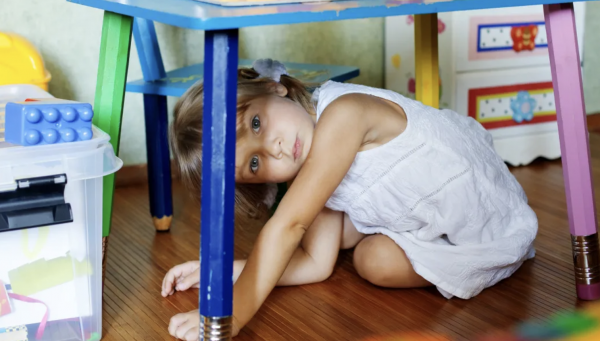
Emily, once so bright and talkative, went silent.
At first, I didn’t think much of it. Kids have bad days. Maybe she was tired or upset that Brian had left so suddenly. But the next day, she still wasn’t talking.

She went through breakfast without a word—didn’t even look up when I put her favorite waffles on the table. I tried reading to her, asking questions, anything to draw her out. But she just shrugged or looked down, tracing circles on her plate with her finger.
“Emily, sweetheart,” I asked gently, “are you upset about something? Did something happen with Brian?”
She just looked at me—those big, sad eyes filling with tears—then shook her head and walked to her room.
Tom tried too.
“Hey, Em, you know you can tell Daddy anything, right?” he said, kneeling beside her.
She nodded but said nothing, clutching the stuffed puppy Brian had given her like it was the only thing holding her together.
I tried to believe it was just a phase, a delayed reaction to a bad dream or something. But a mother knows when something is really wrong.
By the third day, I was sure—it wasn’t a phase. It broke my heart to see my once-lively daughter so withdrawn. She didn’t want to go to the park. Didn’t want to color or play. When she did speak, it was in short, stiff words: “yes,” “no,” “fine,” like she was afraid to say more.
Tom and I began to fear the worst. We took her to the pediatrician, who ran every test—hearing, vision, neurological. Everything came back normal. Then we tried a child therapist. After several sessions, even they admitted they couldn’t explain her sudden silence.
Weeks turned into months. Emily still went through her routines, but the light in her had dimmed. She only spoke when absolutely necessary. We tried every gentle approach we could, but it was like she had shut herself away in a place we couldn’t reach. Our home was quiet in a way that felt heavy—like grief hanging in the air.
Then, one morning—five long months later—Emily broke the silence.
I was buckling her into her car seat on the way to school when she looked at me with wide, frightened eyes.
“Are you going to leave me there forever?” she whispered.
Her words hit me like a punch to the chest.
“What? Emily, why would you say that?” I asked, my voice trembling.

Her lower lip quivered.
“Brian said… said I’m not really yours. That you’re going to leave me like my real parents did.”
My heart shattered. I felt the blood drain from my face as I fought back tears. Tom and I had always planned to tell Emily she was adopted—but when she was old enough to understand, in a safe, loving way.
“Emily, listen to me,” I said, trying to keep my voice steady. “You are our daughter. We love you more than anything in the world. Brian was wrong to say those things. We would never leave you. Never.”
She looked into my eyes, searching for something to hold onto, then slowly nodded. Her shoulders relaxed just a little, but I could still see the doubt.
That night, I told Tom everything. He was furious—beyond words—but more than anything, we focused on helping Emily heal.
After that, she started to speak again—slowly, cautiously. But the fear still lingered. I tried reaching out to Brian, but he never answered. My calls, my messages—nothing. It was like he had vanished. Tom wanted to confront him, but we didn’t even know where he was anymore.
Then one night, out of nowhere, I got a message.
“Can we meet? I need to explain something.”
Against Tom’s advice, I said yes. I needed answers.
When I saw Brian, he looked like a ghost of himself—tired, thinner, haunted.
“I’m sorry,” he whispered as we sat down. “I never meant to hurt her… or you.”
“Then why, Brian?” I asked, months of anger and confusion rising in my voice. “Why would you say that to her?”

He took a shaky breath.
“That day, before I came over… I found out I was adopted. My parents never told me. I went my whole life believing they were my biological parents. And then, just like that—I find out they’re not. It broke me.”
I stared at him, stunned.
“So you decided to hurt Emily? To dump that burden on a little girl?”
His face twisted in pain.
“I wasn’t thinking clearly. She was so innocent, so trusting. I don’t know why I said it. I was lost in my own pain. I thought maybe… maybe she should know the truth before it was too late.”
I shook my head, unable to meet his eyes.
“She’s seven years old, Brian. Just a child. That was our truth to tell her. Not yours.”
“I know,” he whispered. “I’ve been punishing myself every day since. I don’t expect you to forgive me. I just… needed you to know. I’m sorry.”
I left that meeting with a hollow ache I couldn’t shake. Brian wasn’t evil. He was broken. And his pain had destroyed the innocent trust our daughter had in the world. But that didn’t change what we had to do next—heal.

We haven’t heard from Brian since. Emily is doing better, slowly. But there’s still a part of her that hesitates, that asks questions, that wonders.
And I wonder too—how long it takes to rebuild what was broken in just one careless moment.