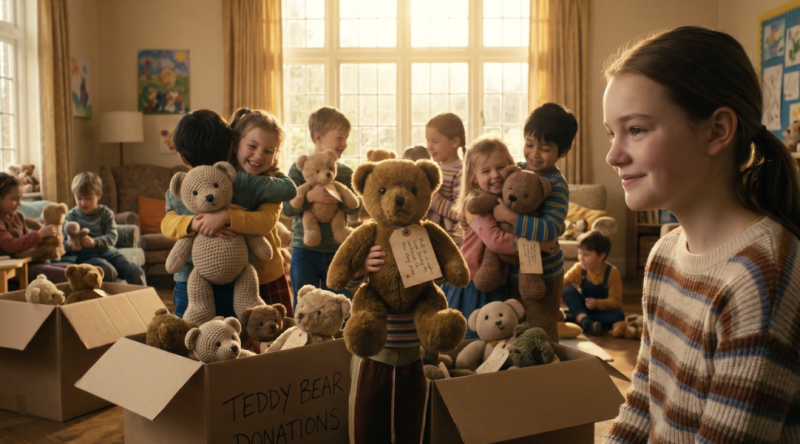
A 14-year-old girl made 50 teddy bears to donate to a children’s home, but her stepmother threw them away, insisting the house wasn’t a shelter. The grandmother later stepped in to address the situation.
My granddaughter, 14 years old, spent weeks sewing 50 stuffed teddy bears for children in an orphanage. Her stepmother threw them all away, saying: “this is not a shelter.” Then I invited everyone for dinner. I had planned every detail silently, alone. When Clarissa saw what covered my table, she screamed.
Richard almost dropped the apple pie.
Emily grabbed my hand so tightly that my fingers hurt.
I remained exactly where I was.
Clarissa stood frozen at the door, looking at the dining room as if she had seen a ghost.
Clarissa stood frozen at the door.
“This is…” she whispered. “This is impossible.”
No one responded.
Not yet.
Because whatever she thought she was seeing, she was wrong.
24 hours earlier, my granddaughter entered my sewing room with a measuring tape around her neck and a teddy bear held proudly against her chest.
“Grandma,” she said, smiling, “number 50.”
Whatever she thought she was seeing, she was wrong.
The teddy bear’s ears were slightly tilted to one side. One arm was a little shorter than the other. The small green ribbon under its chin wasn’t perfectly straight.
But it was perfect.
I hugged her before I even looked properly.
“My sweet girl,” I whispered. “You really did it.”
I hugged her before I even looked properly.
When Emily first asked for my help, she carried a notebook full of small drawings.
“I watched videos,” she said excitedly. “The kids in the orphanage don’t always have something that is just theirs. I thought… maybe each child could have a teddy bear.”
Her mother had taught her that kindness rarely needed explanation.
Before cancer took my daughter-in-law too soon, Saturdays belonged to the two of them.
Kindness rarely needed explanation.
They volunteered at animal shelters, sewed blankets for homeless families, and prepared birthday bags for foster children.
Her favorite phrase was one Emily never forgot:
“Kindness doesn’t need to be loud to be remembered.”
After she died, Emily quietly made those words part of herself.
“Kindness doesn’t need to be loud to be remembered.”
Every Saturday, my dining room disappeared under fabric, thread, stuffing, and small button eyes.
Sometimes we sewed in silence.
Sometimes Emily told me about the boy she tutored after school because reading still frightened him.
Or about the lonely widowed neighbor whose trash bins she quietly brought back to the curb every Thursday without anyone asking.
Sometimes we sewed in silence.
She never mentioned these things for praise.
To Emily, helping simply felt normal.
Clarissa never understood that.
The first time she saw a row of teddy bears on Emily’s bed, she crossed her arms.
“And exactly what is this supposed to solve?”
“They are for the orphanage,” Emily replied. I was there, sorting the first batch by height.
Clarissa laughed.
“That’s cute.”
The word landed like an insult.
“But maybe it would be better to spend that effort on something that actually helps your future.”
The word landed like an insult.
Emily looked down.
“It is helping someone else’s future.”
Clarissa just shrugged.
Another afternoon, she picked up a finished teddy bear with two fingers.
“You know universities don’t give scholarships for stuffed animals.”
“It is helping someone else’s future.”
Emily smiled politely.
“It’s not about college.”
“No,” Clarissa replied. “That’s exactly the problem.”
“Clarissa, she is doing something good,” I said. “Let her be.”
Clarissa frowned. “You’re spoiling her too much.”
“That’s exactly the problem.”
I watched my granddaughter thread another needle without saying anything else.
She had become very good at protecting her peace.
That worried me.
Children shouldn’t have to become experts at ignoring people they live with.
That worried me.
On the afternoon we finished teddy bear number 50, Emily lined them all up across my dining room table.
She counted them.
“I hope they make someone feel brave,” she said softly.
“Let’s take them tomorrow, dear.”
She nodded, her smile almost shy.
“I hope they make someone feel brave.”
That night she texted me.
Emily: “Do you think they will really like them, Grandma?”
I replied immediately.
“My sweet girl… they are already loved. That is enough.”
The next morning my phone rang before eight.
I knew something was wrong before Emily even spoke.
“Grandma…”
“What happened, dear?”
“The teddy bears…” She couldn’t finish. “They’re gone.”
I grabbed my keys without asking anything else and rushed out.
When I arrived at Richard’s house, Emily was sitting on the front steps holding the first teddy bear she had made.
It was the only one Clarissa hadn’t thrown away.
“They’re gone.”
Emily wasn’t crying.
Somehow, that hurt even more.
Clarissa opened the door before I could knock.
“My house is not a shelter,” she said calmly when I confronted her.
Behind her, Emily’s shelves were empty.
The storage boxes were gone.
“My house is not a shelter.”
“It was time someone learned that,” Clarissa added.
I looked past her at the empty room. Then back at Clarissa.
I smiled.
“You’re right.”
She looked satisfied when I added: “It really is time someone learned a lesson.”
That was all I said.
I didn’t argue.
I didn’t ask where she had taken the teddy bears.
The torn garbage bag on the curb, with bits of stuffing stuck to it, had already answered that question.
I simply took Emily to the car.
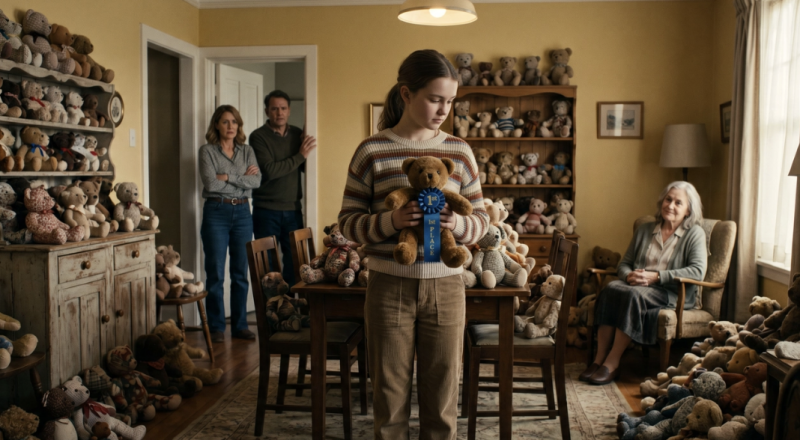
On the way home, she looked out the window, holding the blue-ribbon teddy bear.
“I should have kept them at your house, Grandma.”
“No.”
“I was foolish.”
“No, dear.”
A long silence.
Then she whispered something that froze me inside.
“Maybe Clarissa is right.”
I looked at her.
“About what?”
She swallowed hard.
“Maybe small things don’t really matter.”
That was the real damage.
Not 50 stuffed bears.
But a 14-year-old girl beginning to doubt the kindness her late mother had left her.
“Maybe small things don’t really matter.”
When we got home, Emily went to the sewing room and stood quietly by the window.
The blue-ribbon teddy bear sat in her lap.
I made tea she didn’t touch.
Then I went into the kitchen and called exactly one person.
Betty.
Our retired librarian.
I said only the truth.
“Clarissa threw away Emily’s teddy bears.”
Betty stayed silent for several seconds.
Then she asked: “All of them?”
“All.”
“And they were for the orphanage?”
“Tomorrow.”
Another pause.
Then Betty said softly: “Bonnie… leave this with me.”
“I wasn’t asking for a replacement, Bets.”
“I know.”
She hung up.
By mid-afternoon someone knocked on the door.
Betty was there holding a single handmade teddy bear.
Its fur was faded red corduroy.
A small stitched pocket decorated its chest.
A handwritten tag hung from one arm.
She placed it gently on the hallway table.
“My sister made this after her husband died,” she said. “She always believed grief needed a soft place to rest.”
Before leaving, Betty squeezed my hand.
“I made a call.”
I frowned.
“To whom?”
She smiled.
“Someone who remembered Emily.”
By sunset, another knock came.
Then another.
Kindness had started making its own calls.
Within an hour, another teddy bear appeared on my porch.
Then two more.
By evening, I had stopped trying to guess who would come next.
A retired teacher brought one made from worn denim.
The pharmacist brought another her mother had made years ago.
Someone from the church sewing group left two teddy bears on the porch with a note saying:
“Emily stayed after the fundraiser event to help us pack boxes. We never forgot.”
No one asked for recognition.
They simply placed a teddy bear in my hands, smiled, and left quietly.
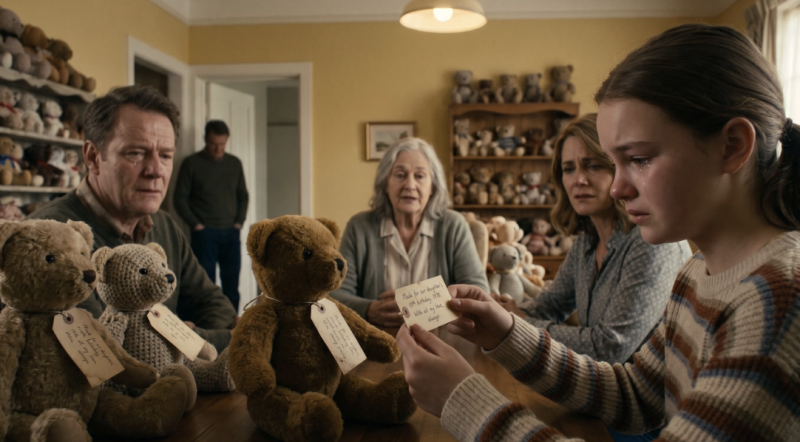
That night, the dining table was already starting to disappear under small stuffed faces.
She picked up the closest one.
It said: “Thank you for reading with my grandson every Tuesday after school.”
Emily frowned.
“I forgot about that.”
“I don’t think they forgot, dear.”
She picked up another.
“Thank you for visiting Rusty at the shelter every Saturday. He waited for you.”
Emily smiled through tears.
“Rusty…”
“The old golden retriever?”
She nodded.
“He was afraid of everyone.”
“But not of you.”
She picked up another tag.
“My husband spoke about the birthday card Emily brought for weeks.”
Her fingers trembled.
“I didn’t know anyone remembered.”
I placed my hand over hers.
“Dear…”
“Yes?”
“Kindness leaves footprints.”
She looked around.
“I thought they disappeared.”
“No.”
“They just keep walking.”
That night, I called Richard.
“I want all of you here for dinner.”
He hesitated.
“Is Emily there, Mom? Clarissa said she was upset and left with you.”
“She is.”
Another pause.
“Alright, we’ll come.”
By six o’clock, nearly 200 teddy bears covered the room.
Every chair except four.
Every windowsill.
Every shelf.
The table was almost gone beneath them.
Each one with its own handwritten story.
The doorbell rang.
Emily stood beside me.
She held only one teddy bear.
The blue-ribbon one.
Richard entered carrying apple pie.
Clarissa followed him.
She smiled politely… until she looked at the dining room.
And screamed.
Richard almost dropped the pie.
Emily instinctively held my hand.
Clarissa stared without blinking.
“This is impossible.”
I said nothing.
Not yet.
She slowly walked toward the room entrance.
“So… you found them?”
“No.”
“These are not Emily’s teddy bears.”
Confusion crossed her face.
“Then whose are they?”
“Sit down, Clarissa.”
For the first time she obeyed.
“These are not Emily’s teddy bears.”
Everyone sat as hundreds of teddy bears watched in silence.
Richard looked stunned.
“Mom… what is all this?”
I picked up the nearest teddy bear.
“This was made by a retired firefighter after his wife died.”
I placed it back.
I picked up another.
“This was from a kindergarten teacher who made one teddy bear every Christmas for foster children.”
Another.
“This came from a woman who said sewing helped her remember her granddaughter.”
I wasn’t telling stories about teddy bears.
I was telling stories about people.
Clarissa picked up one of the tags.
She read it.
Then another.
Then another.
“I know these names,” she murmured.
She looked around.
“Mrs. Greene… the pharmacist… Coach Ellis… the crossing guard…”
“They all live here.”
“Yes.”
She went quiet.
No one had been invited.
And yet… everyone had come.
She slowly walked through the room, reading tag after tag.
Each name belonged to someone she had known for years.
People she smiled at in the supermarket.
People she greeted at church.
She stopped beside Emily.
“I thought…” her voice broke. “I thought these were just toys.”
Emily looked down at the blue-ribbon teddy bear in her lap.
“They never were.”
Clarissa nodded slowly.
“I thought these were just toys.”
No one rushed dinner that night.
We laughed at memories tied to the tags.
Each teddy bear carried someone’s kindness.
Each story somehow led back to Emily.
The next day, we went to the orphanage.
Not with 50 teddy bears.
With more than 200.
The children entered the activity room as soon as the boxes were opened.
A girl hugged a patchwork bear before anyone could say she could keep it.
A boy immediately tucked his under his arm and declared they would be best friends forever.
Emily watched in silence.
Then she laughed.
It was the same laugh she had before Clarissa ever doubted her.
On the way back, I stopped at Richard’s house.
Emily went into the room carrying the blue-ribbon teddy bear.
She held it over the donation box for a moment.
Then she smiled.
“No. Some companions stay home.”
She placed it carefully back on the shelf.
“Some companions stay home.”