
A Stranger Took a Picture of Me and My Daughter on the Subway – The Following Day, He Came to My Door and Told Me to 'Pack My Daughter’s Belongings'
Being a single dad wasn’t my dream. But it was the only thing left after everything in my life seemed meaningless, and I was going to fight for it, if necessary.
I work two jobs to keep a cramped apartment that always smells like someone else’s food. I scrub. I clean. I open the windows. But still, the smell of curry, onions, or burnt toast won’t go away.
Most nights, everything feels like it’s hanging by a thread.
During the day, I ride a garbage truck or get stuck in muddy holes with the city’s sanitation crew.
Broken pipes, overflowing containers, burst tubes, we handle it all.
At night, I clean quiet offices downtown, that smell of lemon disinfectant and the success of other people, pushing a broom while screen savers dance on huge empty monitor screens.
The money shows up, stays for a day, then disappears again.
But my six-year-old daughter, Lily, makes it almost worth it.
She’s the reason my alarm clock rings and why I actually get up.
My mom lives with us. Her movement is limited, and she depends on a cane, but she still does Lily’s braids and makes porridge like it’s a five-star breakfast buffet.
She remembers everything my tired mind keeps forgetting lately.
She knows which stuffed animal is banned that week, which classmate “made a face,” which new ballet move has taken over our living room.
Because ballet isn’t just Lily’s hobby. It’s her language.
When she’s nervous, her feet turn.
When she’s happy, she spins until she loses her balance, laughing as if she’s reinvented joy.
Watching her dance is like stepping out to breathe fresh air.
Last spring, she saw a flyer in the laundry room, crookedly taped above the broken change machine.
Pink silhouettes, sparkles, "Beginner Ballet" in big, rounded letters.
She stared at it so hard the dryers might have caught fire, and she wouldn’t have noticed.
Then she looked at me as if she had seen a piece of gold.
“Dad, please,” she whispered.
I read the price and felt my stomach tighten.
Those numbers might as well have been written in another language.
But she was still there, staring, her sticky Skittles fingers from the vending machine, her huge eyes.
“Dad,” she said again, softer, as if she were afraid to wake me, “this is my class.”
I heard myself answer before I thought.
“Okay,” I said. “Let’s do it.”
Somehow.
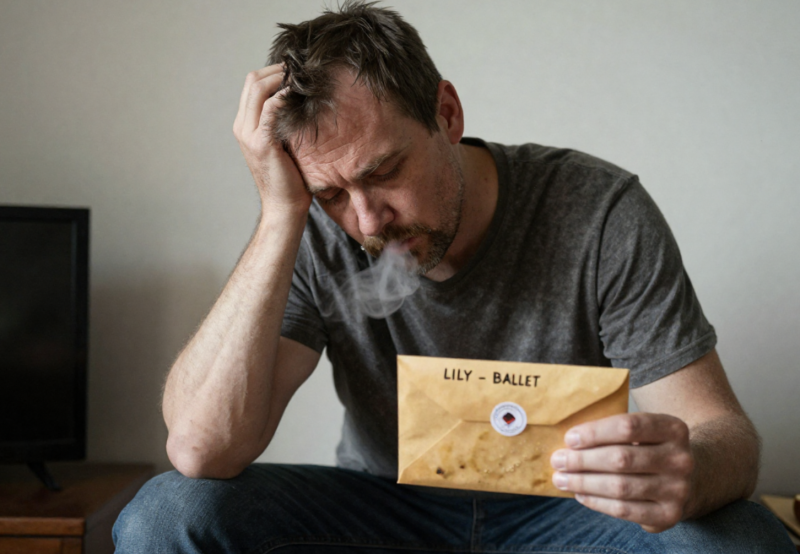
I went home, grabbed an old envelope from a drawer, and wrote “LILY – BALLET” on the front in big marker letters.
Each shift, each crumpled note or handful of coins left over from the laundry went inside.
I skipped lunch, drank burnt coffee from our dying coffee maker, and told my stomach to stop complaining.
The dreams were louder than the growl in my stomach, most days.
The studio felt like the inside of a cupcake.
Pink walls, glittery stickers, inspirational vinyl sayings: “Dance with your heart,” “Take the leap and the net will appear.”
The lobby was full of moms in leggings and dads with tidy haircuts, all smelling of good soap, not garbage trucks.
I sat small in the corner, pretending to be invisible.
I had come straight from my shift, still smelling faintly of banana peels and disinfectant.
No one said anything, but some parents gave me that sideways glance, the one people reserve for broken vending machines and expensive ones asking for change.
I kept my eyes on Lily, who entered that studio like she had been born there.
If she fit in, I could handle this.
For months, every night after work, our living room turned into her personal stage.
I would push the shaky coffee table against the wall while my mom sat on the couch, cane by her side, clapping out of rhythm.
Lily stood in the center, socks slipping, her face serious enough to scare me.
“Dad, look at my arms,” she would order.
I had been awake since four, my legs buzzing from hauling bags, but I kept my eyes on her.
“I’m looking,” I’d say, even when the room started to blur at the edges.
My mom would poke my ankle with her cane if my head started to fall.
“You can sleep when she’s done,” she would murmur.
Then I watched, as if it were my job.
The recital date was posted everywhere.
Circled on the calendar, written on a post-it on the fridge, set on my phone with three alarms.
6:30 p.m., Friday.
No overtime, no shift, no busted pipes, nothing was supposed to interfere with that time.
Lily carried her little dance bag around the house for a week, like it was full of delicate magic.
On the morning of the recital, she stood by the door with her bag and a serious face.
Hair already done, socks slipping on the floor.
“Promise you’ll be there?” she asked, as if checking my soul for cracks.
I kneeled so we’d be the same height and made the promise.
“I promise,” I said. “Front row, cheering the loudest.”
She smiled, finally, that toothless, unstoppable smile.
“Good,” she said, and walked out the door, half-walking, half-spinning.
I went to work floating, for the first time, instead of dragging.
But by around 2 p.m., the sky turned that heavy, angry gray that meteorologists pretend to be surprised by, though everyone can already feel it coming.
At 4:30 p.m., the dispatcher’s radio gave the bad news.
A broken pipe near a construction site, half the block flooded, traffic going crazy.
We arrived with the truck, and it was instant chaos—brown water bubbling from the street, horns blaring, someone already filming instead of moving their car.
I jumped in, boots filled with water, pants soaked, thinking about 6:30 the entire time.
Every minute tightened on my chest.
By 5:30 p.m., it had passed as we fought with hoses and cursed rusty valves.
At 5:50 p.m., I crawled out of the hole, soaked and shaking.
“I have to go,” I shouted to my supervisor, grabbing my bag.
He looked at me as if I’d suggested letting the water flow forever and opening a pool.
“My daughter’s performing,” I said, throat tight.
He stared at me for a moment, then nodded.
“Go,” he said. “You’re not going to help here if your head’s already there.”
That was as close to kindness as he’d get.
I ran.
No time to change clothes, no time to shower, just soaked boots pounding on the concrete and my heart trying to escape.
I caught the subway just as the doors were closing.
People moved away from me on the train, wrinkling their noses.
I couldn’t blame them; I smelled like a flooded basement.
I kept watching the time on my phone the whole trip, negotiating with each stop.
When I finally reached the school, I ran down the hall, lungs burning more than my legs.
The doors of the auditorium swallowed me, smelling of perfumed air.
Inside, everything seemed soft and polished.
Moms with perfect curls, dads with pressed shirts, little kids in pristine clothes.
I sat way in the back, still breathing like I’d run a marathon through a swamp.
On stage, little dancers were lined up, pink tutus like flowers.
Lily stepped into the light, blinking hard.
Her eyes scanned the rows like they were emergency lights.
For a second, she didn’t find me.
I saw panic pass across her face, that tight line she makes when she’s holding back tears.
Then her eyes jumped to the back row and fixed on me.
I raised my hand, sleeve dirty and all.
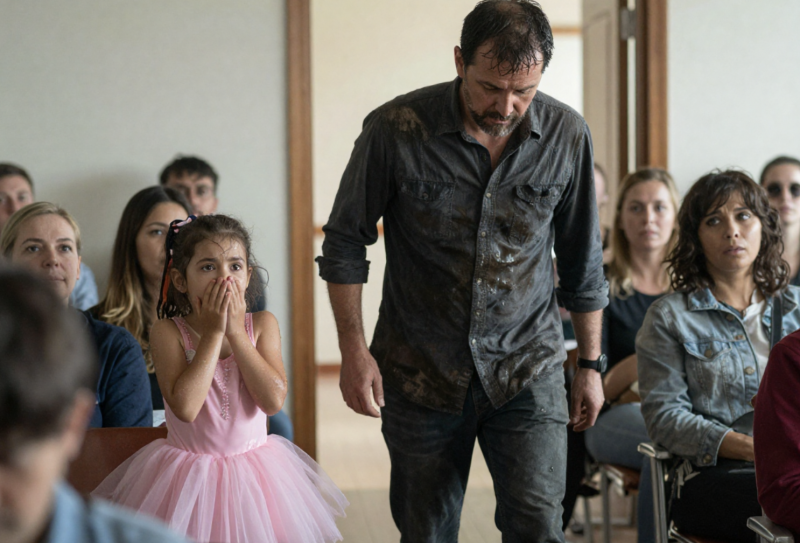
Her whole body relaxed as if she could finally exhale.
She danced like the stage was hers.
Was she perfect?
No.
She stumbled, turned the wrong way once, kept looking to the girl next to her for a hint.
But her smile grew every time she spun, and I swear I felt my heart trying to clap out of my chest.
When they bowed, I was almost crying.
I pretended it was dust, obviously.
Later, I waited in the hallway with the other parents.
Sparkles everywhere, little shoes tapping on the floor.
When Lily saw me, she ran toward me, tutu bouncing, bun half-crooked.
“You came!” she yelled, as if that had really been in doubt.
She hit my chest with such force, almost knocking me over.
“I promised,” I said, my voice trembling too much.
“I looked and looked,” she whispered against my chest.
“I thought you got stuck in the trash.”
I laughed, but it came out more like a sob.
“They’d have to send an army,” I said. “Nothing’s stopping me from seeing your show.”
She pulled back a bit, studied my face, and then finally relaxed.
We went home the cheapest way, by subway.
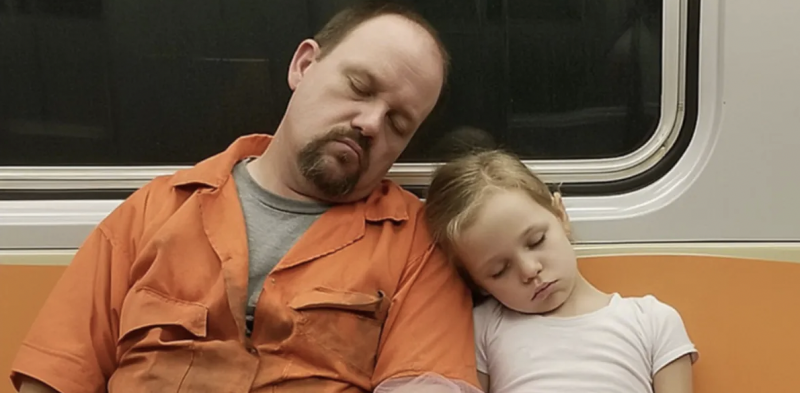
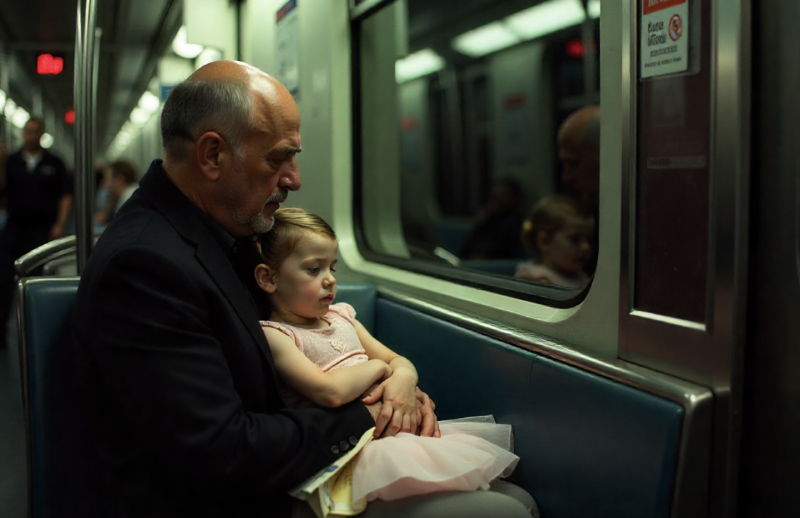
On the train, she didn’t stop talking for two stops, then fell asleep, in costume and all, curling up on my chest.
The recital program crumpled in her hand, little shoes swinging against my leg.
The reflection in the dark window showed a worn-out guy holding the safest thing in the world.
I couldn’t stop looking.
That’s when I noticed the man a few seats ahead, watching.
He was maybe in his forties, with a nice coat, a subtle watch, hair that had clearly been through a good barber.
He didn’t look flashy, just... complete.
Well-groomed in a way I’d never felt.
He kept staring at us, then turning his head, as if fighting with himself.
Then he raised his phone and pointed it our way.
The anger woke me faster than caffeine.
“Hey,” I said, keeping my voice low but firm.
“Did you take a picture of my daughter?”
The man froze, finger hovering over the screen.
His eyes widened in surprise.
“Sorry,” he said quickly. “I shouldn’t have done that.”
No defensiveness, no attitude, just a guilt so obvious even I, half asleep, could see it.
“Delete it now,” I said.
He started typing like his fingers were on fire.
Opened the photos, showed me the image, and deleted it.
He opened the trash, deleted again.
Turned the screen to show me the empty gallery.
“All done,” he said quietly. “It’s gone.”
I stared at him for a few more seconds, arms tight around Lily, pulse still racing.
“You got to her,” he said. “That matters.”
I didn’t answer.
I just held Lily tighter until we reached our stop.
When we got off, I saw the doors closing behind him and told myself it was just that.
Random rich guy, strange interaction, end of story.
The morning light in our kitchen always makes everything seem a little gentler than it really is.
The next day, it didn’t help much.
I was half-awake, drinking terrible coffee, while Lily colored on the floor and my mom walked around the house humming.
The knock on the door was hard enough to shake the cheap frame.
The second knock came even harder, more urgent.
“Are you expecting anyone?” my mom shouted, her voice tense.
“No,” I said, already getting up.
The third series of knocks was like someone collecting a debt.
I opened the door with the chain still on.
Two men in dark coats, one of them big, with that look of someone wearing headphones, and behind them, the man from the train.
He said my name carefully, as if he had practiced it.
“Mr. Anthony?” he asked.
“Have Lily get her things.”
The world tilted.
“What?” I managed to say.
The big man stepped forward.
“Sir, you and your daughter need to come with us.”
Lily’s fingers dug into my legs.
My mom appeared beside me, cane planted.
“Is this CPS? The police? What’s going on?”
My heart tried to jump out of my chest.
“No,” the man from the train said quickly, hands raised. “It’s not that. I phrased it wrong.”
My mom glared at him like she could knock him over.
“Really?” she fired.
He looked at Lily and something in his face broke, all the calm politeness sliding away.
“My name is Graham,” he said.
He pulled a thick envelope from his jacket, the kind of fancy envelope with a silver logo stamped on it.
“I need you to read what’s inside. Because Lily is the reason I’m here.”
I didn’t move.
“Slide it inside,” I told him.
I wasn’t opening the door any more than that.
The envelope slid through the crack in the door.
I opened it just enough to grab the papers inside.
Fancy letterhead paper, my name printed at the top.
Words like “scholarship,” “housing,” “full support” jumped off the page.
Then a photo slid out.
A girl, maybe eleven, frozen mid-jump, legs fully spread, face fierce and joyful at the same time.
She had the same marked eyes as him.
On the back, in looping handwriting, it said:
“For Dad, next time be there.”
My throat closed.
Graham saw my face and nodded, as if he already knew exactly where I had stopped.
“Her name was Emma,” he said softly.
“My daughter. She danced before she could talk. I spent years missing recitals because of meetings.”
His jaw tightened.
“She got sick,” he said. “Fast. Aggressive. Suddenly, all the doctors were talking about options that weren’t really options.”
He took a deep breath.
“I missed her second-to-last recital because I was in Tokyo closing a deal. I told myself I’d make the next one count somehow.”
There was no next time.
Cancer doesn’t negotiate schedules.
He looked at Lily again.
“The night before she died,” he said, “I promised her I would show up for another child’s recital, if their dad was fighting to be there. She said, ‘Find the ones that smell like work, but still clap loud.’”
He let out a broken laugh.
“You checked every box last night.”
I didn’t know if I should cry.
“So what’s this?” I asked, holding up the papers. “You show up, feel guilty, throw money at us, and disappear?”
He shook his head.
“No disappearing,” he said.
“This is the Emma Foundation. Full scholarship for Lily at our school. A better apartment, closer. A facilities manager job for you, during the day shift, with benefits.”
Words that belonged to other people’s lives.
My mom narrowed her eyes.
“What’s the catch?” she asked, demanding.
Graham looked at her as if he had been preparing for that exact question.

“The only catch is that she stops worrying about money enough to dance,” he said.
“You still work. She still works. We’re just taking a little weight off your shoulders.”
Lily tugged on my sleeve.
“Dad,” she whispered, “do they have bigger mirrors?”
That knocked me down.
Graham smiled carefully.
“Enormous mirrors,” he said. “Real dance floors. Teachers who know how to keep the kids safe.”
She nodded, as if she were considering a serious business proposal.
“I want to see,” she said. “But only if Dad comes too.”
I felt the decision being made with certainty.
We spent the day visiting the school and the building where I would work.
Studios full of light, kids stretching at the bars, teachers really smiling.
The job wasn’t glamorous, but it was steady, one place instead of two.
That night, after Lily had fallen asleep, my mom and I read every line of those contracts.
Waiting for tricks that never came.
It’s been a year.
I still wake up early, still smell cleaning products, but I manage to go to every class, every recital.
Lily dances harder than ever.
Sometimes, watching her, I swear I can feel Emma clapping for us.


