After spending 12 years delivering groceries to my 84-year-old neighbor every Sunday, his lawyer gave me an old, battered suitcase after the funeral, and what was inside left me shaking.
For years, my Sundays followed the same quiet routine, and I never once questioned it. I believed I was simply helping an elderly neighbor, without realizing how much those ordinary mornings would come to matter.
The street was still that Sunday morning—the kind of silence you only find in a suburb where everyone is easing into their first coffee. I was 28, standing in my driveway with the recycling bin, watching maple leaves fall two houses down.
It felt like the most uneventful moment of my life, which is probably why it stayed with me so clearly.
Ezra had lived next door for years. We exchanged waves, brief greetings, then returned to our separate lives. I couldn’t have described his front door color without checking.
That morning, I noticed Ezra struggling with four grocery bags at his trunk. One slipped, caught his arm, and nearly hit the ground. I went over before thinking it through.
“Let me take those,” I said.
“Oh, you don’t need to,” he replied.
“I know. Still.”
He didn’t resist after that. I carried the bags up his porch and into a kitchen that smelled like old wood and instant coffee. He moved carefully, like a man used to living alone for a long time.
“Sit for a moment,” Ezra said. “At least let me make you coffee.”
I almost refused—I wasn’t used to coffee with strangers—but something in his tone made me stay.
“One cup,” I said. “Then I need to check my gutters.”
He laughed softly, surprised by it.
We ended up talking for nearly an hour. Ezra spoke about the neighborhood when cornfields still stood where the school is now. I told him I’d moved in expecting to leave after two years.
“Funny how that goes,” he said. “I said the same thing in 1971.”
He mentioned a nephew once—Marcus, I think—saying it casually, like someone remembered but didn’t quite reach for the memory.
“He calls sometimes,” Ezra said. “Only when he needs something.”
He looked at his cup a little longer than necessary. I didn’t ask more.
When I stood to leave, I tapped the doorframe.
“Next time you need groceries, call me. It’ll help your back.”
“I wouldn’t want to be a burden.”
“Then don’t call it that.”
He smiled, slow and uneven.
I walked home thinking I’d done a small kindness on an ordinary Sunday. I had no idea that one cup of coffee had started something that would last 12 years.
Twelve years. That’s how long a simple Sunday favor became a quiet ritual neither of us ever named.
Ezra’s health slowly declined. First a slower walk, then shaky hands when he poured coffee. Eventually driving became too difficult, and I started bringing his groceries every Sunday without ever defining it.
In the early weeks, Ezra still tried pressing money into my hand at the door.
“Anthony, take it. I’m not charity.”
“Ezra, I’m already going anyway.”
“Then take gas money.”
“Next time,” I’d say, knowing I wouldn’t.

Eventually, he stopped offering, and things settled into rhythm. I’d place groceries away, and we’d sit at his small kitchen table with two mugs between us.
Some Sundays, he talked about Margaret, his late wife, and her garden. Other times, he asked about my work, my marriage, and whether Claire and I planned on kids. Sometimes we said almost nothing, just watching birds outside his feeder.
I didn’t think of it as anything meaningful. It was just Sunday.
Claire and I married when I was 38, and she noticed how much those Sundays meant.
“You’re going over there again?” she asked one morning, half joking.
“It’s just an hour or two.”
“And you’ll keep doing this forever?”
“He doesn’t have anyone else,” I said.
She softened, as she usually did, and handed me cookies she had baked.
“Bring these to him. Say hi from me.”
I did.
Ezra held the tin like it was something delicate and thanked her repeatedly.
That was the Sunday he brought up Marcus again—the nephew who only called when he needed money, car help, or bailouts.
“Marcus came by last month,” Ezra said, stirring slowly. “Asked what I was going to do with the house.”
“And?”
“I said I’m staying.”
He smiled faintly, but it didn’t reach his eyes.
I thought about bringing Claire to meet him, but I never did.
I noticed the porch light first.
The next Sunday in October, it was still on at 9 a.m. Ezra never left it on that late. He was precise about habits.
I stood in my driveway staring at the yellow glow. Something felt off, but I told myself I’d mention it when I dropped off groceries.
I went back inside but couldn’t focus on anything.
By noon, an ambulance arrived at Ezra’s house. A neighbor told me what I already knew—he had died in his sleep. Peacefully. He was 84. I was 40.
I stood on his lawn long after others left, staring at the now-dark porch. Claire came later and silently took my hand.
The funeral was smaller than expected. A few distant people, a tired pastor, and a sense that Ezra deserved more than this.
Across the aisle, one man stood out—dark suit, impatient posture, constantly checking his phone.
When it ended, I was leaving when he approached me.
“You’re the grocery guy,” he said, shaking my hand briefly. “Marcus. His nephew.”
“Anthony. I’m sorry.”
He gave a thin smile.
“Ten years of Sundays, huh? That’s a lot of effort for an old man.”
“He was my friend.”
“Sure,” he said. “Either way, the house is being sold quickly. No reason to wait.”
I said nothing.
He leaned closer.
“People get attached to lonely old men for all sorts of reasons. I hope yours were good ones.”
“I never took anything from him.”
“That’s what they all say.”
He walked away, already on his phone.
I stood there until a man approached me holding something.
“Are you Anthony? The neighbor?”
I nodded.
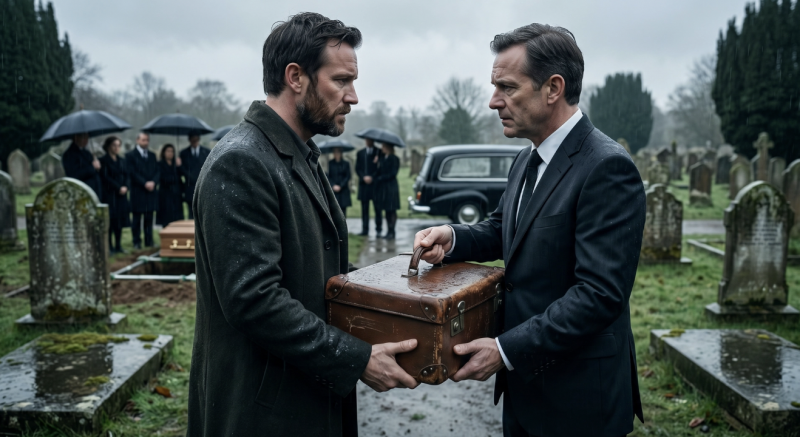
“I’m Mr. Whitman, Ezra’s lawyer.”
He held an old suitcase—worn, aged, carefully kept.
“Mr. Harrison left this specifically for you,” he said. “Private instructions.”
I took it slowly. It was heavier than it looked.
“Did he say what’s inside?”
“He said you would understand.”
Before I could ask more, Marcus appeared again, sharp and tense.
“What is that?”
The lawyer answered calmly.
“It doesn’t belong to the estate. It was legally separated years ago.”
“Years ago?” Marcus snapped. “He was manipulated. That stays here.”
“It does not,” the lawyer said firmly.
Marcus turned to me.
“You’ll regret this.”
I left without responding.
At home, I placed the suitcase on the table and stared at it.
Claire, who hadn’t been at the funeral, watched quietly from the doorway.
“Open it,” she said.
The latches clicked.
Inside were no valuables—only envelopes, photo albums, and a worn journal.
The first letter was dated 12 years earlier, the day we first had coffee.
There was one for every Sunday since then—hundreds—but none had ever been sent.
My hands shook as I opened the journal.
Ezra wrote about losing a son decades ago, Daniel. I remembered him once mentioning a child, briefly, then falling silent.
Inside, he described how over time, he began thinking of me like the son he lost.
At the end was a sealed letter addressed to me, along with legal confirmation.
There was also a separate savings account, untouched and protected outside the estate.
Claire sat beside me, reading, tears forming.
“The connection you had was something rare,” the note said. “It mattered more than either of us probably realized.”
We held each other, overwhelmed.
A few days later, Marcus came to my house.
“You manipulated him,” he said immediately. “That money should be mine.”
I handed him one of Ezra’s letters.
As he read it, his expression changed.
“He wrote this himself,” I said. “I didn’t change anything.”
He read it again.
Slowly, his anger faded.
“He never told me,” he said quietly.
Then he left.
I used part of what Ezra left me to start a small Sunday program for elderly neighbors living alone. I called it the Harrison Sunday Circle.
Every Sunday, I read one of his letters before leaving.
I realized the suitcase was never about money or objects—it was about consistency, memory, and being present.
I miss him. May he rest in peace.