My 4-year-old daughter vanished from kindergarten. Twenty-one years later, on her birthday, I got a letter that started with, 'Dear Mom, you have no idea what really happened.'
Twenty-one years after my daughter disappeared from a kindergarten playground, I thought I had come to terms with it. Then, on what would have been her 25th birthday, a plain white envelope arrived. Inside, there was a photo and a letter that started with, "Dear Mom."
For all those years, I kept her room exactly the same. Lavender walls, glow-in-the-dark stars, tiny sneakers near the door. If I opened the closet, I could still smell strawberry shampoo.
My sister said it wasn't healthy. "Laura, you can't freeze time," she said, standing in the doorway, almost afraid to step inside. I told her, "You don’t get to redecorate my grief," and she left with tears in her eyes.
Catherine disappeared from the kindergarten playground when she was four. She wore a yellow daisy dress and two mismatched barrettes because "princesses mix colors." That morning she asked, "Curly noodles tonight, Mommy?"
Frank grabbed her backpack and grinned. "Spaghetti with curlies. Deal." I shouted after them, "Your red mitten!" and Catherine waved it from the window. "I got it!"
It was only ten minutes. One moment she was in line for juice boxes; the next, she was gone. When the school called, I was rinsing a mug, thinking of nothing important.
"Mrs. Holloway? We can’t find Catherine," Ms. Dillon said, her voice trembling. "What do you mean you can't find her?" I asked. "I turned my back for a second," she said, and I was already grabbing my keys.
The playground looked normal. Kids were still yelling, the swing was still creaking, and the sun shone like it had no shame. Frank stood by the slide, stiff, staring at the wood chips.
I grabbed his arm. "Where is she?" His mouth opened and closed before words came out. "I don’t know," he whispered, and his eyes went blank.
Her pink backpack lay by the slide, tipped over. One strap was twisted, and her favorite red mitten lay in the wood chips, bright as a flare. I pressed it to my face and tasted dirt, soap, and her.
A cop crouched beside the backpack. "Any custody issues? Anyone who might have taken her?" he asked. "She's four," I snapped. "Her biggest problem is nap time."
There were no cameras back then, no clear footage to replay. Dogs searched the tree line, volunteers scoured the neighborhood. Every siren made my heart race, and every silent hour made it sink.

The detectives sat at our dining table, asking questions that felt like knives. "Anyone close to the family?" one asked, pen ready. Frank kept his hands clasped, knuckles white. "I dropped her off," he muttered. "She was smiling."
The detective lowered his voice. "Sometimes it's someone you know." Frank flinched, quick as a blink, but I saw it. After they left, I asked, "What was that?" Frank stared at the floor. "Because I failed her," he said. "That's all."
Three months later, Frank collapsed in our kitchen. He'd been fixing the cabinet hinge Catherine used to swing on and had asked me for the screwdriver. His hand went slack, knees hit the tile, and the sound split my head open.
"Frank! Look at me!" I screamed, slapping his cheek, begging his eyes to focus. In the ER, a doctor said, "Stress cardiomyopathy," as if it was just a weather report. A nurse whispered, "Broken heart syndrome," and I hated her for giving it a cute name.
At the funeral, people said, "You're so strong," and I nodded like a trained animal. Later in the car, I slammed the steering wheel until my wrists ached. I buried my husband while my daughter was still missing, and my body didn’t know which grief to carry first.
Time kept moving, rude and steady. I worked, paid bills, smiled at cashiers, then cried in the shower where the water could hide it. Every year on Catherine’s birthday, I bought a cupcake with pink frosting and lit one candle upstairs.
I sat in Frank’s rocking chair and whispered, "Come home." Sometimes I said it like a prayer; other times, I spat it like a dare. The room never answered, but I kept talking anyway.
Last Thursday would’ve been her 25th birthday. Twenty-five sounded like a stranger. I did the ritual, then went downstairs to check the mail, because my hands needed something to do.
A plain white envelope lay on top. No stamp, no return address, just my name in neat handwriting I didn’t recognize. My fingers shook as I tore it open.
Inside was a photograph of a young woman in front of a brick building. She had my face at that age, but the eyes were Frank’s, deep brown and unmistakable. Behind it was a letter, folded tight.
The first line made the room tilt. "Dear Mom." I read it twice, then a third time, like the words might vanish if I blinked. My chest tightened until breathing hurt.
"You have no idea what happened that day," the letter said. "The person who took me was NEVER a stranger." My hand covered my mouth. "No," I whispered, but the ink kept going.
"Dad didn’t die. He faked my kidnapping to start a new life with Evelyn, the woman he was seeing. She couldn’t have kids." I stared at the sentence until my eyes burned. Frank, dead in the ground, alive on paper—my brain refused the math.
At the bottom was a phone number and a line that felt like a cliff. "I’ll be at the building in the photo Saturday at noon. If you want to see me, come." It was signed, "Love, Catherine."
I called before I could talk myself out of it. The line rang twice. "Hello?" a young woman’s voice said, cautious and thin.
"Catherine?" I croaked. Silence, then a shaky exhale. "Mom?" she whispered, like she didn’t trust the sound. I slid into the rocking chair and sobbed. "It’s me," I said. "It’s Mom."
We spoke in broken pieces. She told me Evelyn renamed her "Callie" and corrected her if she said Catherine aloud. I told her, "I never stopped looking," and she said, sharp, "Don’t apologize for them."
Saturday, I drove to the brick building with my hands locked on the wheel. She stood near the entrance, shoulders tight, scanning the street like prey. When she saw me, her face went blank with shock, then cracked. "You look like my face," she said.
"And you have his eyes," I answered, voice shaking. I lifted my hand, hovering, and she nodded once. My palm touched her cheek—warm, real—and she sucked in a breath like she’d been holding it since kindergarten.
We sat in my car with the windows cracked because she said closed spaces made her panic. She handed me a folder. "I stole copies from Evelyn’s safe," she said. Inside were name-change papers, fake custody documents, and bank transfers with Frank’s name. There was also a blurry photo of him in a cap, alive.
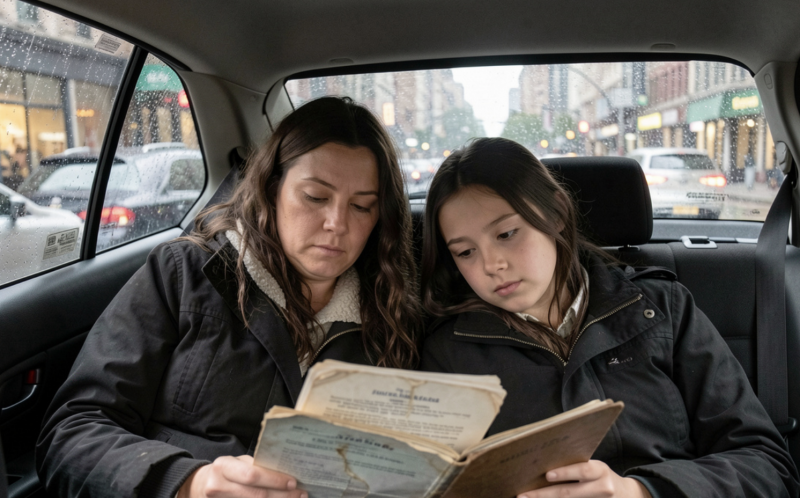
"I buried him," I whispered. Catherine’s jaw tightened. "She told me he died too," she said, "but I remember suits, paperwork, and her practicing tears in the mirror." She looked down at her hands. "He left me with her and disappeared for good."
"We're going to the police," I said. Her eyes shot up, fear flashing. "Evelyn has money," she warned. "She makes problems disappear." I squeezed her hand. "Not this one," I said.
At the station, a detective listened, his face tight. Another officer stood by, skeptical, like we were making up a story. Catherine’s voice shook as she described the playground. "He walked me to the car like it was normal," she said. "He told me you didn’t want me." I leaned in. "I wanted you every second," I said, and her throat bobbed.
The detective sighed. "We need more proof to go after a wealthy suspect." I snapped, "Then help us get it." He gave me a look that said I was being difficult, and I didn’t care.
That night, Catherine got a text from an unknown number: COME HOME. WE NEED TO TALK. Her face drained. "Evelyn never texts," she whispered. "She hates records." My pulse raced. "We don’t go alone," I said.
We arranged for the detective to be nearby and drove to Evelyn's gated house. Stone columns, trimmed hedges, windows like mirrors—everything polished, nothing warm. Catherine murmured, "It always felt like a stage." I said, "Then we stop acting."
Evelyn opened the door in a silk robe, smiling like she owned the air. She looked Catherine up and down. "There you are," she said, as if Catherine were a purse she’d misplaced. Her gaze turned to me and hardened. "Laura. You look tired."
"You stole my daughter," I said. Evelyn’s smile stayed, but her eyes grew cold. "I gave her a life," she replied. Catherine stepped forward, her voice shaking with anger. "You bought me," she said. "Like furniture."
Evelyn hissed, "Watch your mouth." A footstep was heard behind her, and a man appeared in the foyer. Older, heavier, but with the same posture. Frank.
The room spun. I grabbed the doorframe. "Frank," I said, and the name tasted like blood. He looked at me like I was an overdue bill. "Laura," he said flatly.
Catherine whispered, "Dad," and her voice cracked. I found mine by force. "I buried you," I said. "I had a funeral. I begged God to stop." Frank’s jaw tightened. "I did what I had to do," he said.
"You took our child."
Evelyn slid in smoothly like ice. "He rescued her from struggle," she said. Catherine’s eyes flashed. "You locked me up and called it love," she shot back.
Frank tried to sound reasonable. "You were safe," he told Catherine. "You had everything." Catherine laughed once, sharp and wet. "Except my mother," she said. Then, quieter, "Why did you leave me with her?" Frank opened his mouth but closed it again.
Evelyn’s polished demeanor cracked. "You said this would stay clean," she hissed at Frank. Frank snapped, "You said no one would find her." Evelyn lunged for Catherine’s bag, and Catherine stumbled back.
I grabbed Evelyn’s wrist before she could snatch the folder. Her nails dug into my skin, and her eyes went wild. "Let go," she hissed. I leaned in. "Not this time," I said.
A security guard appeared, frozen. Catherine stood shaking, but lifted her chin. "You don’t get to be my dad," she told Frank, her voice clear. Frank flinched like she’d hit him.
The front door opened wider, and the detective stepped in with another officer. His eyes locked on Frank. "Sir, according to records, you are deceased," he said. Frank went pale, and Evelyn’s smile finally died.
Catherine’s hand found mine and squeezed hard. She looked up at me, tears spilling. "Can we go?" she whispered. I squeezed back. "Yes," I said. "Right now."
After that, everything moved in slow, ugly steps—charges, statements, reporters hungry for spectacle. Frank’s second life collapsed under paperwork and handcuffs. I stopped reading the headlines when I saw Catherine’s name turned into clickbait.
At home, Catherine stood in the doorway of her old room and stared at the lavender walls. "You kept it," she said, her voice thin. "I didn’t know how to stop," I admitted. She touched one tiny sneaker with her fingertip. "No one ever kept anything for me," she whispered.
The first weeks were a mess. She checked locks twice and slept with the lamp on. Sometimes she snapped, "Don’t hover," and I backed off, then cried in the laundry room where she couldn’t hear.
We rebuilt with small things: tea on the porch, quiet walks, photo albums only when she asked. One night, she stared at a picture of herself at three and said, "I don’t remember your voice the way I wanted." I swallowed and said, "Then we’ll make new memories. As many as you want."
On her next birthday, we bought two cupcakes. She lit two candles and said, "One for who I was, one for who I am." We sat together in the rocking chair, knees bumping, and the room finally felt like a room again.