At 71, I got married, but my adult children chose not to attend. What they sent instead completely stunned me.
Nine years after my husband passed away, I thought romance was over for me.
Then a man from my past came back, remembering details that only the two of us should have known. I almost married him — until a woman walked into the ceremony with an envelope, and Harold’s smile disappeared.
Nine years after my husband’s death, I believed romance had become a thing of the past in my life.
Then Harold called and used the name that only Daniel used when he wanted my full attention.
“Margaret?”
I laughed.
We had gone to high school together, although we were not close.
“I haven’t heard anyone call me by my first name in almost fifty years.”
“I know,” he said. “I just wanted to make sure I had found the right girl.”
He said he got my number from the alumni committee while helping with a memorial page for classmates we had lost. We had gone to high school together, although we were not close. I remembered him as one of those boys who always seemed older than he really was.
We had coffee together the following week.
Two weeks later, he remembered something else.
At the end of that first coffee, he said:
“You still put one hand under your chin when you laugh.”
Two weeks later, he remembered something else.
“You wore yellow at graduation.”
I stopped walking and looked at him.
“I did.”
A month later, while we were eating pie at a diner, he mentioned that I had slipped a note inside a chemistry book because I was too shy to say hello out loud.
At my age, being remembered can feel like the sweetest thing in the world.
I laughed.
“Oh my God. You remember that?”
He gave a small smile and shrugged.
“Some things stay with you.”
At my age, being remembered can feel like the sweetest thing in the world.
There was a strange moment at the beginning.
I even gave him a spare key so he could warm up my car on cold mornings before I came downstairs.
During a coffee, Harold said he had graduated with me.
A few weeks later, he mentioned that he had left school before the spring of our senior year.
When I asked which version was true, he smiled and said:
“Fifty years makes all of us terrible storytellers.”
I let it go.
I even gave him a spare key so he could warm up my car on cold mornings before I came downstairs.
“So you’ve never seen where he actually lives.”
Peter, my oldest son, was practical.
“Have you ever been to Harold’s house?”
“He’s renting for now,” I answered. “A bungalow in Rose Hill. His trailer lot in Millbrook is still being sorted out.”
Peter frowned.
“So you’ve never seen where he actually lives.”
Elise, my daughter, was gentler.
He proposed six months after our first coffee.
“Mom, I’m happy that you’re happy. I just wish we knew more about him.”
I heard their concern and interpreted it as a lack of trust.
He proposed six months after our first coffee.
He seemed genuinely nervous.
“Maybe this is fast,” he said, “but some things feel obvious when they arrive.”
I said yes before he finished asking.
Peter came to my house the following night.
My children did not celebrate.
Peter came to my house the following night.
Elise came with him.
“Mom,” Peter said, “none of us have ever seen Harold’s real home or met a single person from his life.”
Elise folded her hands.
But all I heard was that they did not trust me.
“And some of his stories keep changing. Ruth James says he left before graduation. Please delay the wedding for thirty days. If we’re wrong, we’ll apologize.”
Thirty days.
That was all they were asking for.
But all I heard was that they did not trust me.
“I’m seventy-one years old,” I replied angrily. “I’m not incapable.”

Their reactions should have mattered more to me than they did.
Peter leaned back as if I had slapped him.
Elise looked down at the table and stayed quiet.
Neither of them argued.
Their reactions should have mattered more to me than they did.
Instead, I told Harold what happened.
He held my hand and spoke in that careful tone he used when he wanted to seem patient rather than persuasive.
“People get strange when love and inheritance are involved.”
“They’re afraid of losing the life they know.”
“What does that mean?”
“You, your home, their place in your life. Maybe none of it is conscious. But people get strange when love and inheritance are involved.”
I pulled my hand away.
“My children aren’t greedy.”
He immediately agreed.
That was the clever part. He never called my children greedy.
“I hope not.”
That was the clever part. He never called my children greedy. He simply placed the idea beside me and let it breathe.
After that, he kept doing it.
When Peter asked whether Harold had shown me any documents about the Millbrook property, Harold later said:
“Already?”
When Elise offered to help me review my beneficiary forms before the wedding, Harold smiled sadly and said:
“If that makes you feel safer, of course.”
All three of my children confirmed they would not attend the wedding.
Then, after a pause:
“I just don’t think thirty days will be enough for them.”
That sentence decided everything.
I kept the date.
All three of my children confirmed they would not attend the wedding.
It should have bothered me that I was about to marry a man whose supposed home I had never seen.
Still, on the morning of the ceremony, I placed two empty chairs in the first row of Harold’s rented garden venue. The bungalow was beautiful in the photographs. White trellises. Rose bushes. A flower-covered arch over the lawn.
It should have bothered me that I was about to marry a man without ever seeing the house he claimed would one day truly belong to him.
Instead, I kept looking at those two chairs.
I stood beneath a warm June sky and told myself I was choosing happiness, not trying to prove something.
Harold squeezed my fingers.
“Don’t look at them, Maggie.”
I tried not to.
The guests arrived. Ruth from church. My cousin Jean. Some old classmates. The officiant reviewed the ceremony order while I stood beneath a warm June sky and told myself I was choosing happiness, not trying to prove something.
Fifteen minutes before the ceremony, the garden gate opened.
Harold went pale. He walked toward her immediately.
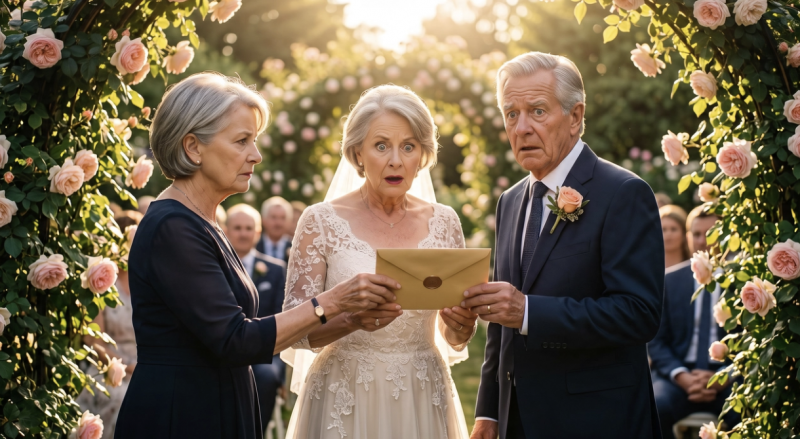
A woman stood there holding a thick brown envelope against her chest. She was about my age, with Harold’s eyes and none of his calm. Her face looked tired.
“Maggie? Margaret?” she said. “Are your children here?”
Harold went pale.
He went to her immediately.
“This is not the time.”
Nora ignored him and came directly toward me.
The woman looked past him at me.
“They told me to put this in your hands and not his.”
“Who are you?” I asked.
“Nora,” she answered. “I’m his sister.”
Harold’s voice became harder.
“Leave.”
She held out the envelope.
Nora ignored him and came directly toward me. Her hand shook so badly that the envelope rattled.
“I hadn’t spoken to Harold in two years,” she said. “Then your daughter sent me a picture of your engagement. I went to his trailer to find proof of where he was actually living. I found more than that.”
She held out the envelope.
“Please read this before you marry him.”
I took it.
I recognized the handwriting before I even opened the first letter.
Inside was a collection of old letters tied together with a faded blue ribbon.
I recognized the handwriting before I even opened the first letter.
Daniel.
My bouquet fell from my hands.
The first letter had been written directly to Harold when they were young. Daniel was away, doing reserve training, writing to his friend the way men do when they are full of love and too far away from the woman who inspires it.
In another letter was the chemistry note.
There, in the middle of the page, was the yellow dress.
In another letter was the chemistry note.
These were not Harold’s memories.
They were Daniel’s.
“You never remembered me.”
Harold’s face changed. He looked at all of us blankly, his eyes wide.
Nora reached into the envelope again and pulled out a small black notebook.
He was scared.
“Margaret, listen to me.”
Nora reached into the envelope again and pulled out a small black notebook.
He tried to take it.
Peter grabbed his arm.
Nora handed me the notebook.
I had not even seen my children enter, but suddenly Peter was there and Elise was right behind him, breathing heavily as if she had run from the street.
Nora handed me the notebook.
“I found this in his trailer too.”
I opened it.
The first page had a date three weeks before Harold’s first call to me.
The following pages were worse because they were so calm.
Beside my name, he had written:
Widowed nine years.
Owns home.
Protective children.
The following pages were even worse because they were so organized.
Favorite flowers.
Then came the reminders.
Daniel’s death date.
Peter married to Laura.
Elise attends St. Mark’s.
Difficult holidays: Christmas, anniversary, his birthday.
Then the reminders.
Ask about Daniel, never seem jealous.
Near the end was a page titled “After the Wedding.”
Mention yellow dress.
Mention chemistry note later.
If children pressure her, say they’re afraid of losing control.
No postponement.
Move into Maggie’s house.
Sell trailer.
Discuss deed after honeymoon.
Fewer family visits.
Gradual change of photographs.
My hands started shaking.
Harold raised both hands in a pleading gesture. He almost looked desperate.
“They were reminders,” he said. “I was trying to remember details that mattered to you.”
I turned the notebook around and showed him the date on the first page.
Three weeks before he had even called me.
Before our first coffee.
Before he knew whether I would even speak to him.
“No,” I said. “You studied a way to enter my life. I can’t believe my children saw this before I did.”
Thirty days. That was all they had asked for.
Peter’s voice was tight with anger.
“We didn’t want the house, Mom. We wanted thirty days.”
That was the sentence that destroyed me.
Not the notebook.
Not even Daniel’s letters.
“You wrote instructions about how to talk about my husband.”
Thirty days.
That was all they had asked for, and I let a stranger convince me I was being controlled.
Harold stepped toward me.
“I used the letters to start a conversation. That doesn’t mean my feelings weren’t real.”
“You wrote instructions about how to talk about my husband.”
“I was trying not to hurt you.”
My cousin Jean walked to the family table, picked up Harold’s place card, and turned it face down.
“No,” I said. “You were trying not to lose access.”
The garden became completely silent.
The officiant closed the book.
My cousin Jean walked to the family table, picked up Harold’s place card, and turned it face down.
That small gesture gave me more strength than anything else.
I walked beneath the arch and turned toward the guests.
I raised Daniel’s letters.
“This wedding is not happening.”
No one interrupted.
I raised Daniel’s letters.
“These letters belonged to my husband. Harold used them to make me believe he carried memories of me from our school days. He didn’t. He borrowed them from Daniel.”
One of my old classmates stood up.
The extent of the lies he had created came out all at once.
“Harold didn’t even finish graduation,” she said quietly.
Someone else shook their head.
“And he was never in our chemistry class.”
He said nothing.
The extent of the lies he had created came out all at once.
Elise came toward me and held out her hand.
Then I held out my own hand.
“The key.”
For a moment, he didn’t move.
Then I held out my hand again.
“Give it back.”
He reached into his pocket and placed the key in my palm.
The small weight felt warm in my hand.
Even then, he was still calculating, searching for which lie could still survive.
I removed the ring too and placed it on the cake table.
Nora looked at him and frowned.
“That belonged to my mother,” she said softly.
I looked at Harold.
Even then, he was still calculating, searching for which lie could still survive.
There were none left.
“Go,” I said.
He looked at the arch, the flowers, the lunch tables, as if the day still partly belonged to him.
“Leave, Harold. And be grateful I’m not taking this further. Go.”
He left through the same gate where his sister had entered and did not look back.
For a long moment, no one moved.
I looked at the chairs I had placed there for the children I accused of trying to control me.
Then I looked at the two empty chairs in the first row.
I looked at the chairs I had placed there for the children I accused of trying to control me.
I said their names.
Peter and Elise came together.
They did not sit.
They stood beside me.
“You were trying to protect my right to choose.”
“I was wrong,” I said.
Elise’s eyes filled with tears immediately.
I forced myself to continue.
“You were trying to protect my right to choose. I let him convince me that you were trying to take that right away from me.”
Peter hugged me first.
Then Elise.
In the following weeks, I changed the locks and removed Harold from every emergency form where I had placed his name.
The guests stayed for lunch. We removed the cake topper and served the cake anyway. Nora sat with us and answered what she could. She said Harold had done versions of this before, never this deeply, always collecting information until he could make himself seem like he belonged in someone else’s life.
In the following weeks, I changed the locks and removed Harold from every emergency form where I had placed his name. My children helped, but they did not take control. Every signature was mine. Every decision was mine.
I did not keep Harold’s notebook.
Nora returned Daniel’s letters after making copies of the few pages that concerned her family. I placed the letters in the cedar box where I kept our wedding photographs.
I did not keep Harold’s notebook.
Peter arrived first for Sunday lunch and sat in one of the chairs.
The following spring, Elise helped me move the flower-covered arch to the far end of the garden and plant climbing roses around it. We placed the same two chairs beneath it.
Peter arrived first for Sunday lunch and sat in one of the chairs.
Elise came through the gate a few minutes later and took the other.
For the first time, neither chair was empty.