Every morning, my husband measured me against his late first wife—until his sister finally uncovered the secret his first wife had never been able to share with me.
Every morning, I used to wake up before dawn to make breakfast for my husband, and every morning he would find something wrong with it. I thought I was failing him until the day I finally stopped trying, and his reaction made me realize it was never about food.
My name is Laura, I’m forty-six years old, and I’ve been married to my husband, Mark, for five years.
Mark was a firefighter, so our life revolved around sirens, night shifts, and mornings that started before the rest of the street was awake.
So I started waking up at five to prepare breakfast.
Eggs, coffee, toast, bacon when we had it.
At first, it felt loving. It felt like a way to make his life easier.
Then the comments started.
“The eggs are dry.”
“The coffee is too strong.”
“The toast is cold.”
I can still hear the way he said those things.
Then one morning he took a bite of bacon, set his fork down, and said, “My first wife never burned the bacon.”
Mark’s first wife, Renee, had died before I met him.
I started watching cooking videos on my phone after work.
I bought better coffee, better pans, better bread.
I learned to make homemade biscuits because he once mentioned Renee used to make them on Sundays.
Nothing changed.
One morning, after a twelve-hour shift, he sat down, cut into his eggs, took a bite, and pushed the plate away.
“Honestly, Laura, I don’t know how you still get this wrong.”
Something in me finally snapped.
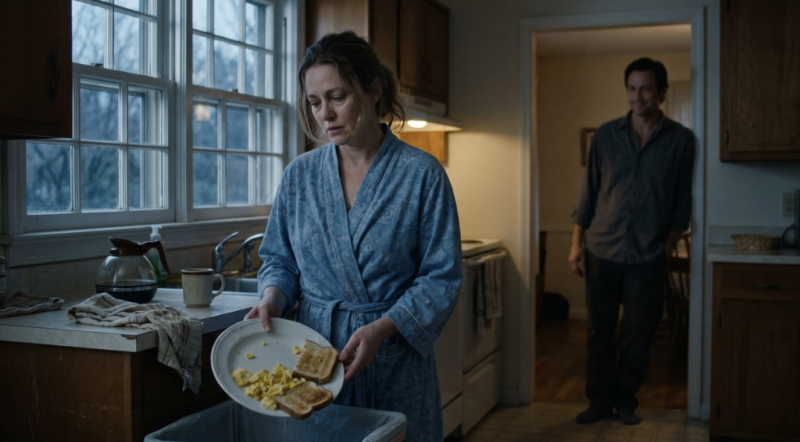
I picked up the plate, threw the food in the trash, and turned to him.
“Then make your own breakfast from now on.”
I expected him to yell.
Instead, he smiled.
It was a satisfied smile.
“Good,” he said. “That’s exactly what I was hoping for.”
I didn’t understand what that meant, and he wouldn’t explain. He just stood up, rinsed his fork, kissed my head like we had resolved something, and went upstairs to shower.
In the following days, he started making his own breakfast and acted cheerful.
A week later, his sister Elaine knocked on the door while Mark was at work.
I let her in and poured us coffee.
She didn’t touch hers.
She sat at the kitchen table, looked at me, and said, “I’m not here to ask you to cook for him again.”
I frowned.
“Then why are you here?”
She reached across the table and held my hand.
“I’m here to beg you to stop apologizing.”
Elaine looked at the stove and then back at me.
“Mark called me two days ago,” she said. “He sounded proud. Said you finally stopped babying him. That’s when I knew.”
“Knew what?”
She squeezed my hand tighter.
“That he was doing it again.”
She studied my face.
“He smiled when you finally snapped?”
I stared at her.
“How do you know that?”
She opened her bag and took out an old envelope, yellowed at the edges and sealed with tape that had darkened with time.
“Before Renee died, she asked me to give this to the next woman who started blaming herself.”
For a second, I thought I’d misheard.
“The next woman?”
Elaine nodded.
“He did the same thing to her.”
My fingers trembled before I even touched the envelope.
I opened it and unfolded the paper inside.
The letter began without a name.
“If you are reading this, it means he has started again.”
I stopped there and covered my mouth.
I kept reading.
Mark didn’t believe in love unless it survived pressure.
He called it honesty.
Standards.
Helping someone grow.
But it was always a test.
The worst part, she wrote, was that he seemed sincere.
He believed pain proved devotion.
“If someone truly loves me, they’ll stay even when it’s hard to love me.”
My hands started shaking even more because Mark had said something like that in our first year of marriage.
We had argued because he corrected me in front of friends about the name of a restaurant.
Everyone laughed.
He called it a joke.
I cried in the bathroom.
Later, when he knocked on the door, he said, “I know I’m not easy, Laura. But real love doesn’t leave the first time things get hard.”
Now I understood he had been telling me the rules.
I looked at Elaine.
She was already watching my face.
“That wasn’t relief,” she said. “In his mind, you finally passed.”
“Passed what?”
“A test you never agreed to take.”
Elaine told me that once, years ago, Renee had said Mark needed a woman who would stand up to him. After Renee became ill, he repeated that phrase until it became permission. He decided he was evaluating whether the woman beside him was strong.
He called it respect.
Elaine called it something else.
Control.
I asked if Renee ever pushed back.
Elaine gave a tired, sad smile.
“Toward the end, yes. When she was too exhausted to keep performing for him, she started telling the truth.”
Then Elaine reached into her bag again.
“There were two letters,” she said. “One for the next woman. Another for Mark.”
I looked at her.
“You never delivered his?”
She shook her head.
“I was afraid he would distort that too.”
She placed the second envelope on the table between us.
Before I could touch it, she said:
“Renee told me that if he started again, the next woman should read this first. So she would know she wasn’t imagining it.”
I picked up the second letter.
“If you read this,” Elaine said quietly, “you won’t be able to unknow it.”
For a moment, I wanted to push it back across the table.
I wanted to stay with the version of my life I understood.
Then I opened it.
This one was shorter. More direct.
Renee wrote that love was not something Mark had the right to measure through pressure, hunger, silence, or criticism.
She wrote that making someone prove devotion by enduring pain was not strength.
It was cruelty wrapped in a romantic story.
Then came the sentence that settled everything in me.
“If you keep telling yourself you are teaching love when you are actually draining it, that is a choice, not confusion.”
Elaine stayed with me while I folded the letters back into their envelopes.
Finally, she said:
“I took too long.”
I looked at her.
She swallowed hard and continued.
“I heard Renee say those same words at this table, and I still allowed myself to believe it was a marriage problem, not harm.”
Then Elaine stood, squeezed my shoulder, and left me alone with the letters.
Mark came home after seven that night.
He walked in smelling like smoke and cold air, dropped his keys into the bowl by the door, and kissed my cheek.
“Long day,” he said.
I watched him take off his coat.
Then I asked:
“Was breakfast ever about breakfast?”
He froze.
His eyes went to the kitchen and then back to me.
“Did Elaine come here?” he asked.
“Answer.”
He let out a long sigh and sat at the table.
After a silence, he said:
“No. It wasn’t about breakfast.”
“Then what was it about?”
He ran both hands over his face.
“I got tired of watching you bend yourself for me.”
“So your response was to wear me down until I reacted?”
He frowned, as if I were being unfair.
“I kept thinking: ‘why won’t she react?’”
“To criticism of everything I did?”
He shrugged.
“I respected you more when you finally did.”
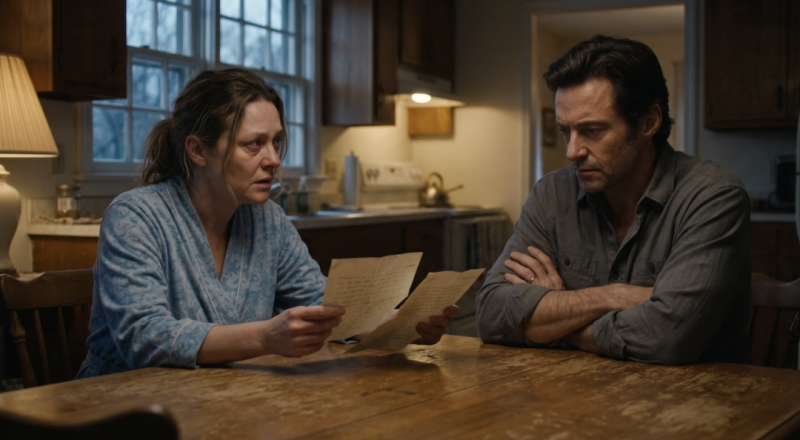
I sat across from him and placed both letters on the table.
His eyes moved from the envelopes to my face.
“Elaine gave you these?”
“Yes,” I said. “And I read them.”
He reached for the one addressed to him, but I kept my hand on it.
“No. You listen first.”
Then I read Renee’s words aloud.
“Love is not something you can measure through pressure.
Making someone prove devotion by enduring pain is not strength. It is cruelty.
If you keep telling yourself you are teaching love when you are actually draining it, that is a choice, not confusion.”
Mark stared at me as if the floor had shifted.
He took a shaky breath for the first time that night.
“That’s not what she meant,” he said, but there was no strength in his voice.
“She believed in me,” he added. “She knew I needed someone strong.”
“No,” I said. “She knew you needed an excuse.”
He flinched.
I continued, because I had spent too long softening things for him.
“You didn’t misunderstand it. You distorted it into something that served you.”
“You used Renee as a measuring stick for me, but she was warning you, not helping you. She saw it in you before I did.”
He put a hand over his mouth and looked away.
I wanted to say this was the moment everything changed, but that would be too easy.
Mark didn’t become gentle overnight.
But he cried.
First in silence, then with the kind of broken, disbelieving grief of someone discovering that their favorite story about themselves was never true.
For a moment, I wondered if even his tears were another test.
If I comforted him too quickly, would he call that love too?
“I thought she wanted me to be stronger,” he said.
“No,” I replied. “She wanted you to stop confusing pressure with love.”
He nodded, but I already understood enough to know that understanding something in a moment doesn’t undo years of choice.
Tears don’t fix anything.
So I told him what would happen next.
“I’m not forgiving you today,” I said. “And I’m not taking a test I never agreed to take.”
Instead, I gave him two choices.
“You can go to real therapy and show change over time, or we separate respectfully. No speeches. No promises today. Just a decision.”
He asked if I was leaving.
I said, “That depends on what you do when no one is applauding you.”
He looked at the letters.
I went to the guest room that night.
Not to punish him.
But to give myself space that didn’t depend on his moods, his needs, or his rules.
The next morning, I woke up at five out of habit and stared at the ceiling.
For years, that hour had belonged to my husband.
His coffee.
His breakfast.
His approval, if I could earn it.
I rolled over and went back to sleep.
It felt almost like rebellion.
In the months that followed, Mark started therapy.
He cooked for himself.
He didn’t change overnight.
He still seemed to want credit for basic decency.
But when discomfort showed up, he had to sit with it alone.
I stopped waking up at five unless I wanted to.
I read in bed before work.
Took long, slow showers.
Let silence stay silence instead of filling it with service.
Whether the marriage would survive was still uncertain.
But I was back in my own life again, and that came first.
A few months later, Mark made breakfast one morning when neither of us had anywhere to be.
I smelled butter and coffee before I even got out of bed.
When I walked into the kitchen, he was at the stove, trying to look casual.
He set a plate in front of me.
Eggs.
Toast.
Bacon slightly overcooked.
Before, that would have tightened my stomach.
Before, I would have waited for Renee’s name to come up in conversation.
Then he sat across from me and waited.
Maybe for praise.
Maybe for correction.
Maybe for some sign he had done enough.
I took a bite, swallowed, and said, “Thank you.”
That was all.
I didn’t praise him.
I didn’t rescue him from silence.
I just ate in peace.
And for the first time, he had to sit with his own discomfort instead of handing it to me and calling it love.