My 10-year-old daughter used the last of her money to buy a meal for a homeless man. The following morning, he showed up at our front door and quietly said something that completely changed the way I saw everything.
"Yesterday revealed a trap."
The man on my porch spoke so quietly that I almost didn’t hear the words.
Six black cars were lined up on our narrow street. Relatives and witnesses stood near the sidewalk while my neighbors watched through their curtains.
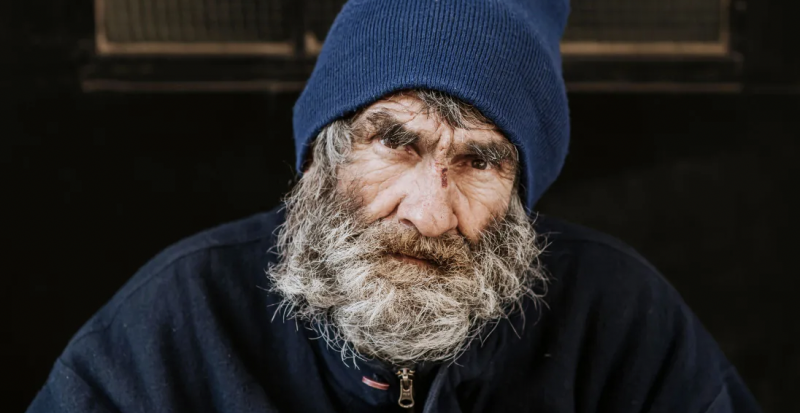
His torn coat and beard were gone. Evelyn had given him a clean suit, but his tired eyes and the dog beside him were the same.
"Yesterday revealed a trap."
"Barry?" I kept the chain locked on the door. "Why are you here?"
My ten-year-old daughter, Emma, appeared behind me wearing her pajamas.
Barry looked at her and tightened his grip on his hat.
"I only discovered the truth recently, but Frank's son was hidden from this family for ten years."
I pulled Emma behind me.
"Why are you here?"
"Did you know my husband?"
"I didn't know him well enough," he said. "But I knew his family."
An older woman stepped out of the closest car.
She had silver hair and Frank's eyes.
Barry lowered his voice.
"Rachel, your husband's family was told that your daughter had died before she was born."
"Did you know my husband?"
I closed the door.
The chain hit against the wood.
"Mom?" Emma whispered. "What did he mean?"
I pressed both hands against the door.
Less than 24 hours earlier, Barry had been sharing bread with his dog.
Now he knew my husband's name.
"What did he mean?"
Somehow, he also knew our story.
That previous day had started with Emma hiding a wet sock.
I sat at our scratched kitchen table, smoothing crumpled bills beneath my palm.
Since Frank died before Emma was born, I had learned to make every penny count. One chicken became four dinners, and every dollar already had a purpose.
That morning, I had enough money for groceries, bus fare, and electricity.
Then Emma entered the kitchen too carefully.
I looked down.
"Emma, why are you walking like that? Show me your shoes."
"I'm fine."
"Lift your foot, Em."
"Show me your shoes."
She sighed and lifted her foot.
The sole of her boot had split open near the toe. Her sock was completely wet.
My stomach dropped.
"How long has it been like this?"
"It only gets wet when it rains."
"It has rained all week, Emma."
She shrugged.
"We're buying boots today, girl. End of story."
"I have money, Mom!" she said.
Emma ran to her room and came back with a small beaded purse. She poured birthday bills and coins onto the table.
"You don't buy necessities," I said. "You're ten years old. I do that."
"I have money, Mom!"
"You buy everything."
She wasn't being disrespectful; she was being sincere, and that made it worse.
"I'm your mother. That's my job."
"I know. But I can help."
I looked at her wet sock and pushed most of the money back.
"You can add a few dollars. I'll pay the rest."
"You buy everything."
She smiled and put the coins away.
On the way to the shoe store, we passed the restaurant.
Emma looked at the red booths.
"I set aside enough money for lunch," I said. "Two bowls of soup and toasted sandwiches, okay?"
"And the groceries?"
"That's different money."
"And the bus fare? And the electricity bill?"
"I listen when you worry, Mom."
"You should be thinking about your friends."
"I think about both."
Before I could answer, she stopped.
An older man was sitting against the brick wall near the alley. A thin brown dog rested its chin on his knee.
The man held a piece of bread.
"I listen when you worry, Mom."
He broke the bread in half and gave the larger piece to the dog.
"Why did he do that?" Emma asked.
"Because he loves her."
"But he's hungry too."
"Sometimes loving someone means pretending you're less hungry than you really are."
Emma opened her purse.
"Because he loves her."
"No, Emma."

"I didn't do anything."
"You were going to use your boot money."
"He needs lunch."
"And you need dry feet."
She looked at the torn sole.
"He needs food more. I'll be okay."
"No, Emma."
I reached for my wallet.
"We're going to buy food for him."
"A real meal."
"Yes, sweetheart. I'll pay for everyone."
Emma closed my fingers over the money.
"We still need groceries."
"A real meal."
"I said this money is separate."
"And the bus fare. And the electricity bill."
I stared at her.
"You shouldn't have to think about those things."
"I don't worry about them," she said. "I just know you do."
The man gave his last crumbs to the dog.
I looked at her.
"Okay. You can buy his lunch. I'll pay for ours."
Emma ran over to him.
"Sir?"
He looked up.
"Would you and your dog like to eat with us?"
His eyes moved toward me.
"I don't want trouble."
"You're not in trouble," I said. "My daughter is stubborn."
"I'm generous," Emma corrected.
The dog's tail hit the sidewalk.
The man smiled.
"I'm Barry. This is Gypsy."
"I'm generous."
Inside the restaurant, Emma ordered soup, meatloaf, and coffee for him. She ordered plain cooked meat for Gypsy.
I ordered the cheapest soup.
Emma noticed.
"You said I could choose what I wanted, Mom."
"You can."
"You can too."
"I want soup."
She gave me the look she used when she knew I was lying but loved me enough not to say anything.
Barry ate slowly. He hid small pieces of food for Gypsy under the table.
When the bill arrived, Emma emptied her purse. She counted every bill and coin twice.
Barry watched.
"Why spend everything on a stranger?"
"Because you looked lonely."
"Lonely people don't always deserve kindness."
"Maybe not," she said. "But they still need it."
His eyes turned toward me.
"Was it your mother who taught you that?"
"Yes, she did."
Barry's hand stopped over the coffee cup.
"Where is your father?"
"He died before I was born."
"What was his name?"
"Frank. My mom said his mother's name is Evelyn."
The spoon hit against his bowl.
I held Emma's hand.
"Where is your father?"
"Did you know him?"
Barry looked at her face.
"You have his eyes."
"How did you know my husband?"
He pushed his chair back.
"What is your last name?"
"Did you know him?"
"I won't tell you."
"Please."
"No."
Emma leaned forward.
"We live near the old park."
"Emma."
She shrank back into the chair.
"Please."
Barry went pale.
"Frank would be proud of you," he whispered.
Then he looked at me.
"You did a good job raising her."
He left quickly.
I followed him, but when I reached the corner, Barry and Gypsy were already gone.
I bought Emma’s boots using the grocery money.
At the store, I put back the cereal, cheese, and coffee I wanted for myself.
"You did a good job raising her."
Emma noticed every item.
She didn’t say a word.
The next morning, Barry knocked again.
"Rachel," he called through the door. "Please let me explain."
"Start talking."
"Yesterday revealed a trap that started ten years ago."
"Please let me explain."
The older woman stepped forward.
"My name is Evelyn," she said. "Frank was my son."
My hand tightened around the lock.
Frank rarely talked about his mother. After we married, they argued because Evelyn believed I had taken him away from the family.
Frank left when she refused to respect our marriage.
After he died, I wrote to her about the funeral, my pregnancy, and Emma’s birth.
"Frank was my son."
Almost every letter came back unopened.
"You knew where we lived," I said.
Evelyn’s mouth trembled.
"I was told you had left the country."
"Who told you that?"
Before she could answer, another woman appeared on the porch.
"Who told you that?"
She was elegant, rigid, and angry.
"This has gone too far, Mother."
Barry tensed.
I opened the door two more inches.
"Who are you?"
"Margaret. Frank’s sister."
"Who are you?"
Frank had mentioned her once. He said Margaret always found the version of the truth that best served her interests.
She looked at my old robe and the peeling paint on the door.
"This is exactly what I warned you about," she said to Evelyn. "She is already using this child to make you feel guilty."
I removed the chain.
"Her name is Emma."
Margaret’s eyes moved over me.
"Where is she?"
I blocked her view.
"You don’t ask about my daughter before explaining why you’re in my yard."
"You disappeared for ten years," she said. "Now you want money."
"I never asked anything from you."
"You never contacted us."
"Where is she?"
"I wrote every year."
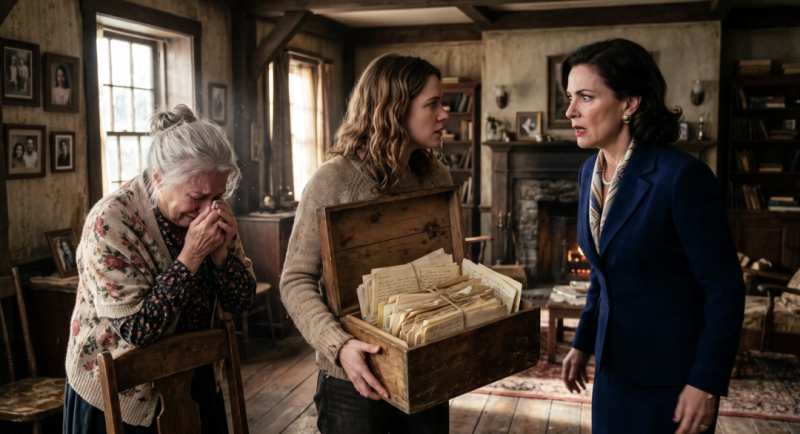
I went to the bedroom and pulled a cardboard box from the closet.
Inside were returned letters, postal receipts, birthday cards, and pictures of Emma growing up.
Every envelope had Evelyn’s address.
I dropped the box at Margaret’s feet.
"I wrote every year."
She barely looked down.
"These letters could have been made yesterday."
Barry pulled several yellowed envelopes from inside his coat.
"I found these on her desk. She kept some, but everything else was returned to Rachel."
Barry looked at Evelyn.
"Margaret fired me when I found the letters. The cottage came with my job, so losing one meant losing the other."
Evelyn let out a sad sound.
"I found these."
Margaret’s expression changed for only a second.
Then she lifted her chin.
"I was protecting my mother."
"From photographs of her own granddaughter?"
"From you."
"You told her my baby had died."
"You would have used Emma to gain access to the inheritance."
"I was protecting my mother."
I stepped closer.
"My daughter is not an inheritance problem."
"You don’t understand what Frank did to this family."
"He chose his wife."
"He abandoned us."
"He stepped away from people who tried to control his life."
"He chose his wife."
Evelyn closed her eyes.
"I need to sit down."
I let Evelyn and Barry come inside.
Margaret moved toward the door.
I stopped her.
"You stay outside."
"This is a family matter."
"This is my house, my daughter, and my decision."
For the first time, Margaret had no prepared answer.
Inside the house, Evelyn sat on our worn-out sofa while Emma watched from the hallway.
"She has Frank’s eyes," Evelyn whispered.
I stood between them.
"You cannot claim her just because she looks like him."
"She has Frank’s eyes."
"I know. I came to ask, not claim."
Emma looked at me. I nodded.
"Are you my grandmother?"
Evelyn covered her mouth with her hand.
"I should have been."
"You were," I said. "You just weren’t here."
"I want to fix things."
"You can’t replace ten years."
"No," she said. "But I can tell you how we found you."
Barry lowered himself into a chair.
"After the restaurant, I went to Evelyn’s house and refused to leave," Barry said.
"He arrived exhausted," Evelyn added. "Then he told me about Emma. I helped him clean up and we talked all night."
"You can’t replace ten years."
"And the cars?" I asked.
"They belong to relatives who believed Margaret," Evelyn said. "I wanted them to hear the truth. But I came to apologize and meet my granddaughter."
Emma stayed beside me.
"Meeting her doesn’t mean we’re a family again," I said.
"I understand."
Barry reached inside his coat.
"I found this with your letters."
He handed me an old envelope.
I recognized Frank’s handwriting immediately.
The letter admitted that Evelyn had offered Frank money to leave me.
"You tried to buy my husband away from me."
"I thought I was protecting him."
"I recognized Frank’s handwriting."
"That’s the same excuse Margaret used."
"I was wrong, Rachel."
"You were cruel."
Emma touched my sleeve.
"Does this make Dad a bad person?"
"No. But he hid something from us that hurt us."
"He should have told you."
"He should have."
I turned to Barry.
"Where did you sleep?"
"In my car with Gypsy."
Emma looked at him.
"Then how did you find us?"
Barry looked into her eyes.
"I didn’t find you. You found me."
That weekend, Evelyn had planned to announce that Margaret would take control of her finances, correspondence, and family matters.
Margaret had already told everyone that I had appeared and demanded money.
"I didn’t find you. You found me."
I gathered my letters and receipts.
Emma waited near the door wearing her new boots.
"Will it take long?"
"I hope not."
Barry joined us as we entered the meeting.
"I hope not."
Margaret stood up immediately.
"What is she doing here?"
"I'm here because you spent ten years telling people who I am."
"This is private."
"You made it public when you called me a liar."
I placed the box on the table.
"I wrote to Evelyn every year. These are my copies, postal receipts, and the letters that came back."
Margaret barely looked at them.
"They prove you sent envelopes. They don’t prove what was inside."
Barry stepped forward and placed several old envelopes beside the box.
"These prove the rest," he said. "I found them hidden in your desk."
The room fell silent.
Margaret’s face hardened.
"I protected this family. Frank left, and Rachel would have used that child to try to get part of the inheritance."
Emma moved closer to me. One of her boots made a small squeak against the polished floor.
"My daughter has a name," I said.
Margaret looked away.
"My daughter has a name."
"You erased Emma because you didn’t want to share what you expected to inherit."
"I stayed," she replied. "I took care of Mom’s accounts, appointments, and emergencies."
Evelyn slowly stood.
"And you used that responsibility to control every part of my life."
"Mother, I gave up years for you."
Evelyn slowly stood.
"You also hid my granddaughter, lied that she was dead, and pushed Barry away when he discovered the truth."
Margaret went pale.
Evelyn looked at everyone in the room.
"Margaret is removed from handling my affairs until an independent legal review is completed."
"You can’t do this to me."
"You also hid my granddaughter."
Evelyn’s voice did not shake.
"You did this to yourself."
No one defended Margaret.
Emma held my hand.
"Can we go home after this?" she whispered.
"Yes."
"You did this to yourself."
Her boots were finally dry, and Margaret could no longer pretend that the child she erased from history was just a threat on paper.
Weeks later, Barry moved into an apartment where Gypsy was welcome.
Evelyn paid what he was owed and covered the housing costs he had lost.
"Don’t call it charity," I said. "Ask what he needs."
Barry chose the apartment himself, and Gypsy claimed the sunny window.
A week later, Evelyn sat across from me at my kitchen table.
"I failed Frank before Margaret ever lied," Evelyn said.
"You did."
"I owe both of you more than money."
"I failed Frank."
"Then understand something: Emma does not need to be saved. There will be no gifts without asking, private promises, or money connected to access to her."
Evelyn nodded.
"You set the rules."
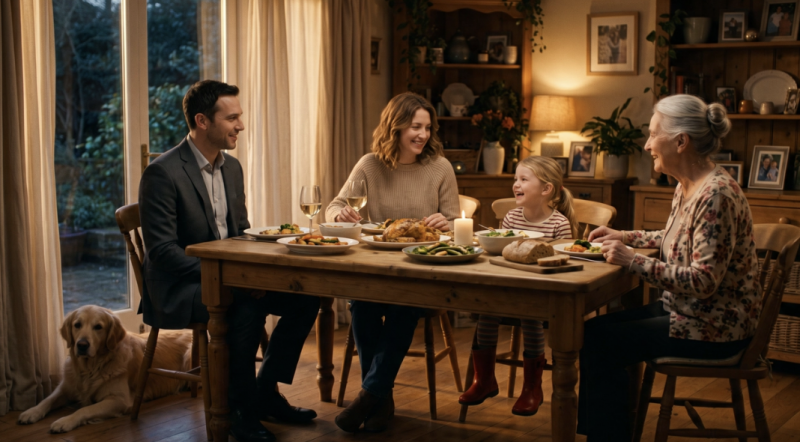
That night, Evelyn had dinner with us. Barry came too, with Gypsy sleeping beneath his chair.
"You set the rules."
Evelyn looked at the chicken, potatoes, and carefully divided portions.
"I’m sorry you had to live this way."
"Don’t apologize for my table. We survived."
"Then what should I apologize for?"
"For making Frank choose, and for letting your pride stop you from looking for us."
She accepted that without trying to defend herself.
"I’m sorry you had to live this way."
I served another piece of chicken to Emma.
"Tell me something true about her father."
Evelyn smiled.
"At sixteen, he gave his winter coat to someone and said he had lost it. He found someone who was colder."
Emma laughed, and Evelyn laughed with her.
"Tell me something true about her father."
Margaret had stolen ten years, but she would never control our truth again.
Frank’s family finally found his daughter.
I would decide how they stayed.