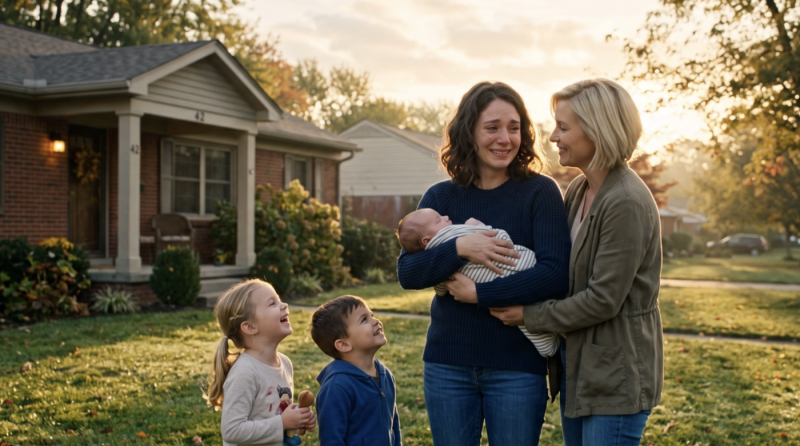
My daughter asked me to babysit her children, but when she returned 10 days later, she had a different baby with her. Shocked and confused, I decided to call the police.
She promised she would be back before dinner. Ten days later, she showed up in my garage, injured, exhausted, and holding a baby that no one knew existed.
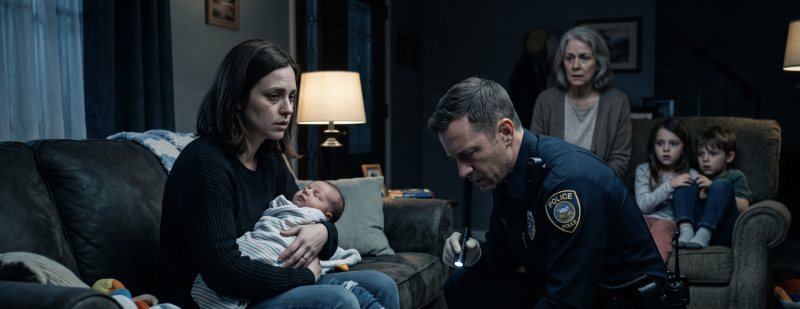
The officer pulled the baby’s sock down.
A thin white plastic band surrounded her ankle.
It wasn’t a hospital bracelet.
This one was thinner, with a small black square embedded near the clasp.
The officer looked at it for half a second.
Then he grabbed his radio.
— Dispatch, I need Major Crimes and Child Protection at this address. Possible active tracking device. Involving an infant.
My daughter, Emily, was sitting on my couch with both hands folded in her lap.
She didn’t look surprised.
She looked relieved.
I stepped between her and the officer.
— What do you mean, tracking device?
The second officer walked to the front window and closed the curtains.
— Ma’am, step away from the glass.
My grandchildren, Noah and Lily, were standing in the hallway.
Noah was seven.
Lily was four.
Both of them stared at the baby as if she had appeared from a fairy tale.
Emily turned toward them.
— Go upstairs with Grandma.
— No, — I said. — You’re coming with us.
The officer near the window shook his head.
— She needs to stay here.
— She’s my daughter.
— And that baby may be evidence.
Emily flinched at that word.
Evidence.
The newborn made a small sound against her chest.
Emily lowered her face and kissed the top of the baby’s head.
— I’m sorry, — she whispered.
I didn’t know which one of us she was talking to.
Ten days earlier, Emily had left Noah and Lily at my house and promised she would be back before dinner.
Then she disappeared.
For ten days, I imagined every terrible thing a mother could imagine.
Her car at the bottom of a river.
Her body found somewhere in a field.
A stranger answering her phone.
But instead, she came home carrying a child no one knew existed.
— What did you do? — I asked.
Emily looked up.
— I brought her back.
— Back from where?
Before she could answer, the baby started crying.
Emily pulled the blanket aside to adjust it.
That was when I saw the injuries.
Small purple marks covered the baby’s left arm.
They weren’t fingerprints.
They were needle marks.
My stomach turned.
— Oh my God.
Emily covered them quickly.
— They were testing her.
— Who was?
She looked toward the window.
Then she said the name so quietly I almost didn’t hear it.
— Dr. Voss.
I knew that name.
Everyone in our county knew it.
Dr. Voss ran the Bellweather Family Center, a private maternity clinic 32 kilometers from town.
The building appeared in commercials during the evening news.
Soft music.
White rooms.
Smiling mothers.
Voss looking into the camera and saying:
— Every child deserves a safe beginning.
He had delivered Lily.
Emily trusted him.
So did I.
One of the officers crouched near her.
— Emily, where did you get this baby?
— Bellweather.
— Did you take her from the clinic?
— Yes.
The officer’s expression hardened.
— Are you saying you kidnapped her?
Emily looked at the baby.
— No.
— Then whose child is this?
My daughter finally met my eyes.
— Mine.
The room went silent.
I gave a short laugh. Not because it was funny.
— You weren’t pregnant.
— I know.
— You would have told me.
— I couldn’t.
— You left your children here ten days ago wearing jeans and a sweater. You weren’t pregnant.
Emily started crying.
— Mom, I said she’s mine. I didn’t say I was the one who gave birth to her."Mom, I said she's mine. I didn't say I gave birth to her."
Two unmarked cars arrived five minutes later.
Detective Cole entered first.
She was in her late 40s, short, with gray hair beginning at her temples and a voice that never rose.
A woman from Child Protection came in behind her carrying an infant medical bag.
They examined the ankle band without removing it.
Then they turned off every phone in the house.
Mine.
The officers'.
Even the television.
Detective Cole placed them inside a metal evidence case.
"What is happening?" I asked.
"The tracker is transmitting," she said.
"To whom?"
"We're trying to find out."
Emily shook her head.
"Bellweather."
Cole looked at her.
"You know that?"
"I saw the monitor."
"What monitor?"
"The one with all the babies."
The child protection worker took the newborn from Emily.
For the first time, my daughter resisted.
Her arms tightened.
"She's sick."
"We need to check her."
"You can't take her to County General."
"Why not?"
"Voss has people there."
Detective Cole leaned forward.
"Emily, you need to start at the beginning."
My daughter stared at the floor, then she looked toward the stairs.
"Not in front of Noah and Lily."
I took the children upstairs.
Noah stopped me outside the bedroom.
"Is that our sister?"
The question hurt more than it should have.
"I don't know."
"Mom said her name is Grace."
I looked back toward the stairs.
"When did she tell you that?"
"Before she left."
My hand tightened on the railing.
"Ten days ago?"
Noah nodded.
"She said if she came back with a baby, we had to be nice because the baby had been alone."
Emily had known.
Whatever happened had not begun during those ten days.
She had planned it.
When I returned downstairs, Detective Cole had placed a recorder on the coffee table.
Emily sat with a blanket around her shoulders.
The newborn slept in a portable bassinet beside her.
I stayed near the doorway.
Emily took a breath.
"Three months ago, I received a letter."
"From whom?" Cole asked.
"It wasn't signed."
"What did it say?"
"That one of my embryos had survived."
I stopped breathing.
Five years earlier, after Lily was born, Emily and her ex-husband, Jake, had thought about having another child.
Emily had undergone fertility treatment before both pregnancies.
There were remaining embryos.
She and Jake signed documents authorizing their destruction after the divorce.
Emily cried for a week, and then told me everything was settled.
— The clinic sent confirmation, — I said.
— They lied.
Detective Cole’s eyes narrowed.
— Bellweather kept an embryo?
— More than one.
Emily looked at the sleeping baby.
— They implanted my embryo into another woman.
The room seemed to spin.
— Without your permission? — Cole asked.
— Without hers either.
The woman who carried Grace was named Tessa.
She was 26 years old.
She was single.
She went to Bellweather for treatment after suffering several miscarriages.
Voss told her he was implanting an embryo created from her egg and donor sperm.
At 28 weeks, Tessa overheard two nurses arguing.
One accused the other of switching identification labels.
Tessa started asking questions.
Two days later, the clinic informed her that she had developed a dangerous psychiatric condition.
They moved her to a private room.
They took her phone.
They restricted her visitors.
— They told everyone she was unstable, — Emily explained. — They told her family she didn’t want contact.
— How did she get in touch with you? — Cole asked.
— One of the nurses helped her.
— Which nurse?
— Caroline.
Detective Cole looked at the other officer.
I recognized the name.
Caroline had been reported missing eight days earlier than Emily disappeared.
Her photo had appeared beside Emily’s in the news.
Two women.
Two separate disappearances.
Except they were never separate.
— Caroline sent the letter, — Cole said.
Emily nodded.
— She included test results. Embryo records. My signature on the destruction form.
— And you believed her?
— Not at first.
Emily opened her dirty jacket.
A flash drive was sewn inside the lining.
— I found her.
— Where?
— At a rest stop outside the county.
— What did she tell you?
— That Bellweather had been doing this for years.
The clinic targeted families with stored embryos.
Sometimes parents requested they be destroyed.
Sometimes they stopped paying storage fees.
Sometimes they moved and never updated their addresses.
Voss marked those embryos as discarded.
Then he sold them.
Not through legal adoption.
Not through approved donation.
But through private arrangements with wealthy clients desperate to have children.
Some babies went to the women who carried them.
Others did not.
— What does that mean? — I asked.
Emily’s face went pale.
— He chose which families deserved to keep them.
Grace moved in the bassinet.
Emily stared at her.
— Tessa wasn’t supposed to leave with the baby.
The room fell completely silent.
According to the records, Tessa was only a surrogate.
After delivery, Grace was supposed to be transferred to a couple from another state.
They had paid Bellweather $240,000.
Tessa knew nothing.
Neither did Emily.
— What happened ten days ago? — Detective Cole asked.
— Caroline called me at six in the morning. Tessa had gone into labor.
Emily had brought Noah and Lily to my house because she planned to meet Caroline at a motel.
She expected to be gone only a few hours.
They were going to take the records to a lawyer.
But Caroline never arrived.
Instead, Emily received a video.
On the screen, Caroline was sitting in a chair inside Bellweather.
Her face was bruised.
Voss was standing behind her.
— He knew about the files, — Emily said. — He told me I had to come alone if I wanted Caroline alive.
I covered my mouth.
— You went?
— I couldn’t call the police.
— Why?
— Because he sent me a picture of Detective Harris inside his office.
Harris had led the search for Emily.
He had sat in my kitchen and promised he would bring my daughter home.
Every night, he called with updates.
No witnesses.
No cameras.
No leads.
He was making sure none existed.
Detective Cole paused the recorder.
Then she left the room.
When she returned, two officers were gone.
— Continue, — she said.
Emily drove to Bellweather through a service entrance at the back.
Voss took her phone.
He showed her Tessa, sedated and trapped in a recovery room.
Grace had been born less than an hour earlier.
Caroline was there too.
Alive.
Voss offered Emily a choice.
Sign new documents giving up all rights to the embryo, and both women would be released.
— I signed, — Emily said.
I stared at her.
— You signed away the baby?
— I was trying to keep them alive.
— He forced me to stay while the staff prepared Grace for transport.
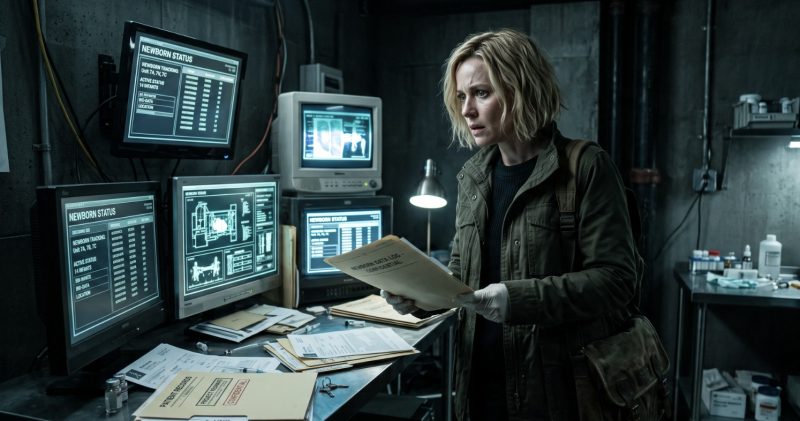
That was when Emily saw the monitors.
Every baby wore an ankle band.
Each band showed a location, a medical file, and a payment status.
Payment status.
Babies listed as merchandise.
Some had green circles beside their names.
Others had red circles.
Grace’s was gold.
— What did gold mean? — Cole asked.
— Private transfer completed.
The buyers were scheduled to arrive the next morning.
Emily waited until Voss left the recovery wing.
Caroline had hidden an access card inside her shoe.
They freed Tessa.
Then the power went out.
— Caroline did that, — Emily said. — She told us the emergency system would lock the main exits but open the old fire doors.
The three women escaped.
Tessa could barely walk.
So Emily carried Grace.
They reached the parking lot and found Detective Harris waiting.
My hands went cold.
— What happened?
— Caroline told us to run.
Emily’s voice broke.
— She stayed behind.
— Is she dead? — I asked.
— I don’t know.
Emily stole a vehicle from the clinic.
She took Tessa and Grace to an abandoned hunting cabin Caroline had prepared.
They stayed there for nine days while Tessa recovered.
No phones.
No bank cards.
No roads with cameras.
— Why didn’t you come home? — I demanded.
— Because Harris was watching you.
She looked at me.
— The moment I showed up, he would know where Tessa was.
On the ninth night, Tessa developed a fever.
The bleeding got worse.
Emily decided they couldn’t wait.
She drove Tessa to a hospital across the state line, left her at the emergency entrance with the flash drive, and waited until doctors took her inside.
Then she drove home with Grace.
— You left Tessa alone?
— She told me to.
Emily’s eyes filled with tears.
— She said if we stayed together, Harris could take the baby before anyone opened the files.
Detective Cole stood up.
— We need to leave.
— Why? — I asked.
She looked at the covered window.
— Because Harris knows Emily is here.
Headlights illuminated the wall of my living room.
One car stopped outside.
Then another.
Detective Cole drew her weapon.
— Everyone get down.
The front door shook from a heavy knock.
— County police! — a man shouted. — We have a warrant to recover a kidnapped infant.
Emily grabbed Grace.
Detective Cole pulled her away from the bassinet.
— Put the baby down.
— No.
— Emily, listen.
The newborn started crying.
Outside, Detective Harris called my daughter’s name.
— Emily, you’re not in trouble. Open the door.
His voice sounded exactly like it had during the searches.
Calm.
Patient.
Safe.
Noah appeared halfway down the stairs.
— That’s the officer who came before.
I ran toward him.
The front window exploded.
A metal container rolled across the carpet.
Smoke filled the room.
Cole shouted for us to move.
I grabbed Lily.
Noah held onto my robe.
Emily followed behind with Grace pressed against her chest.
We ran through the kitchen and into the garage.
An officer opened the side door.
A gunshot echoed.
He fell backward.
Emily screamed.
Detective Cole fired toward the garage entrance.
— Get in the van!
We climbed into an unmarked police vehicle.
Cole jumped behind the wheel.
As she reversed, Harris stepped out from behind my car.
He raised his weapon.
Then another shot rang out.
Harris collapsed.
A woman stood near the fence holding a pistol with both hands.
A hospital gown showed beneath an oversized coat.
Tessa.
Blood ran down one of her legs.
Two state troopers rushed toward her.
She lowered the gun.
— I told them everything! — she shouted.
Detective Cole drove us away.
By sunrise, the Bellweather Family Center was surrounded by state police and federal agents.
Dr. Voss was arrested while trying to escape through a maintenance tunnel.
Detective Harris survived.
Caroline did too.
Police found her locked inside a medication storage room.
The files on Emily’s flash drive led investigators to 23 children born through illegal embryo transfers.
Some were still babies.
Others were nearly teenagers.
Not every family knew the truth.
Some parents believed they had followed all legal procedures.
Others had paid Voss to make questions disappear.
Grace’s case became the center of the investigation.
Genetic tests confirmed what Emily already knew.
The embryo had been created from Emily’s egg and Jake’s sperm.
Biologically, Grace was their daughter.
But Tessa had carried her.
Tessa felt her movements.
Tessa went through 14 hours of labor while strangers planned to sell her daughter.
For weeks, reporters asked the same question.
Who was Grace’s real mother?
Emily hated that question.
Tessa did too.
At the first custody hearing, the judge asked whether they intended to fight each other.
Emily looked at Tessa.
Then at Grace.
— No, — she said. — We’ve already had too many people deciding what this baby needs without asking us.
Tessa moved into the apartment above Emily’s garage.
It was supposed to be temporary.
That was eight months ago.
Grace sleeps downstairs with Emily.
Tessa handles the late-night feedings because she says she is already awake anyway.
Noah calls her Aunt Tessa.
Lily calls her “the other mommy,” which makes all the adults uncomfortable except Tessa.
The courts are still deciding questions of parentage, custody, and even what the law can recognize.
There is no form for this.
No box that says:
One mother raised you.
One mother carried you.
Both nearly died bringing you home.
Last Sunday, Emily came to pick up the children after spending the afternoon with me.
Grace was strapped against her chest in a baby carrier.
The tracking band was gone.
Police removed it as evidence.
A faint, almost invisible mark still circled her ankle.
Before Emily left, she stood beside the car and looked at my house.
The same way she had ten days before she disappeared.
This time, I didn’t wave.
I walked outside.
— Are you going to be back before dinner? — I asked.
She smiled.
— Yes.
— Promise?
She adjusted Grace carefully and kissed Noah’s hair.
Then she looked at me.
— I’m not making promises like that anymore.