My five-year-old child pointed at a woman in the supermarket and claimed that she was the same woman who visits our house whenever I’m away at work.
The house was silent as I stood at the foot of our bed, folding a pile of Leo’s tiny shirts. On top of the dresser, my mother’s silk scarf was curled up like a sleeping cat, still faintly carrying the scent of her jasmine perfume three months after we buried her.
I lifted it to my face and took a quick breath of its scent before I could stop myself.
“Mommy, are you crying again?”
Leo was standing in the doorway, wearing mismatched socks — one blue and one striped — holding a little juice box like it was a trophy.
“No, sweetheart. I was just smelling Grandma.”
“Grandma smells like flowers.”
“She does.”
He walked in slowly and climbed onto the bed, and I noticed it again. A streak of silver paint on the side of his thumb, dried and peeling, and another hardened mark on his elbow that I was certain hadn’t been there when I bathed him last night.
“Leo, what is this?”
“Paint.”
“I know it’s paint. Where did it come from?”
“Art class,” Mark called from the hallway, appearing behind him with coffee in one hand and his phone in the other. “The teacher is doing a unit on galaxies this week. Stars, planets, that kind of thing.”
He gave me that smile. Small, private, with the corners of his mouth held back like he was keeping something he didn’t want to let slip.
“Seems hard to wash off. Doesn’t it come out in the bath?”
“You know how he is in the bathtub. He splashes water everywhere except on himself.”
“I did it!” Leo shouted, then jumped off the bed and ran down the stairs.
Mark stepped closer and kissed my forehead, quick and affectionate.
“You look tired, Ket.”
“I’m fine.”
“Our anniversary is in three days. Ten years. Are we going to do something, or are you going to keep pretending you forgot?”
“I didn’t forget.”
“Good.”
He looked at his phone again, with that same soft smile, and slipped it into his back pocket before I could see the screen.
“I need to go out for an hour,” he said. “Take care of something.”
“On a Wednesday morning? Don’t you have work?”
“It’s something boring. I promise.”
I watched him leave and told myself I was being ridiculous.
Grief did strange things to a person. My mother used to say that suspicion was just love with nowhere to land, and lately my love had nowhere to go.
That night, I went to put away a stack of towels in the guest room, but the door wouldn’t open.
“Mark?” I called. “Why is the guest room door locked?”
“Is it?” he answered from downstairs. “Must be stuck. I’ll look at it later.”
“Do you have the key?”
“Somewhere,” he said. “Don’t worry.”
I stood there with my hand on the doorknob for a long moment. Then I walked away, because that was what a reasonable wife did. That was what a woman who trusted her husband did.
The next afternoon, I had almost convinced myself.
“Milk, apples, bread, and something for dinner,” I said to Leo as I placed him in the shopping cart. “Help me remember.”
“Milk, apples, bread,” he sang, swinging his legs.
“Good boy.”
The store was filled with the ordinary sounds of an ordinary afternoon. Squeaking wheels, a baby crying in another aisle, a muffled pop song playing from the ceiling speakers.
I grabbed a carton of milk, placed it in the cart, and joined the checkout line.
For the first time in weeks, I felt something inside my chest loosen. Almost like peace. Almost like normal.
Leo was sitting in the child seat of the cart, swinging his legs and humming while I looked at the clock, thinking about what to make for our anniversary.
Then, suddenly, he became completely still.
He tugged hard on my sleeve.
“Mommy. Mommy, look.”

The beep of the scanner behind me sounded, but the noise felt far away, like it belonged to another woman’s afternoon.
Leo kept pulling my sleeve, pointing toward the bakery section.
“I see it, sweetheart,” I whispered. “Speak quietly.”
“But it’s her,” he said, still pointing. “It’s the woman who comes to our house when you’re working! She plays upstairs in the room.”
My hand squeezed the milk carton so tightly I felt the cardboard bend.
I placed it on the conveyor belt before I crushed the package.
The woman near the bakery still hadn’t turned around.
She was young. Maybe around thirty.
She wore a short green dress, with dark hair loosely tied back, and a canvas bag hanging from one shoulder.
I couldn’t see her face. And I wasn’t sure I wanted to.
“Leo, sweetheart,” I said, crouching down so I was closer to his eyes. “What do you mean she plays?”
“Games,” he answered naturally, swinging his legs. “But Daddy said it was a secret. So I don’t tell.”
“But you just told me.”
His mouth opened. Then closed. His eyes widened with that specific panic children have when they realize they broke a rule.
“I didn’t mean to,” he whispered.
Ten years. Ten years of Sunday mornings, burnt pancakes, and Mark rubbing my back when I couldn’t sleep after the funeral.
Ten years, and my son was telling me a woman came to my house while I was at work.
The cashier said something.
I didn’t hear.
“Ma’am? Ma’am, the total. Forty-two eighteen.”
I dropped my card. Picked it up. Swiped it with a hand that wouldn’t stop shaking.
The machine made a small approval sound.
The cashier put the milk, bread, and cereal box back into the cart without looking at me.
“Mommy, are you mad?”
“No, sweetheart.”
“Your face looks mad.”
“I’m not mad at you.”
Honestly, I wasn’t mad at anyone yet.
I was somewhere colder than anger, somewhere empty where every good memory of my husband was quietly beginning to transform into evidence.
The paint on Leo’s fingers last week. Mark laughing and brushing it off. The locked guest room door on Thursday. That small private smile at his phone on Saturday morning while I made coffee.
My mother had died three months ago.
Three months, and I had been telling myself that the imbalance inside the house was only grief. Only me. Only the empty chair at celebrations and the perfume on the scarf that never faded.
I looked again at the woman’s back.
“Leo,” I asked quietly. “How many times has this woman come here?”
He counted on his fingers, lost track, and started over.
“A lot. But only when you’re working. And she brings the big bag.”
“What big bag?”
“With the sticks inside.”
Sticks. Brushes, maybe. Or something else. My mind couldn’t accept any reasonable explanation.
I pushed the cart toward the exit, but stopped.
My feet simply stopped.
I could leave.
I could put Leo in the car, drive home, and pretend I had never heard any of it.
I could confront Mark that night in the kitchen, where the lighting was soft and I would have control of the situation.
Or I could turn around right then, only a few feet away from a stranger who might already know more about my marriage than I did, and ask her directly.
“Mommy?”
“One second, sweetheart.”
I closed my eyes.
I thought about my mother, about the way she used to say that something worth knowing was worth knowing today.
I turned the cart around.
My legs felt like they belonged to someone else as I walked back toward the bakery section. Leo went quiet, sensing the change in me the way small animals sense a storm.
Ten feet. Six feet. Three.
“Excuse me,” I said. My voice came out weaker than I wanted.
The woman didn’t turn.
“Excuse me,” I repeated.
She looked up, distracted, still holding the bread.
Her eyes moved over me, reached Leo, and something flashed there. Recognition. A soft, surprised kind of recognition, like when you look at a child you’ve seen in a photograph.
Then her eyes returned to me, and she understood who I must be.
“Oh,” she said quietly.
“Do you know my son?”
She slowly put the bread down, as if buying herself a few extra seconds.
“I… think you should call your husband.”
“I’m asking you.”
She didn’t answer.
The sound of his name in her mouth had already broken something inside my chest.
I could feel Leo watching me, could feel the entire brightly lit supermarket vibrating around us, and I couldn’t make a single word come out.
She noticed.
Whatever she saw on my face, she noticed, and her expression softened, almost caring, almost sad.
She smiled at me. A small, kind, impossible-to-interpret smile.
And standing there with my son and my carton of milk, I couldn’t tell if it was the smile of a stranger trying to be kind or the smile of the woman who was quietly destroying my life.
“Who are you?” I asked.
My voice came out low, trembling, wrong.
“Sorry?”
“Who. Are. You.” I stepped closer, close enough that Leo’s swinging feet touched my hip. “My son says you come to my house when I’m at work. So who are you?”
Her expression changed. It wasn’t exactly guilt, but a careful, protected calm. She looked at Leo, then back at me.
“My name is Nora,” she said quietly. “I’ve been doing work for Mark. It’s something private, and he asked me not to tell anyone. I gave him my word.”
Private.
The word slid through me like a thin blade.
Leo went completely still in the cart, looking at me with those big eyes he made when adults used the wrong tone of voice.
“Mommy?”
“Everything is okay, sweetheart.”
It wasn’t okay.
I stared at Nora for a long moment, memorizing her face, the paint on her fingernail, the loose braid over her shoulder.
Then I turned the cart around and rushed out of the store.
“Mommy?” Leo asked.
I didn’t answer. I just kept pushing the cart toward the parking lot.
I buckled Leo into his car seat with fingers that wouldn’t stop trembling.
In the driver’s seat, I grabbed my phone and called Mark.
It went straight to voicemail.
I called again. Voicemail.
A third time. The polite recorded voice asked me to leave a message, but I couldn’t think of a single word that fit.
“Where is Daddy?” Leo asked from the back seat.
“I don’t know, sweetheart.”
“Is Daddy in trouble?”
I looked at him through the rearview mirror.
“Why would Daddy be in trouble?”
He hesitated. He bit the inside of his cheek, exactly the way Mark did.
“I wasn’t supposed to tell about the woman.”
“I know, sweetheart.”
“Daddy said it was a surprise. He said if I told, the surprise would be ruined.”
The drive home took seven minutes, but it felt like an hour.
I kept imagining the guest room.
At home, I left the groceries still in the car and carried Leo inside.
“Stay down here,” I said, placing him on the couch with the television on. “Mommy needs to check something.”
I ran upstairs.
The guest room door was locked.
I pulled the handle.
I pulled harder.
I pressed my forehead against the wood and tried to breathe.
“Mark,” I whispered, to no one. “What did you do?”
Footsteps behind me. Small footsteps.
Leo had followed me anyway, one hand gripping the railing.
“Mommy,” he said in that loud whisper children think is quiet. “I wasn’t supposed to tell.”
“Leo, sweetheart, please go back downstairs.”
“But there’s a surprise in there.” He climbed the last step. “Daddy has the key. He keeps it in his work bag. He said only him and the woman can open it because the surprise isn’t ready yet.”
I closed my eyes.
All the clues lined up in a row and formed the picture I had already drawn in my head.
A locked door. A key hidden from me. A woman who came when I wasn’t home. A child who had been told to keep a secret. And a husband who wasn’t answering his phone.
I sat down on the top step.
Leo sat beside me and rested his warm little head against my arm.
“Are you mad, Mommy?”
“I’m not mad at you.”
“Are you mad at Daddy?”
I didn’t answer.
I went back downstairs and sat on the bottom step, rehearsing sentences I never wanted to say.
“I want a separation.”
“I think you should sleep somewhere else tonight.”
“Please don’t lie to me. Not today. Not this week.”
Ten years.
Our anniversary was on Saturday.
I had bought him a watch and had a message engraved on it.
Leo appeared with his stuffed rabbit and climbed into my lap without saying anything.
That was the part that broke me, more than the locked door, more than the woman in the green dress.
He knew something was wrong, and he was trying to fix everything with a stuffed rabbit.
Suddenly, my phone vibrated against my leg.
I almost didn’t look.
When I did, my hand went cold.
It was a photo sent by Mark.
The inside of the guest room, taken from the doorway.
Half of one wall was covered with soft, unfinished brushstrokes in shades of blue and warm brown, the beginning of a face.
The face of a woman.
Eyes I would recognize anywhere.
My mother’s eyes.
Below the photo were four lines:
“I took this photo yesterday.”
“I still wasn’t ready to show you.”
“Please come upstairs.”
“I love you.”
I opened the photo again.
The blue paint.
The silver stars.
Leo’s paint-stained fingers.
The locked door.
Nora’s paint-covered hands.
Every clue I had spent the last hour arranging as evidence of betrayal suddenly rearranged itself into something completely different.
I covered my mouth with my hand.
“Oh my God.”
The words barely came out.
I was wrong.
Not just a little wrong.
Completely wrong.
I looked at Leo.
He was curled up on the couch with his stuffed rabbit, watching me with worried eyes.
“Mommy?”
I swallowed the knot in my throat.
“Come on, sweetheart,” I whispered. “Let’s go back to the store.”
He tilted his head.
“To see the paint lady?”
I nodded.
“Yes. I think… I owe her an apology.”
Twenty minutes later, I saw Nora in the store parking lot, folding a paint-stained cloth and placing it in the trunk of a small blue car.
My legs felt like they didn’t belong to me as I walked toward her.
“I’m sorry,” I said before she could fully turn around. “I said horrible things. I thought…”
Nora smiled, calm and patient.
“Mark found me four months ago,” she said. “He brought me a shoebox full of your mother’s photographs. He asked me to put them on a wall so you could see her every night.”
My eyes filled with tears. Leo stood quietly against my leg.
“The stars,” Nora said, crouching down to Leo’s height. She took a thin paintbrush from her apron and placed it in his hand. “Your daddy told this little man that Grandma loved stars. He was coming secretly to help paint them.”
Leo held the brush like it was something sacred.
“I wasn’t supposed to tell,” he whispered.
“You didn’t tell the important part,” Nora replied. “You saved that part for tonight.”
I drove home with trembling hands on the steering wheel.
Mark was waiting on the porch, his face pale.
“I’m sorry,” he said. “I should have…”
“Take me upstairs,” I said.
He opened the bedroom door.
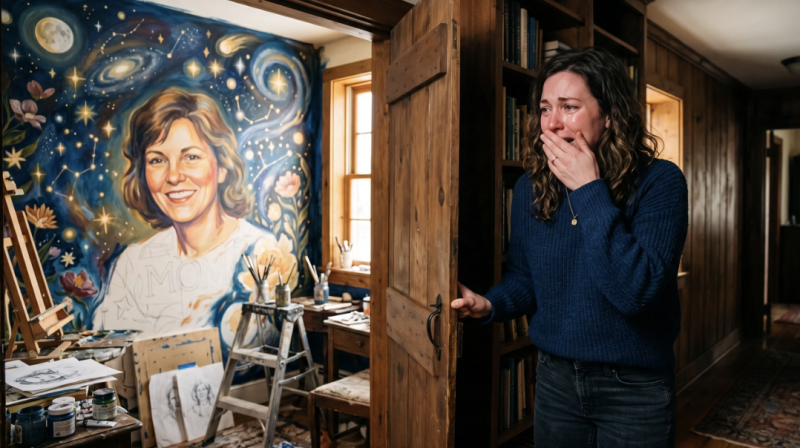
My mother was looking at me from the wall, with the exact eyes I remembered from the kitchen window, and above her was a ceiling full of silver stars that were still unfinished.
I sat on the floor and cried the way I hadn’t allowed myself to cry for three months.
Mark knelt beside me.
“I didn’t know how to reach you,” he said. “You became so distant.”
“I know,” I whispered. “I became distant even from myself.”
Leo climbed onto the bed and dipped the brush into the small jar of silver paint.
“Mommy,” he said. “Come finish the last one with me.”