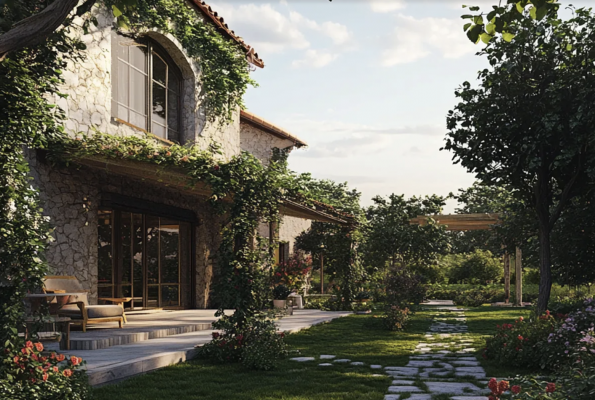
My grandmother left me her old farmhouse — But the true legacy was hidden behind the mirror
During the reading of the will, my sister received five hundred thousand dollars in cash.
I inherited our grandmother’s old, crumbling country house — “with all its belongings and responsibilities.”
Only when I opened the closet and found the mirror with a hidden handle did I begin to understand what she had really left me.
The room smelled of coffee, leather, and dust — that specific scent you only find in old law offices and even older secrets.
I sat stiffly in a high-backed chair, hands folded in my lap, knees together.
Claire sat beside me, dabbing at imaginary tears with a silk handkerchief, as if we were on a film set instead of in the middle of our grandmother’s will reading. Of course she was crying.
Claire always knew how to cry in a way that made people want to comfort her. It was her special gift.
The lawyer, an older man with tired eyes and a voice that crackled like dry paper, cleared his throat.
“To Claire, my younger granddaughter, I leave five hundred thousand dollars in cash.”
Claire gave a soft, delicate sigh. She placed a hand on her chest like she’d just been crowned queen. I didn’t look at her.
Instead, I stared at the books behind the lawyer, clenching my jaw so hard it ached.
Then came my turn.
“To Abigail — my eldest granddaughter — I leave the country house in Maple Ridge, with all its belongings and responsibilities.”
No sigh. No trembling. I didn’t move. I didn’t even blink. Just felt the weight of those words settle onto my shoulders like wet snow.
Responsibilities.
A rotting roof. Rusted pipes. Moldy corners and endless to-do lists.
Claire leaned toward me and whispered:
“You always liked that place, right?”
I didn’t answer. What was there to say? That while she escaped to weekends at spas, I was the one who stayed behind?

Who wiped Grandma’s forehead during fevers? Who argued with the pharmacy to get her medications?
Claire got the money.
I got the mess.
Later, I drove to the country house alone.
The gravel crunched under the tires just like always, but the house felt smaller now. Tired. Waiting.
I stepped inside. The air was heavy with the smell of old curtains and forgotten dreams. Dust floated in the light like tiny ghosts.
I dropped my bag by the door and looked around. Peeling wallpaper. Floorboards that moaned under my feet.
“She’s mine now,” I whispered to no one. “For better or worse.”
And something in the silence seemed to agree.
The sun was already setting when I returned for the third time.
The house still smelled of damp and old memories, but that didn’t stop me.
I had a long list: clean the attic, fix the front door hinge, check the wiring.
I was exhausted, sore, soaked in sweat — but I wasn’t giving up.
I had just dumped a pile of moldy old boxes in the trash when I came back in and hung my jacket in the upstairs closet.
That’s when I noticed it — something I hadn’t seen before.
A tall mirror at the back of the closet, half-hidden in shadows. Its surface was fogged with age, the frame chipped and dusty.
I reached out to wipe it clean and noticed a small hidden handle on the side.
Curious, I pulled it.
The mirror creaked open like a secret sigh, revealing a narrow hidden space behind the wall. Not very deep — just enough to conceal one thing.
A letter.
Yellowed, brittle, stuck to the back panel. My name — Abby — written in Grandma’s careful handwriting.
I peeled it off and opened it right there, one hand still holding the damp cleaning rag.
“Abby,
There are things more valuable than money. I knew one day you’d understand.
This house needs someone who will care for it.
That’s why I chose you.
With love,
Grandma.”
I stared at the words. My jaw clenched, a sharp breath escaped from my chest.
“You’ve got to be kidding me,” I whispered into the quiet room. “Is this some kind of joke?”
While Claire was likely sipping cocktails on a rooftop somewhere, I was here — sweating, scrubbing mold, dodging loose floorboards.

And this — this was my reward?
A note about values?
I shook my head. “Unbelievable.”
Still, I folded the letter carefully and tucked it into my back pocket.
Because this house — with all its cracks and creaks — was mine now.
Because Grandma asked me to take care of it.
And because, no matter how bitter the job, I always did what needed to be done.
The afternoon air was clear. The porch smelled of fresh paint and sunlight.
I held a paintbrush in one hand, a cup of coffee resting on the railing.
The rhythm of work was starting to feel natural: clean, scrub, fix, repeat. I was tired — but it was the good kind, the kind that lets you sleep easy.
Then I heard it — a low purr on the gravel driveway.
A black car. Sleek, shiny — the kind you see in magazines. It pulled up slowly and stopped near the mailbox.
A man stepped out. Tall. Older. Hair slicked back. Suit sharp as glass. Shoes spotless.
He walked up the steps like he belonged there.
“You must be Abigail,” he said with a warm smile and a slight nod. “I’m Henry. I was a friend of your grandmother’s.”
I wiped my hands on my jeans, suddenly very aware of my paint-stained shirt.
“She never mentioned you.”
“We had an agreement,” he said calmly. “About this property. If it ever ended up in your hands, I was to make you an offer. One million dollars. Cash.”
The brush nearly slipped from my hand.
A million?
He looked around — at the porch, the fields, the half-fixed fence.
“I see you’ve been working hard. She’d be proud. I didn’t know what I’d find when I came here.”
My heart pounded so hard I could hear it in my ears. I gripped the railing to steady myself.

“I need time to think,” I said, barely a whisper.
“Of course,” he replied, adjusting his cufflinks. “But don’t take too long.”
He left with a polite goodbye, his tires crunching over the gravel as he drove away.
That evening, Claire showed up on my porch, her face lit with excitement.
“You have to sell,” she said. “It’s crazy not to. We could split it. We’d both win.”
I looked past her, through the window. The barn was leaning but solid. The wind whispered through the fields.
And I remembered Grandma’s words:
There are things more valuable than money.
I stayed silent. Let the moment settle.
The morning air was crisp and quiet. I wrapped my sweater tighter around me and sat on the porch steps, watching the sun stretch over the fields.
The offer sat folded on the kitchen table — right where I’d left it two days ago.
Claire’s texts had gone from enthusiastic, to persistent, to silent. I didn’t reply. I needed quiet. I needed to think.
So I worked. I cleared out the attic. Swatted cobwebs. Found photo albums that smelled like time.
I replaced the front step — the one that always creaked under Grandma’s weight.
I let the decision spin inside me until it stopped being a question — and became an answer.
That afternoon, Henry’s car returned, right on time.
Just as polished as before. I opened the door before he could knock.
“Well?” he asked, calm as ever.
“I’m not selling,” I said, standing tall.
His eyebrows lifted slightly. “Are you sure?”
“I am. This isn’t just land. Or broken windows and dusty corners. This place mattered to her. She left it to me because she believed I’d understand. And now… I do.”
We stood in silence. The trees rustled in the wind. A bird sang near the fence.
Then, slowly, Henry smiled. A deep, genuine smile.
“Good,” he said. “That’s exactly what I hoped you’d say.”
I blinked. “What?”
He leaned on the porch post.
“Yes, I was her friend. But we also talked business. Often. She told me — if you chose the money, that was fine. But if you chose the land — if you truly chose it — then you were the one she believed in.”
My brows furrowed. “So all this was… a test?”
“In a way, yes,” he replied. “She wanted to know if her granddaughter had courage. Vision. Determination.”

“And now?”
“Now,” he said, “I’d like to offer you something better than a check.”
I didn’t say anything. I just waited.
“I want to talk about building something here. Together.”
Henry started visiting regularly — every two or three weeks, always with a notebook and a new idea.
Some days, we walked the land in silence, feeling the soil, listening to the wind in the corn.
Other days, we talked for hours about what this place could become.
He brought people.
A local architect who loved old wood and big windows. A farmer who knew how to revive tired soil.
And Linda — a woman who made goat cheese so creamy and delicious I nearly cried when I first tasted it.
“It’s all about care,” Linda said, handing me a cracker. “The goats need love. The milk too. And the land — even more.”
I nodded, understanding more than I could say.
Henry never pressured me. He simply offered support, connections, and a quiet faith that gave me room to dream.
We started slow: fixing the barn roof, cleaning out the old shed, planting vegetables in the garden.
Then we built a market. Set picnic tables under the big oak. Hung string lights on the porch.
Claire started showing up again — nervous smile, bottle of wine in hand. At first she just watched. Then she asked questions. Eventually, she picked up a paintbrush.
“I have no idea what I’m doing,” she said, painting a window frame.
“None of us do,” I replied. “We’re learning.”
And we did.
We never talked about money again.
We didn’t need to. Something better was growing here — deeper than cash, more valuable than any check.
The farmhouse came back to life. Families visited. Laughter echoed on the porch. The kitchen smelled like fresh bread again.
Sometimes, I’d open Grandma’s letter behind the mirror. I didn’t cry anymore. I’d read it, take a deep breath, and smile.
She was right.

There are things more valuable than money.
Like being trusted.
Like building something real with your own hands.
This farm wasn’t the end of anything.
It was the beginning of everything.