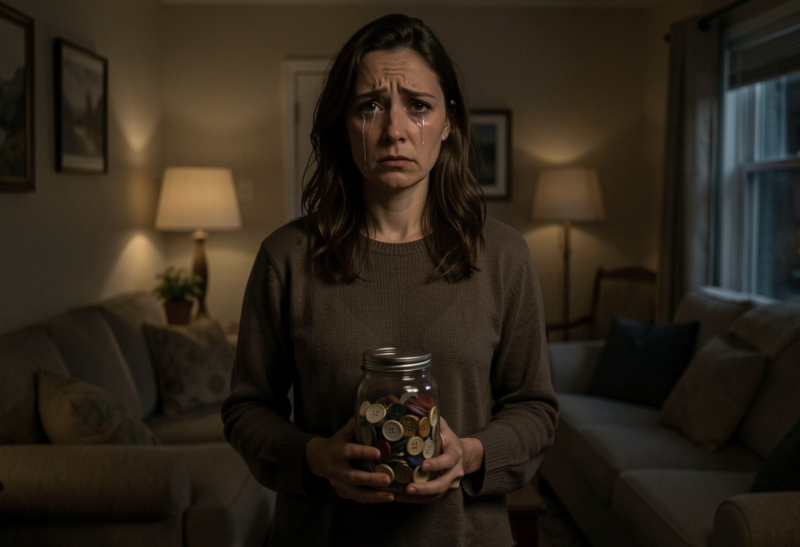
My mom gave the house to my brother, and I was left with an old jar of buttons — But when I accidentally dropped it and it broke, I was stunned to discover what was hidden inside.
I once thought losing my mother was the hardest thing I’d ever face—until I found out what she had left behind. What initially seemed like a thoughtless oversight became something I couldn’t ignore, and now, I’m glad I didn’t walk away.
At 29, when my mother passed away, it felt like my life no longer belonged to me.
For three years, everything in my life revolved around caring for her.
I scheduled appointments, battled with insurance companies, managed medications, and arranged for hospice when the time came. I became so attuned to her breathing that it was like reading a clock.
I slept on the couch because my room was too far from hers, and I needed to hear her at night. Every shallow breath would make my chest tighten. Every pause would have me sitting up, heart pounding.
Sometimes, she’d whisper in the dark, “Elena?”
“I’m here, Mom,” I’d reply, already up on my feet.
She hated how much I did for her—I could see it in her eyes.
“You shouldn’t be sleeping out here,” she once said. “You need rest.”
“I’m fine,” I’d always say.
Mom never argued—she just held my hand a little longer than usual.
My 32-year-old brother, Mark, lived 40 minutes away. He’d say he couldn’t take time off work, that things were too busy.
Over the course of three years, he came to visit twice.
The first time, he stood in the doorway, frowning. “She looks worse than I thought.”
The second time, he glanced at his watch and sighed. “I can’t stay long.”
He stayed for barely 20 minutes. I’m not exaggerating.
Mom watched him leave without a word.
After that, she stopped asking when he’d come next.
When she passed, I thought the hardest part would be the silence.
I was wrong.
Two days after the funeral, Mark and I went to the lawyer’s office for the reading of her will. It was a small office with a faint smell of stale coffee.
Mark sat across from me, relaxed, bouncing his leg like this was a hassle rather than a follow-up to a funeral.
Thomas, the lawyer, adjusted his glasses and opened the folder in front of him. When he read the will, I wasn’t thinking about money. I just wanted proof that Mom saw me.
Clearing his throat, Thomas read: "To my son, Mark, I leave the family home, including the land and all buildings on it."
Mark let out a long breath and leaned back, grinning. “Finally. That place is a goldmine!”
I stared at my hands.
“If I can rezone it, I could double the value,” Mark added, looking at me.
Thomas didn’t even glance at Mark. He just continued: “And to my daughter, Elena, who has been my hands and my heart...”
My chest tightened, and I straightened in my chair.
“I leave my vintage sewing kit, including the sewing machine and the glass jar of buttons on the mantle, along with its contents.”
Mark laughed. “You’re kidding, right?”
Thomas shook his head.
That was it.
Mark got a house worth over $600,000, and I got a sewing machine and a dusty jar of buttons.

"Wow," Mark said, shaking his head. "I guess you’ve always liked crafts."
I didn’t respond.
Outside, Mark jingled his keys. "I’ll list the house on Monday. Need help loading your stuff into your car?"
"My stuff?"
"Yeah, your craft stuff."
I was too drained to argue with him.
I grabbed the sewing machine, the kit, and the jar of buttons and drove home alone.
That night, I sat on the floor of my apartment, holding the jar in my lap.
"I don’t understand," I whispered. "I was there."
I was overwhelmed by the realization that I’d been taken advantage of by the one person I loved most.
I was crying so hard that my hands trembled. When I stood up quickly to grab some tissues and placed the jar on a shelf, it slipped from my hands.
The jar shattered.
Buttons rolled across the floor, scattering under the couch and along the baseboards.
I let out a shaky laugh. "Perfect. Exactly what I needed right now."
As I gathered the buttons, I noticed something odd.
One button was heavier than the others. It wasn’t plastic.
It was wrapped in Scotch tape.
My heart began to race as I carefully peeled back the tape.
Inside, there was a tiny folded note. The first line made my heart stop.
"My dearest Elena, I know this looks like betrayal, but please listen to me."
My knees buckled, and I sank to the floor.
"I didn’t leave the house to Mark because I trusted him," the letter continued. "I did it because he forced me to sign papers while I was medicated. It happened during his first visit when he lied and told you I was craving seafood, and you went out to buy it."
I pressed the paper to my chest.
I remembered finding it strange that Mom hadn’t mentioned the craving until Mark arrived. But I hadn’t thought much of it at the time because I always assumed Mark was Mom’s favorite—at least that’s what I thought.
That day, Mom didn’t even eat the seafood, but Mark did. I had brushed off the whole thing until this moment.
The letter continued, "He told me it was nothing important. I was too sick to argue. I also feared that if I refused, he would make things even harder for me."
Tears blurred the ink.
"The jar isn’t an inheritance," she wrote. "The note inside is the proof. Proof I hid where he’d never look."
I whispered, "You knew."
"I knew you’d find it," the letter said. "You always were clumsy when you were emotional. We were the same that way. So, I figured after the will reading, you’d be upset, and the jar would break."
My heart was pounding. I realized I needed to act fast if I wanted to stop Mark from selling the house.
I hardly slept that night, trying to figure out what to do.
The next morning, I called the lawyer.
"There might have been coercion involved," I said.
"That’s a serious accusation."
"I know."
"Well, in that case, I’ll need you and your brother to come back today. Please bring any evidence you have to support your claim," Thomas instructed.
I agreed, but little did I know that the second meeting would nearly break me.
Hours later, Mark showed up. To my surprise, Aunt Linda, my late father’s sister, came with him. Cousin Pete was also there. Thomas folded his hands and began.
"As I mentioned in our call, Elena believes the will was signed under duress."
Mark scoffed. "She’s just grieving."
"Your mother was as sharp as ever," Aunt Linda said. "She even joked with me the day she signed the will."
I swallowed hard. "She was on morphine."
Mark leaned forward. "You’re embarrassing yourself, little sis."
The room seemed to close in on me. I almost gave up, but I wasn’t going to leave until the lawyer had read Mom’s note. When I handed it to him, Thomas read it quietly, sighed, and then passed it to Mark.

My brother laughed after reading the note.
"Unfortunately, this note isn’t signed or dated, and it really doesn’t prove anything. There's no guarantee your late mother wrote it. It also just makes it seem like you’re bitter and can’t accept your mom’s decision," Thomas explained.
I wanted the ground to open up and swallow me right then and there.
The smug expressions on Mark, Aunt Linda, and Cousin Pete’s faces made me want to throw up.
There was nothing more I could do. The truth wasn’t enough.
Outside Thomas's office, Mark turned to me and said, "Tick-tock. Hope you’ve cleared out your stuff. Monday’s coming."
Linda and Pete laughed. It was obvious they were going to benefit from Mark’s scheme.
That night, I began packing the buttons into a new jar, one by one, honoring my mom’s quiet defiance. I didn’t know exactly what to do with them, but I knew I needed to keep them as a reminder of what I had lost.
That’s when I found another button wrapped in Scotch tape!
The note on it said, "Remember the sewing machine."
I rushed to grab the sewing machine!
Hope swelled in my chest.
When I lifted the machine, something rattled inside.
"Mom," I whispered. "What else did you hide?"
I made a silent prayer, hoping Mom had left something else—something that would change everything.
I managed to open a compartment I’d never noticed before.
Inside was a folded document.
It was the original will!
I quickly saw it was dated weeks earlier and signed differently.
I wanted to scream in joy, but I hesitated, not wanting to get my hopes up only to be let down. So, I decided to take a cautious approach.
The next morning, I went straight to Thomas’s office with the will in hand.
I didn’t want to give Mark another chance to show up and humiliate me. I needed answers while I still had the courage to ask. Thomas stared at the new will in silence.
"This predates the final will," he said slowly. "This changes everything."
"Do I have a case?" I asked, holding my breath.
"Yes, yes, you do, Elena. I need to call your brother in, and he’ll need to bring his witnesses."
After seeing the new will, Mark stood up, looking furious.
"This is ridiculous!"
"It’s not," Thomas replied.
The lawyer folded his hands and looked at Aunt Linda. "You said you were present when Margaret signed the will."
"Yes," Aunt Linda said quickly. "I was right there." She hesitated. "Well, not the whole time. I stepped out to take a call."
"How long were you gone?" Thomas asked.
"I don’t know. A few minutes."
Mark crossed his arms. "This doesn’t matter."
"It does," Thomas said calmly. "Linda, you testified earlier that Margaret was alert and conversational when you returned."
"She was," Aunt Linda insisted.
I swallowed and said, "You never came to visit my mom."
Aunt Linda’s eyes flicked toward Mark. "I did, you were out."
"I’d never leave Mom alone without a nurse, and how would you have gotten in? Neither you nor Mark had a key."
"Margaret was on morphine at that point," Thomas added. "She was on a dosage that medical records show causes confusion. But the will Elena brought was signed well before Margaret was placed on morphine."
"I’m not a doctor," Aunt Linda snapped.
"No," Thomas agreed. "But these things matter. You said she signed at 11 a.m."
"Yes."
Thomas flipped a page. "The nurse's log shows medication was administered at 9:45."
Aunt Linda's mouth opened and closed. "Well, I might be mistaken about the time."
Mark leaned forward. "This is nitpicking."
Thomas ignored him and turned to Cousin Pete. "You said you spoke with Margaret that afternoon."
Pete nodded. "She sounded fine."
"On the phone?"
"Yes."
"What time?"
"Uh, around 2:00 p.m."
Thomas glanced at me.
I said softly, "She was unconscious from 1:30 p.m. until nearly 5 p.m. That’s how long she usually napped."
Pete frowned. "That’s not what I remember."
"So your entire account is based on a phone call that can’t be verified," Thomas said, "and one you can’t even place accurately in time."
Pete shifted uncomfortably.
Mark’s voice rose. "You’re twisting this!"
Then Thomas slid the original will—the one I brought—across the table.
Aunt Linda stared at it. "I’ve never seen this before."
"Exactly," Thomas said. "Because it was hidden."
Pete cleared his throat. "Maybe I mixed up the days."
Aunt Linda slumped. "It was a stressful time."
Thomas met Mark’s eyes. "I’m obligated to follow the evidence."
Mark looked at me, his face tight. "You planned this."
I didn’t answer. His confidence evaporated.
Eventually, the ruling came down. The house was mine.
Weeks later, I stood alone in the living room where my mom had taken her last breath, the jar of buttons heavy in my hands.
"Thank you," I whispered.
I realized that if I had done nothing, Mark’s version of events would have won.
But because I persisted, his timeline collapsed, and I finally got what I deserved: to be seen by our mom.