My parents left me for their new families and handed me over to my aunt – years later, they showed up at my doorstep.
Ivy's artistic career suddenly took off, and her parents, who had abandoned her, reappeared with smiles and hidden motives. However, Ivy had her own plans. In a story about betrayal, possessiveness, and the family we choose, a woman finally finds her voice to rewrite an ending no one ever expected.
My parents didn’t die. They just left.
Not all at once; not with used luggage and slammed doors like in the movies. No, Tanya and Charlie disappeared slowly, in arguments about who was supposed to take care of me that week, as if I were an abandoned child someone forgot to pick up.
I was 10 when I realized they didn’t want anything to do with me anymore. Not because I had done something wrong, nor because they were going through hardships, but because they had moved on with their lives.
My father, Charlie, married Kristen, an "old friend" who always wore a strong perfume and smiled as if she had a secret she shouldn't reveal. She had a son named Travis, a year younger than me, and shortly after their wedding, she had a daughter with curly, golden hair.
“We're perfect, our little sunshine.”
They became my father’s family, his true family. The family he showed off at barbecues and posted in Christmas cards.
And me? Oh. I was the leftover daughter.
My mother, Tanya, married Donnie. He had muscular arms and a voice that was never louder than a murmur, but somehow, he scared me more than the yelling. He didn’t like distractions, especially the kind that cries while watching movies or needs help with math.
When my half-sister, Rosie, was born, my mother’s world became all about feeding schedules and sleep-training apps.
Her hugs became light taps with one hand, and her conversations grew shorter and thinner.
“Ivy, you need to be quiet. Donnie just got back from his extra shift,” she once said when I tried to show her a drawing I made of our backyard.
I remember the night they stopped pretending. I heard them arguing behind the closed bedroom door.
“She’s not my daughter, Tanya. Seriously. I don’t want kids. She’s different from Rosie because Rosie is my blood,” Donnie murmured.
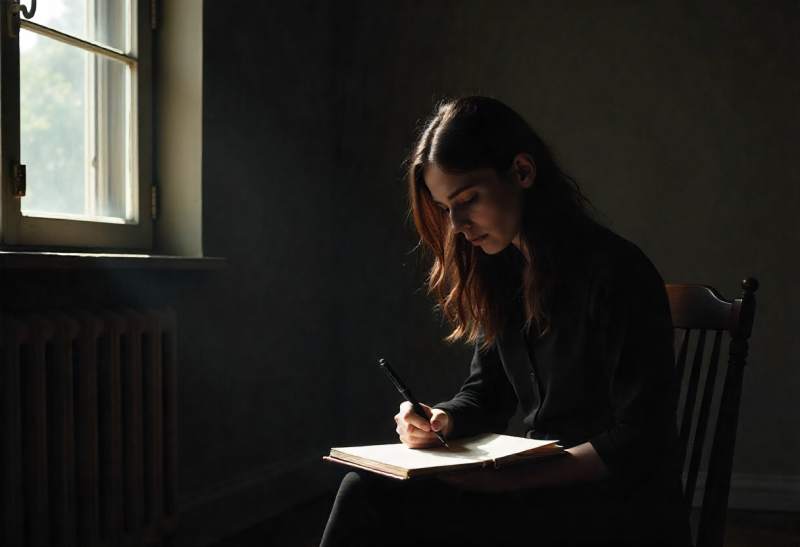
“Yes, but she’s not his daughter either, Don,” my mother whispered.
“What do you want me to do?”
Then, no more than five minutes later, I heard my father's voice on the phone, static.
“We already have our own routine now, Tanya,” he said. “I mean, it's not easy with two small kids. Kristen doesn’t feel comfortable having another one. Ivy doesn’t fit in here.”
That night, my mother sat at the kitchen table, holding a cup of already cold tea.
“Sweetheart… maybe it’s better if you stay with Aunt Carol for now. Until we… figure things out,” she said.
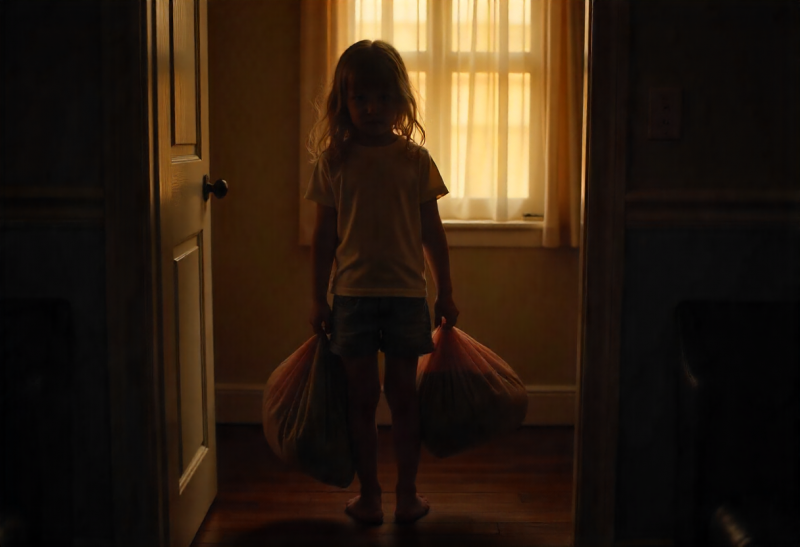
The next morning, my father showed up, and they packed up my life in three garbage bags.
They didn’t even bother with suitcases or cardboard boxes; the trash bags were enough.
When we arrived at Aunt Carol's house, small and yellow, she opened the door, still drying her hands with a dish towel. Her eyebrows furrowed when she saw me standing between my parents, a couple who preferred not to be seen together.
“Hi, Ivy, dear,” she said, smiling at me.
Then she saw the bags.
“Why is she bringing... luggage?” she asked, looking from me to my mother.
Tanya laughed a bit too loudly and adjusted her blouse, as if we were just there for tea.
“You two will get along so well!” she said. “We’ll pick her up later, Carol! Thanks!”
Aunt Carol’s face changed. She wasn’t angry or upset, just surprised. And I saw her realize they weren’t coming back.
But she didn’t ask any more questions. She just bent slightly and opened her arms for me.
“Come in, dear,” she said. “We’ll get the guest room ready for you.”
My parents had already left before I could look back.
Aunt Carol didn’t ask questions that night. She didn’t ask what I feared, at least. She hugged me like someone who truly cared, made me a grilled cheese sandwich with too much butter, and put me to sleep in the guest room with a blanket that smelled like fabric softener and old books.
It had been so long since I had been cared for like that... I remember wanting to cry as I fell asleep.
But just before I could, Aunt Carol sat on the edge of the bed, gently brushing my hair away from my face.
“You’re not a burden, Ivy,” she whispered. “You’re a blessing. And I really mean that, sweetheart.”
Something broke in my chest, not from pain, but from relief.
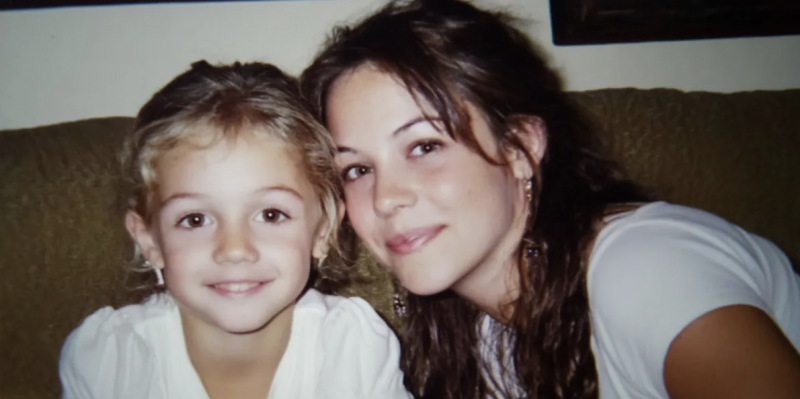
In the following weeks, she gave me the house keys so I could come in after school, and let me paint the walls of my room sky blue.
When I changed my mind, she brought another roll of new paint and white paint.
“Let’s start over, Miss Van Gogh,” she said, smiling. “Even the most beautiful flowers need to be transplanted sometimes.”
She never called me stubborn, emotional, or messy. She always said I was growing.
“Blooming takes a little effort, Ivy,” she would say. “And I’ll be here, whenever you need me.”
Aunt Carol worked long hours at the pharmacy, but always came home just in time to help me with science projects or rewrite essays when I doubted every word.
Once, she took me from one end of the city to the other to find a special green paint for a school project, even though we had an envelope with money set aside for “shopping” and “emergencies.”
She never made me feel guilty for it. She just smiled and kissed the tip of my nose.
“Art is sometimes an emergency, Ivy,” she said.
She framed or carefully saved every sketch I made, even the ones I hid in the trash.
“Don’t throw this away,” Aunt Carol would say, pulling a crumpled sheet of paper from the trash. “You’ll want to remember how far you’ve come.”
At 14, my art corner expanded into the hallway. By 16, I won the local art contest. And by 20, I took a bus to an exhibition in another state, carrying a crumpled portfolio and a term of iced tea made by Aunt Carol, with freshly baked lemon bars.
And what about Tanya and Charlie? They became shadows.
They didn’t come to my birthday or school performances; they didn’t even send a message after graduation.
But sometimes, over the years, a card would arrive with my name misspelled, “Ivi,” and only a rushed signature from my mother.
When I was 22, I entered an international art competition. My piece, Heritage, was raw and personal. It was the image of a girl building a ladder with scraps, with two faceless figures watching from a distance.

The piece went viral overnight.
And I won, of course. The prize?
$250,000 and an exhibition right.
The local media called me the “artist who bloomed through neglect,” thanks to an interview where I decided to be honest about what I went through.
Three days later, my parents showed up.
I was cleaning a table at the café when Erin, my coworker, called me.
“Ivy,” she said. “There’s a couple waiting for you outside. They want to talk to you. And just to warn you, they look emotional.”
I went outside and stopped.
There they were, the people who had left me years ago, as if I were just a pet bothering them, and they needed to find a new home.
My mother’s mask was smeared, and Charlie was holding a bouquet of wilted flowers, almost dead, from a gas station.
“Sweetheart! Ivy, my sweet! Look how you’ve grown. You’re beautiful,” Tanya exclaimed, moving to hug me.
“My wonderful daughter,” Charlie smiled. “I always knew you had potential.”
I just stared at them. I wasn’t angry, not exactly. I was just waiting for something to happen.
They insisted on taking me to dinner.
“As a family,” my mother said.
I agreed, not because I expected to reconnect with them, but because I wanted to see what story they had rehearsed for this visit.
If there’s one thing I could count on with my parents, it was that there was always a script in their hands.
They chose a local restaurant from my childhood. Of all places, they chose this one. The diner was smaller than I remembered, and the menu hadn’t changed much.
It was like stepping into a time capsule I never asked to be reopened.
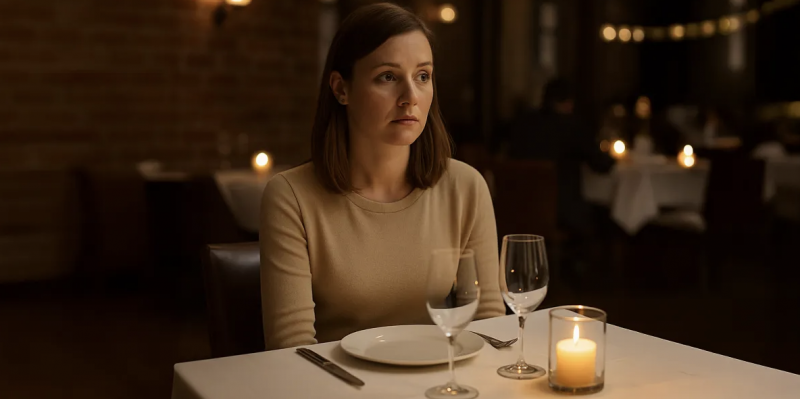
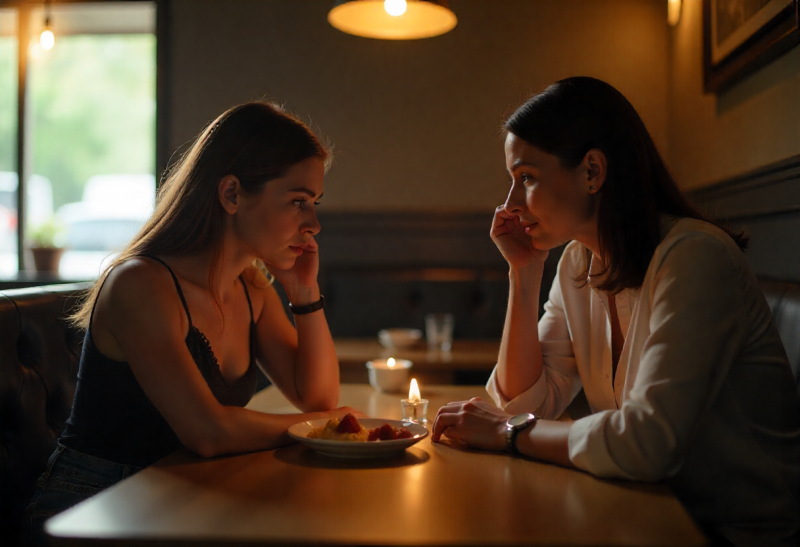
Tanya ordered a salad she didn’t eat. Charlie ordered a hamburger with fries and barely touched his plate. And I ordered fries drenched in vinegar, with the strong smell I loved instead of the regular fries.
On the other side of the table, my mother folded the napkin precisely.
“I prayed for this moment,” she said, squinting more than she should. “I want us to be a family again. I know things aren’t perfect, but what is perfect? And I think we can... heal together.”
I almost choked on my own laughter.
“Rebuilding the relationship is important, Ivy,” my father said, nodding his head as if giving an official statement. “Especially now.”
And then their masks began to fall.
“Carol has good intentions,” my mother said, leaning forward slightly. “But she twisted everything. She filled your head with poison. She always wanted a daughter, and then she saw an opportunity with you... our daughter.”
“She used you, dear. She didn’t give us a chance to come back,” Charlie added.
I said nothing. My silence was stronger than anything I could have said.
Then came the offer.
“My car is broken,” Tanya said. “It’s really dangerous. I’m scared every time I drive.”
“We were planning on moving, actually, Ivy,” Charlie said. “Your little sister is growing! We just need a little help.”
And there was the truth:
They didn’t come for me. Of course not. They came for money.
“Fine,” I said calmly. “I’ll help you. But with one condition.”
“Of course!” my mother exclaimed. “Anything, Ivy. Anything,” Charlie said, finally taking a bite of the hamburger.
“There’s an event on Saturday,” I said, folding my napkin. “In the community, it starts at 7 p.m. I want both of you to be there.”
“Of course, dear,” my mother said. “Is it some kind of gala? What should I wear?”
“I’ll let you decide that,” I said.
I knew they were already planning their outfits when we arrived at the parking lot.
Saturday arrived.
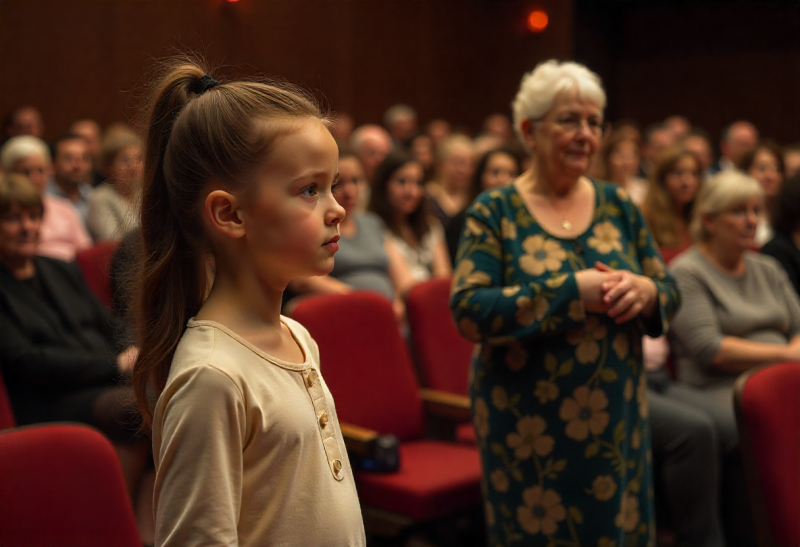
The community center was filled with people: other artists, journalists, teachers, classmates, family members, and strangers who had followed my work online. Many of Aunt Carol’s neighbors were also there.
The walls of the community center were covered with prints of my first collection, and a banner hung on the stage:
“Presenting the Woman Who Shaped an Artist.”
Tanya and Charlie arrived 10 minutes early. My mother wore pearls and a pale pink blouse I vaguely recognized from old Instagram posts. Charlie looked stiff in a suit that was too big.
They smiled as I guided them to the front row seats.
“It seems like it’s a big night, Ivy,” Charlie whispered. “The crowd is huge.”
“It’s a big night,” I replied. “I’ve worked hard to get here. Enjoy the show.”
Just before the lights dimmed, the side door creaked open.
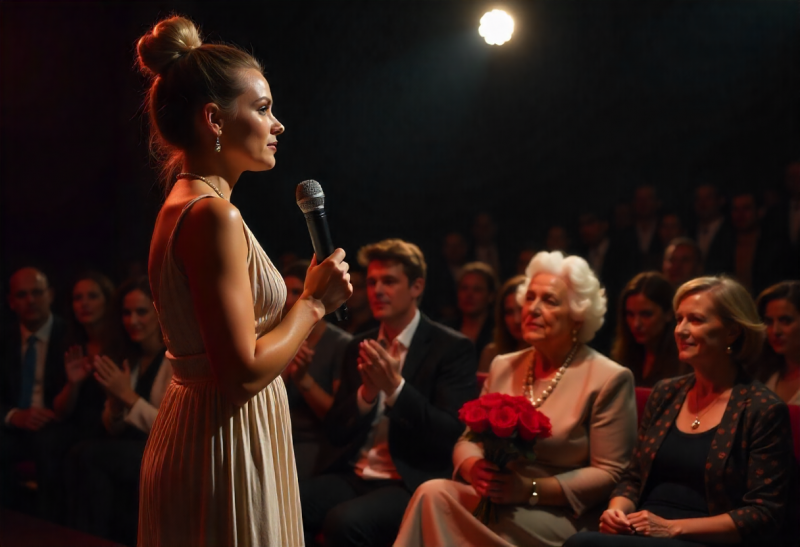
Aunt Carol entered quietly, holding a bouquet of red and white roses in both hands. Her eyes scanned the crowd until they finally found me, and then looked at them.
Her face froze for a moment, her expression caught between confusion and disbelief.
I saw the question forming on her lips: “What are they doing here?”
I said nothing. It wasn’t necessary.
I extended my hand and gently took hers, calming her in that instant. My fingers intertwined with hers, a silent promise and an answer that came with her. Her eyes softened.
She gave a slight nod and sat down next to me, the bouquet of roses resting in her lap.
Then the lights went out.
The slideshow appeared on the projector; one photo after another lighting up the screen.
Aunt Carol at my sixth-grade art exhibition, leaning next to me, holding my sketchbook.
Aunt Carol in the kitchen, wiping paint off my nose — the neighbor Elena took that photo.
Aunt Carol signing the custody papers when I was 14.
Carol, with swollen eyes but proud, hugging me after the announcement of the contest win.
The audience started whispering. My mother clenched her purse. Charlie lowered his head to look at his shoes.
When it was my turn to speak, I went up to the stage and grabbed the microphone.
“This night is for the only family I ever really had,” I said.
I saw my mother lift her head.
“For the woman who didn’t leave when things got tough. For the woman who didn’t hand me over as too heavy a burden. And for the woman who never asked me to shrink or disappear...”
I paused for a moment; the silence was thick.
“For Aunt Carol, the reason I’m here, and the reason I’m still whole.”
The applause began to erupt.
“You said you needed to fix your car,” I said to my mother.
“Yes, well, I—” she started.
“And you wanted money for the condo?” I said to my father.
“We just thought—” he replied, clearing his throat.
“My condition was that you be present tonight,” I said. “To hear this.”
I leaned toward the microphone.
“You won’t get anything. Not a cent. You lost the right to ask for anything from me the day you packed up my life in garbage bags and left me on someone else’s doorstep.”
A murmur of shock spread through the crowd. Someone started clapping. And then the whole audience stood up.
“But you said—” Tanya’s voice cracked.
“No, I gave you a lesson,” I said calmly. “And now, you’ve learned.”
Then we turned our backs.
That night, we went home under the stars, with Aunt Carol’s bouquet of roses in my arms, and I never looked back.