On our 21st birthday, a box arrived, and we were shocked when we discovered what was inside.
There were three of us once.
Me, Leila, and Nora.
That’s how it starts in my head—not like something I’ve accepted, but like something I keep circling without ever fully being able to move past. I never made peace with what happened. I only learned how to talk around it without falling apart.
People started calling Leila and me twins after Nora died. It was simpler for them than saying “the two who remained,” simpler than watching our mother’s face break every time someone asked about the third daughter. But we never felt like twins. We felt like fragments of something that used to be whole.
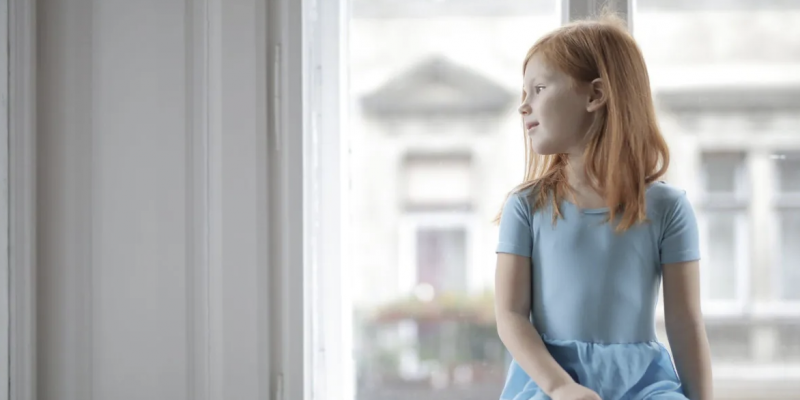
Nora was the oldest by seven minutes, and she acted like those minutes made her responsible for everything. She never let us forget it.
“I’m older,” she’d say proudly. “I decide.”
“Seven minutes doesn’t count,” Leila would argue.
“It does if you were late,” Nora would reply with a grin.
Most of our childhood sounded like that—laughter, teasing, footsteps running down hallways, our mother yelling about crayons on walls, and our father smiling quietly into his coffee before he was around less and less.
Nora always stepped between us when we fought. She’d hand over toys or clothes like she was negotiating peace treaties.
“Gia gets it today,” she’d say. “She can have it tomorrow.”
“You always take her side,” Leila would complain.
“I take the side of peace,” Nora would answer, making a ridiculous face until we both laughed.
She was warmth in human form. She tied our shoes, saved red sweets for Leila, and slept between us during storms because she said leaders protected both sides.
One night during a thunderstorm, Leila crawled into bed first, clutching her rabbit. Nora barely opened her eyes.
“Both of you are bad at being brave,” she muttered, letting us lie on either side of her.
“You’re scared too,” I whispered.
“No,” she said. “I’m responsible.”
Even then, she acted like love meant protecting others.
Then she got sick.
At first, adults tried to soften it with vague words, but Nora always knew when people were lying. She always had.
In the hospital, everything smelled like disinfectant and felt too bright. Leila couldn’t sit still. My mother kept calling her “sweetheart” while holding her hand too tightly.
“What’s wrong with Nora?” Leila asked.
“She’s just tired,” Mom said, looking away like truth might arrive on its own.
Nora, hooked to tubes, rolled her eyes.
“I’m not a baby,” she said, then smiled at us—smaller, but still hers.
“Stop looking like that,” she added. “You look weird when you worry.”
Leila immediately started crying.
I didn’t move. I just held the metal rail, as if holding tight could stop everything from changing.
She was only eleven, so small in that bed, and somehow she already understood leaving more than anyone should.
When she died, the house went quiet in a way that felt permanent.
Her slippers stayed in the hallway for weeks. Her toothbrush remained beside ours. Her bed stayed untouched, and Leila turned toward the wall at night while I stared at the emptiness.
There were still balloons and cake, but always one missing chair.
Every year after, Leila and I sat side by side pretending not to notice the empty place. We still made three wishes in our heads.
At 12, I wished she’d come back.
At 13, I wished my mother would stop crying alone.
At 14, I wished Leila would talk to me again like she used to.
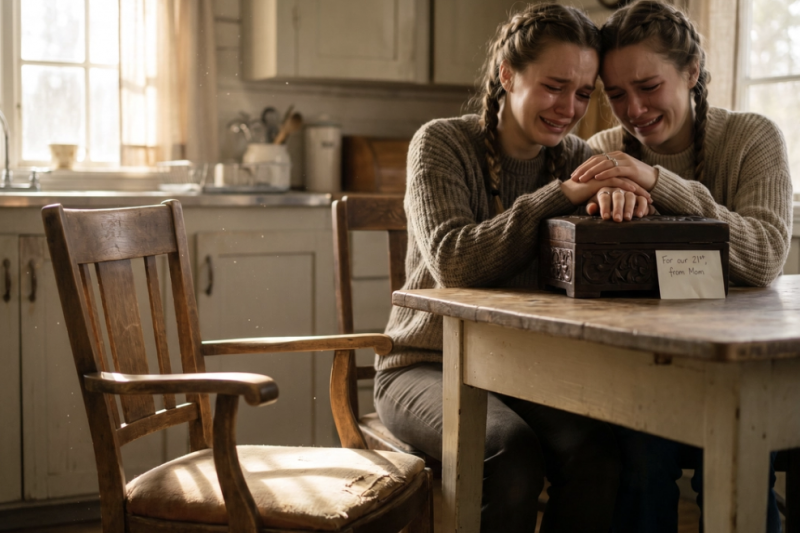
Nora’s absence didn’t pull us together the way people expected. It pushed us apart.
Leila became sharp, fast to speak, faster to leave. I became quiet.
At sixteen, our mother told us we needed each other.
Neither of us answered.
Because needing each other hurt. Every time I looked at Leila, I saw what was missing. I think she saw the same thing in me.
By the time we turned 21, I thought I had learned how to live with it. I was wrong.
That morning, I woke early in my small apartment, listening to the city outside.
Turning 21 felt like entering a dark room and hoping your eyes would adjust.
Mom asked us to come for breakfast before plans with friends. Leila arrived shortly after me, careful and guarded as always.
“Happy birthday,” I said.
“You too,” she replied.
We hugged briefly, like neither of us trusted closeness.
The dining room was decorated anyway—balloons, cake, and three plates out of habit more than hope.
No one mentioned the missing place.
Halfway through breakfast, Mom walked in holding a small wooden box.
She looked exhausted in a way I didn’t understand at first.
Leila frowned. “What is that?”
Mom didn’t answer. She placed it between us.
The box was old, dark, worn at the edges, like it had been kept hidden for years.
On top was an envelope with Nora’s handwriting.
My stomach dropped.
Leila whispered, “No.”
Mom said, trembling, that Nora had made it before she died. She had asked for a box, saying she wanted something ready for when we turned 21. Mom had never opened it.
Leila reached for my hand under the table. I held on tightly, like we were children again.
Then I opened the box and GASped.
Inside were three small bundles tied with faded purple ribbons.
Nora’s crooked bows. Always imperfect. Always hers.
One had Leila’s name, one had mine, and one had both.
Leila leaned closer.
“She really made these?” she whispered.
Mom nodded through tears. “She worked on them for weeks, even when she was too weak.”
I opened my bundle first.
Inside was a letter, a bracelet, and a photo of us at the beach—Nora in the middle, arms around us, smiling like nothing in the world could ever end.
“Dear Gia,” the letter began, “you are 21 now. That is very old, but Mom says it is still young, so don’t act like you know everything.”
A small laugh escaped me.
Leila wiped her face.
Nora wrote about how I still drew flowers, how I used to sing when I thought no one could hear, and how I should never have stopped.
I realized I had stopped singing after she died without noticing when it happened.
She wrote that I felt deeply, even if I pretended not to, and that hiding pain didn’t make me easier to love.
I pressed the letter to my chest.
“She knew me,” I whispered.
Mom cried harder. “She loved you so much.”
Then Leila opened hers.
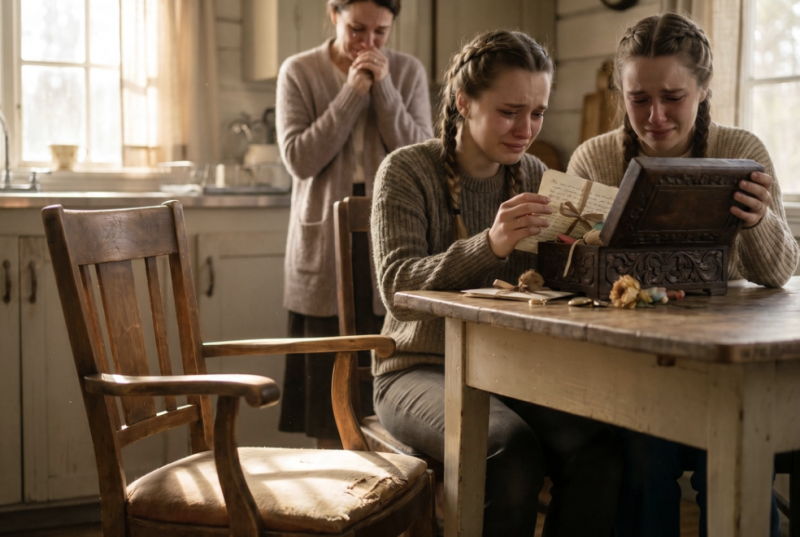
Her hands shook as she read.
“Dear Leila…”
She made a broken sound.
“What is it?” I asked.
“She knew everything,” Leila said.
The letter called her out for pretending anger instead of sadness, for rolling her eyes when she was hurting, for acting strong when she felt anything but.
Leila covered her face.
Mom sank into a chair.
Leila kept reading through tears. Nora told her she wasn’t cruel—she was scared. That her anger was just another form of pain.
I had spent years thinking Leila resented me. But watching her now, I realized she had been hurting just as much.
She finally looked at me.
“I missed her,” she said.
“I know.”
“No… I missed you too.”
That broke something open.
I moved to her side and hugged her. She froze, then held on like she was afraid of losing me too.
Mom cried openly now.
When we pulled apart, the last bundle remained.
“Together?” Leila asked.
“Together.”
We opened it.
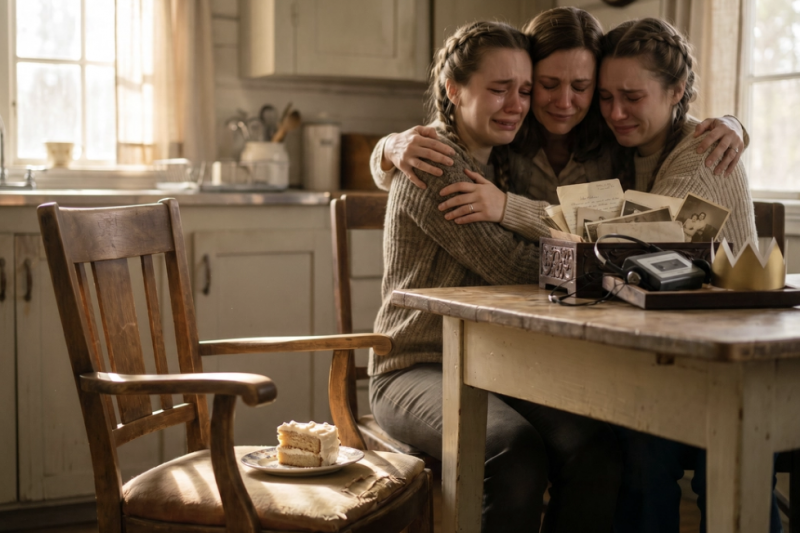
Inside were photos, a paper crown, and an envelope that said:
“READ THIS OUT LOUD. NO CHEATING.”
Leila laughed through tears. “Still bossy.”
“Seven minutes older,” I said.
“For seven minutes,” she replied.
The letter began with Nora imagining us grown up—maybe dressed up, maybe arguing, maybe living lives she would never see but still wanted for us.
Then she made a request.
Don’t let her absence become the space between us.
We were not “the ones who stayed.” We were Gia and Leila.
She said birthdays would be hard, that the empty chair would always exist, but she wanted us to live anyway.
She asked us to save her a slice of cake every year and tell each other one good thing from the year. Only good things. So she could know we kept living.
At the end, she wrote:
“Look under the paper crown.”
Beneath it was a cassette tape.
Mom suddenly remembered an old recorder.
We took it to the den and played it.
Static filled the room, then Nora’s voice.
Small. Real.
“Hi Gia. Hi Leila. Hi Mom. If this works, I’m basically a genius.”
Leila grabbed my hand.
Nora said she wasn’t angry about dying—just sad. That being our sister was the best thing she ever had.
Then she revealed she had heard us at night, crying, wishing we could take each other’s place.
She told us we were both wrong.
No one should replace anyone.
We had to stay—for life, for love, for her.
Her voice ended:
“Remember I loved you first. I loved you last. And I am still your sister.”
Silence followed.
Then Leila pulled me into a hug. Mom joined us.
We stayed like that for a long time.
Later, we cut three slices of cake.
One for Leila.
One for Nora.
And for the first time, the empty chair didn’t feel like loss alone.
It felt like love still being remembered.