The first photo ever taken
Long before photography became a daily part of life and billions of images flooded our screens, there was a single, groundbreaking moment that marked the beginning of capturing reality through a lens.
The very first photograph ever taken emerged in the early 19th century, thanks to the curiosity and experimentation of a French inventor named Joseph Nicéphore Niépce.

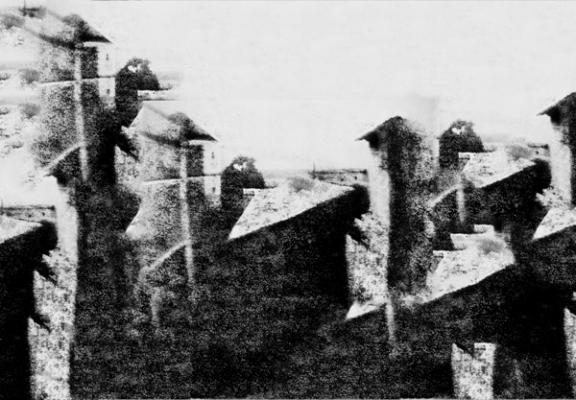
Around the year 1826, Niépce managed to create what is recognized today as the oldest surviving photograph. The image, titled "View from the Window at Le Gras," was produced through a process he invented called heliography.
Rather than using photographic film, Niépce coated a pewter plate with a light-sensitive material known as bitumen of Judea.
He then placed this plate inside a camera obscura and allowed it to be exposed to sunlight for approximately eight hours. Over the course of that long exposure, light gradually etched an image onto the surface.
At first glance, the resulting image might appear abstract or difficult to interpret. However, with careful observation, one can make out the rooftops and buildings outside Niépce’s window, bathed in sunlight that seems to shine from multiple directions. This unusual lighting effect came from the extended exposure, which captured the sun's movement across the sky.

Though the image is crude by today's standards, it marked an extraordinary achievement: the first time a scene from the real world had been successfully recorded in a permanent form using a camera.
Niépce’s photograph wasn’t widely recognized in his lifetime, and he passed away in 1833, only a few years before photography would gain momentum thanks to his partner Louis Daguerre and others who built upon his work.
Today, this historic photograph is preserved at the Harry Ransom Center in Texas, where it remains a symbol of the moment photography was born.
Despite its rough appearance, this image represents a revolutionary idea—the ability to hold on to a moment in time, to transform fleeting light into something lasting.
Every photograph taken since, from family portraits to viral snapshots, owes its origin to Niépce’s remarkable experiment and that quiet view from his window nearly two centuries ago.